Six Centuries of Type & Printing Now Available

A book over a year in the making, Six Centuries of Type & Printing, is now available for purchase. Starting a few years ago, I began to research printing history more intensively, and then stepped it up alongside my project the Tiny Type Museum & Time Capsule. In collecting type and printing artifacts for these museum collections, I also gained terrific hands-on insight into key aspects of the development of the mass production of metal and wood type and advances in printing technology. This included previous visits to museums of printing and a trip to M&H Type (part of the Grabhorn Institute) in San Francisco last June.
I spent months writing this 64-page book, which starts well before Johannes Gutenberg in examining previous inventions of movable type and mass production of book pages, before diving deeply into how this member of a Mainz, Germany patrician family seemingly invented and pulled together a host of different techniques to create a consistent, reproducible process that was quickly copied and spread.
The book covers just under six centuries as the production of type evolves and presses speed up, including innovations like type-casting machines for individual pieces of type, hot-metal composition for book and newspaper typesetting, paper molds (“flongs”) to create full-page printing plates (“stereotypes”), offset lithography, phototypesetting, and finally our modern digital era.
The book recapitulates history in its manufacture. Written in a word processor and roughed out into pages in Adobe InDesign, the text was transmitted to Nick Gill at Effra Press in North Yorkshire, England, who used a Mac-to-Monotype bridge called the CompCAT. It allows previewing of composition on a Mac and then transmission through pneumatic tubing to trigger hot-metal type composition.
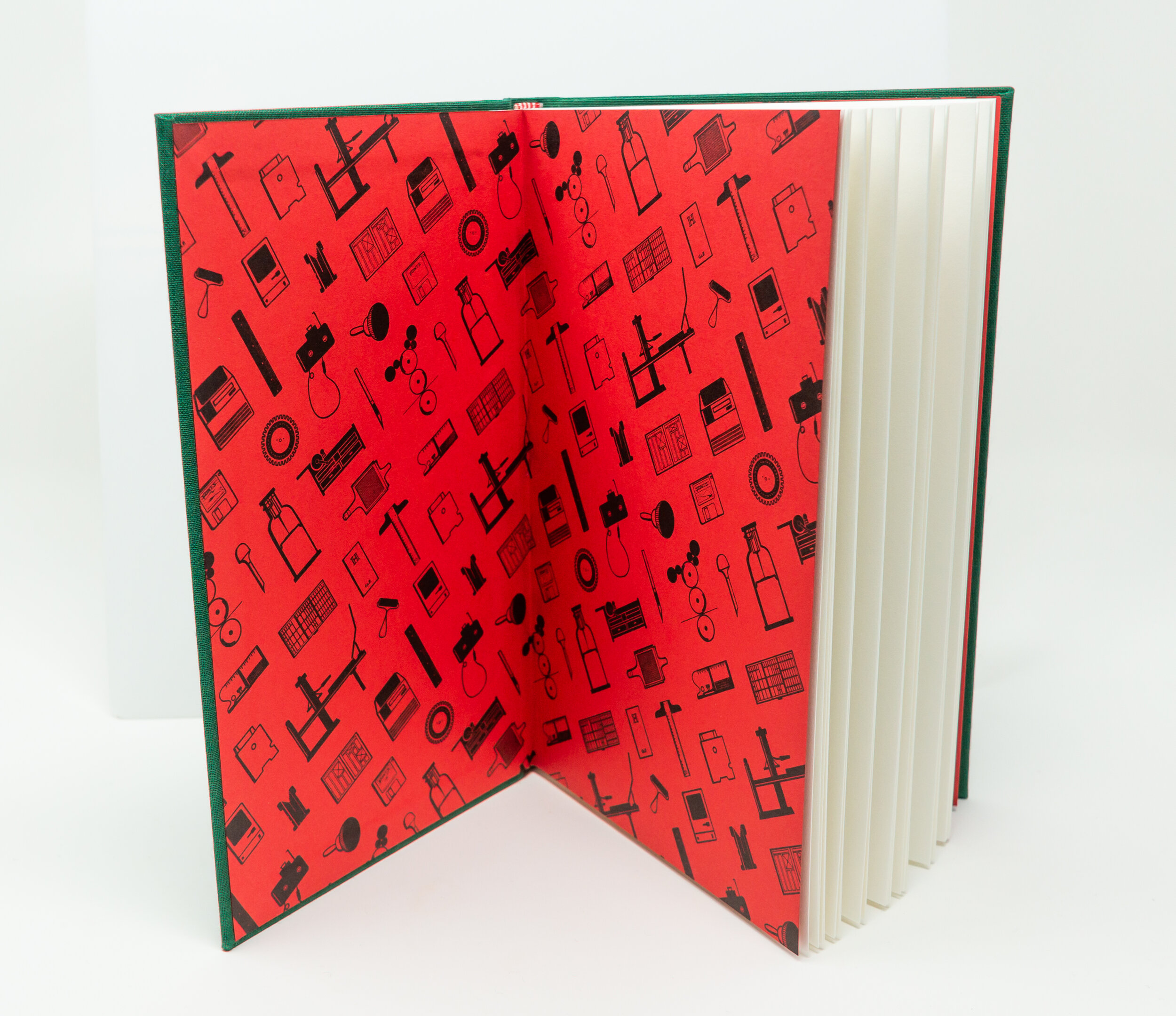
After traditional stages of galley proofs, the type made its way to London, where Phil Abel of Social Enterprise Printing paginated it and added zinc plates created from digital illustrations. More corrections followed, and then the book went on a high-speed Heidelberg letterpress. The endpapers were designed in Adobe Illustrator and produced as photopolymer plates printed by letterpress. From London, unbound pages went to Spinner Buchbinderei in Germany for hardcover binding, foil stamping, and slipcase creation.
The books recently arrived in Seattle, and copies ship immediately. We are taking all precautions in hand washing and handling in packing, and everyone in my household is well.
You can order the book in its letterpress edition, which includes the ebook version as well. You can also purchase the ebook separately.