2021: A Year of Change (As Always)


I wasn’t sure what to expect at the end of 2020 from 2021. Surely, it couldn’t be worse? It started badly, with an insurrection. Democracy asserted itself. Here we are: still fighting for the future. All of that seems very far away, as I spent the year toiling in my day-lit basement on projects aplenty.
To get announcements about my new projects, you can sign up for my legitimately low-volume mailing list—I sent out just six messages in 2021!
Books
2021 was the year of books for me. I’ve been writing titles in the Take Control Books series since its founding in 2003. I’ve usually had one to three currently updated books across topics like security and remote access. But because of changes in the freelance journalism market and my interest in stable, recurring income, I focused in 2020 and 2021 on filling niches in the Take Control line-up, working closely with publisher Joe Kissell on topics he wanted covered.
That has led to me having a whopping nine actively updated books as of December 2021, including four books freshly written in 2022! These books divide into two major areas and then miscellaneous topics.
Security and Privacy in the Apple Ecosystem
- Take Control of iOS & iPadOS Privacy and Security (revised in October 2021 for iOS 15/iPad OS 15) covers all networked and local aspects of iOS and iPadOS with a lens of keeping your private data private, protecting against tracking, and employing device and account security. Updates include Apple’s new and revised methods for securing your Apple ID account with devices, letting other people act as trusted recovery helpers for your iCloud data, and providing trusted legacy contacts who could have access to your iCloud data and Apple ID account when you pass away.
- Take Control of Securing Your Mac (new in 2021, and revised in November for macOS 12 Monterey) is a thorough look at all the information you need to ensure your Mac is protected against outside attacks and attempts to install or convince you to install malware, and hardened to block extraction of private information without your consent.
- Take Control of Find My and AirTags (new in 2021) covers Apple’s increasingly complicated and interlocking Find My People, Find My Devices, and Find My Items infrastructure for opt-in people locating and hardware finding, as well as its AirTags and third-party items that can use Apple’s crowdsourced network.
General Apple Stuff
- Take Control of Your Apple ID (revised in November 2021 for updates to operating systems and the Apple ID website) provides insight for how to use and maintain your Apple ID account, and extensive troubleshooting advice for when (unfortunately for many people, not if) something goes wrong.
- Take Control of Your M-Series Mac (new in 2021, and revised in October for macOS 12 Monterey) sweeps in a lot of different information across multiple topics useful for owners of Macs that use Apple’s M1, M1 Pro, and M1 Max chips. This includes creating an external bootable volume, working with system security, running iOS and iPadOS apps on your Mac, and understanding Rosetta emulation (Intel), native apps, and universal apps.
Miscellaneous Topics
- Take Control of Wi-Fi Networking and Security (updated in November 2021 for 6 GHz spectrum additions and the latest 802.11/Wi-Fi standards updates) is the latest update in a series of books dating back almost two decades. This book provides comprehensive advice on what you need to best cover your house or modest office with a high-speed wireless network, and how to troubleshoot, upgrade, or reconfigure an existing network.
- Take Control of Home Security Cameras (revision coming in early 2022) offers a framework for you to consider installing security cameras, including evaluating what you need, how many, and what kind, as well as dealing with privacy and security issues for yourself and neighbors.
- Take Control of Cryptocurrency (new in 2021 and updated in November 2021) isn’t my guide to investing, but my guide to untangling what cryptocurrency and how to understand its role in the current economy and its future potential. Consider this a book that informs you—it’s not a recommendation to buy in!
- Take Control of Zoom (updated August 2021; revision coming in early 2022) is in its second year of revisions, introducing early in 2021 after the pandemic started. It’s a thorough examination of Zoom from the standpoint of being an effective participant in meetings and hosting meetings. Zoom continues to roll out significant updates, and the next update (due in January 2022) will fold in everything that’s changed in the last six months.
If that’s not enough, I have one book cooking that has the working title of Take Control of Untangling Connections. I get so many queries about USB-C and USB cables, Thunderbolt ports and capabilities, connecting monitors to ports, and much more along those lines. This book will try to provide a comprehensive look at ports, protocols, cables, and connections without lapsing into jargon or focusing too much about the technical standards.
Typographic Projects

Another chunk of my time is devoted to typographic interests. Here’s what I worked in in 2021.
Tiny Type Museum & Time Capsule
If you’ve followed my work for the last few years, you know that I devoted a significant part of 2019 and 2020 to the Tiny Type Museum & Time Capsule and the associated book Six Centuries of Type & Printing, a copy of which is part of every museum but also available separately. Between late 2020 and early 2021, I shipped over 90 museums and about 150 books.
Because we had held four museums in reserve against damage or loss to buyers, I set the edition provisionally at 100 until we had shipped all Kickstarter orders and pre-orders; I’ve released those so the final edition size is 104. At the moment, I have shipped 98 museums and have just nine six left for order forever. (Updated Feb. 6, 2022.)

I still have plenty of Six Centuries of Type & Printing, a book set in hot metal and letterpress printed. It’s a great gift for yourself and for anyone who loves type, printing, or history. I can ship this worldwide (except in the UK, due to new VAT rules).
3D Duplication of a Historic Matrix
I have an intensely large number of typographic and type/printing history projects that I would like to take from conception to fruition. Many involve creating new physical objects through 3D printing, laser cutting, casting, and pressure! I started down this path modestly with a low-target Kickstarter campaign in November that raised nearly $5,000 to create a 3D model and 3D prints of a historic type matrix, a mold for casting the same piece of metal type in large quantities.

The scale of this project has allowed me to test companies that perform 3D scanning to create a file that can be modified and printed; 3D printing techniques; purchase and learn 3D software; and prepare for much larger projects with more complexity to come. Unlike many other crowdfunding campaigns I’ve run, I am not taking pre-orders until I have items produced and ready to ship to initial backers. The Kickstarter project will fund expenses, including making extra for later sale, but I can’t correctly price those items with a markup for my labor and shipping until I go into production.
The Tiny Typecast Podcast
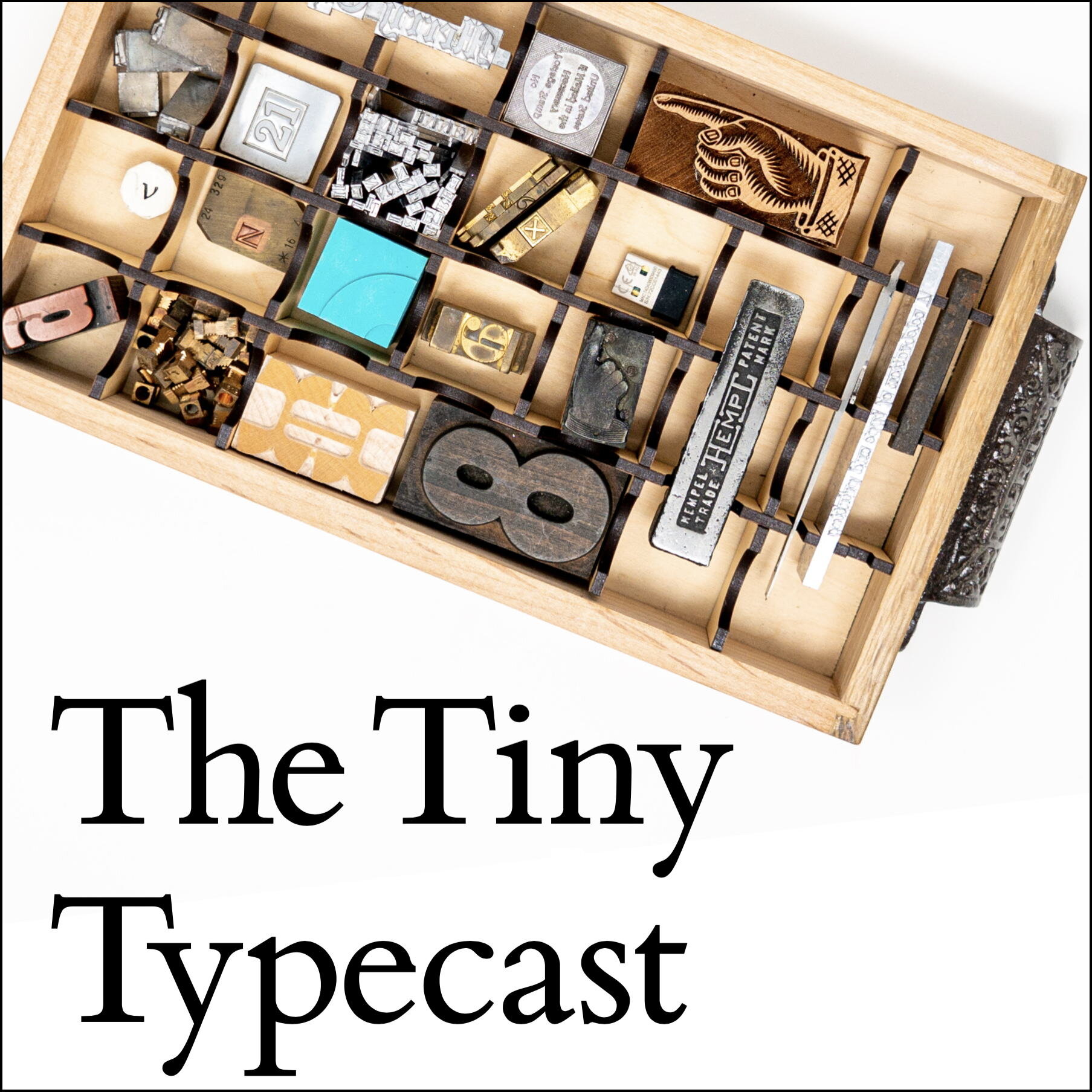
A few months into the year, I picked back up producing a podcast that I recorded several episodes of in 2019 and 2020 and posted in 2020, the Tiny Typecast. (subscribe via iTunes or RSS). Meant as a companion and extension to the museum project, I restarted it in 2021. This time, I hired an audio editor, and turned episodes around much more quickly. We put out 10 episodes in 2021 with folks like Jim Moran, the master printer and collections officer at the Hamilton Wood Type & Printing Museum in Two Rivers, Wisconsin; Toshi Omagari, type designer and video game font historian; and Amelia Hugill-Fontanel, the Associate Curator in the Cary Collection at the Rochester Institute of Technology. I hope to do another batch in 2022—time and money permitting.
Ongoing Writing at My Patreon Campaign
I continue to publish regularly about type and printing history at my ongoing Patreon campaign. This campaign allows you to contribute monthly or yearly to help underwrite my time and expenses for producing articles and material work. Backers at higher tiers receive ebooks and objects, too. Two articles I made publicly available there this year are about about editions:
- Reading the Reprintings: The Printer’s Side: How book publishers account for editions and printings within each edition and, more particularly, how they mark them in books. (You can also read via this Medium link.)
- The Truth in the Stars: Likewise, how newspapers could turn fast-breaking news into updated newsprints at the speed of lead, and mark them openly or secretly in the masthead or header of each section.
Flong!
This year also marked my increasing focus on flong, a paper-like mold used mostly in newspapers to turn a flat laid-out page in metal into a curved solid plate for printing. You can read much more about flong in my essay “Flong Time, No See.” With eBay watchlists and tips from friends, I’ve collected a number of full pages from newspapers dating back to the 1920s, particularly focusing on comics pages. I also managed at least to buy an affordable newspaper printing plate made from flong. Called a stereotype, it’s a nearly intact full page of 1976 cartoons.
I’ve been working slowly but inexorably on a video about the history of comics syndication from the early 20th century through the 1980s as a function of print production and reproduction methods. The script is written, a rough audio version recorded for timing, and images collected. I just need to put the time in to assemble and edit all the pieces.

My interest in flong also seems to have me veering towards writing a book about it. The focus will likely be on comics, though perhaps I should write one about flong and one about the full history of comics syndication from its earliest days through photostats and scanning to the current born-digital form of cartoonist-to-syndicate and syndicate-to-newspaper and -website workflows?
In the meantime, enjoy this “flong party” I held, suggested by one of the participants, in which we shared flongs we had collected live in a Zoom session stream over YouTube.
Publications
Macworld, where I’ve been a senior contributing for nearly two decades, has continued to be the outlet in which most of my freelance work appears. You can find all my articles via this link. I write a few columns a week in the Mac 911 series, answering reader questions about anything in the Apple ecosystem (not just Macs!), and helped relaunch the Mac Gems column a few months ago. Mac Gems ran for many years, offering regular reviews of utilities and other software made by a single developer or small firms and that fit a particular need to a T. I’ve also continued to write reviews of surge protectors and uninterruptible power supplies for Macworld’s sibling publication, TechHive.
My freelance work for other publications declined significantly in 2021 as I increased my book output, focused on type-related projects, and increased work for Macworld. Some publications I’ve written for occasionally or regularly in the past turned away from freelancers, reduced budgets, or didn’t respond to pitches, too!
But several stories stand out for me across the year:
- An External SSD Gave My iMac a New Lease on Life (TidBITS): a shockingly popular article about refreshing an old machine with new hardware
- Why did Berkshire Hathaway’s share price threaten Nasdaq? (the Economist): what do “Gangnum Style” and YouTube have in common with Berkshire Hathaway and NASDAQ?
- Bambi: The Life of a Copyright in Disney’s Forest (four-part story at Meh.com): A extensive look at the history of the original syndicated story, its transition into a book, its tangled copyright path, and how Disney hoists itself by its own petard
- The prescient, quirky legacy of U.K. gadget inventor Clive Sinclair (Fast Company)
- This new novel is a love letter to a whole era of Apple nerdery (Fast Company): A review of LaserWriter II, a novel, and an interview with its author, Tamara Shopsin
- USBefuddled: Untangling the Rat’s Nest of USB-C Standards and Cables (TidBITS): Another surprisingly popular article in which I dug into USB-C, USB, and Thunderbolt cable and ports
Shift Happens
I can’t finish my year in review without talking about Shift Happens, a massive book project written and produced by Marcin Wichary. I first discovered Marcin’s project in 2016, when he accidentally visited the most amazing typewriter museum in the world. Marcin had already begun researching a project of some kind revolving around the history of typewriters, ancient and modern. The museum visit became a catalyst that led him to an over 300,000-word manuscript. I began a correspondence with him, offered solicited and unsolicited advice, and eventually signed on as editor.

I’ve worked on three drafts: an early one for which I provided developmental feedback, including suggesting cuts back in 2018; a significantly revised version which I did large-scale editing down to line editing in the second half of 2020; and a final draft before proofreading, which I did a once-over on in late summer 2021. I’ve put in something like 130 or 140 hours of editing on it. It’s always had good bones, good research, and good stories, and my role has been helping to regularize things, tease out some narratives, and help Marcin find the heart of each story. It’s been so rewarding to work on this longitudinally. I see the work become stronger and more focused—more riveting and moving—and Marcin’s existing strengths as a writer become more pronounced. We’ve shed tens of thousands of words along the way, though some parts will wind up in his newsletter, in podcast episodes, and elsewhere.
What a thing to take on as your first long writing project a book that will be about 1,200 pages in two volumes when it goes to press. We are currently working on his plans to crowdfund production and deliver books in 2022.
Marcin wrote honestly and beautifully about the emotional nature of being edited in his newsletter. I try to be very fair, but I can also be quite blunt when it’s useful to make a point. In a March 2021 update, Marcin wrote:
How personal it all feels is the biggest surprise. Sometimes, I read my editor’s word choices and I nod vigorously. The other times I want to shout “Do you even get this book?” while I slam F3 so hard I’m worried about my expensive switch underneath.
“Let’s cut this section,” he says in a comment, and I remove it with pleasure. Next chapter. “Let’s cut this section,” he says, and in my head the first response that arrives is “How about I cut you.”
It was such a good and heartfelt response. I laughed aloud when I read this out of its humor and out of recognition of myself—and I read it to my wife and we both agreed Marcin really got me. My friend Jason Snell had this response over at his site Six Colors:
It’s okay, Marcin. We’ve all wanted to cut Glenn at one time or another.
Ah, friendship. But it was all in good fun. Marcin noted later:
My editor also knows what he’s doing. The negative feedback is candid and to the point, but there’s also a lot of positive reinforcement, and some of his rewrites are so good it’s almost unfair people will give me credit for them.
An editor should see a sculpture inside every block of words, and the better the editor, the fewer strikes with a chisel they make and the more they help simply mark a path for the author to carve away.
Fun and Interesting Other Things
Despite what sounds like an absurd amount of work above, I did manage to find some distraction and entertainment in 2021:
- Pants in the Boot: I continued to host and produce episodes of a humorous series, Pants in the Boot, about how English is used in different countries (mostly the US, UK, CA, AU, and NZ) for The Incomparable network. We tape for a few hours at a time, and then I split the recording into episodes. We issued 14 in 2021! And I plan about the same or more in 2022. It’s a lot of fun, and listeners write in with words and concepts they want explained from various countries. (You can write in at pants@theincomparable.com.)
- The Incomparable: A stalwart participant on other programs on The Incomparable network, I managed to show up for seven Game Show episodes in 2021—and created one new concept and hosted an episode of it, Bedecked!

- A course on Gutenberg: Due to the pandemic, the London Rare Books School at University of London conducted courses remotely, and I was able to take a course from Elizabeth Savage (LRBS) and Eric White (Princeton) that dove deeply into how (and a bit if) Gutenberg made his early work, with a focus on his Bible. Eric was able to show Gutenberg works from the remarkable Princeton collection, and other scholars popped in via Zoom to show their Gutenbergs, too. I rose at 5:30 am for a week for a three-hour class, 6 am to 9 am my time—and it was invaluable and delightful.
- Laser printing and letterpress: I taught a remote version of a course I previously conducted in person that crossed the utility and flexibility of laser cutting with the constraints and joy of letterpress printing in June. I plan to teach more of these in the future; time remains my enemy.
- Addiction to British television: Not just me, but the whole family became addicted to UK TV in 2020. That expanded in 2021. Me plus one or three other family members are now regular watchers of QI, Taskmaster, Only Connect, Richard Osman’s House of Games, 8 out of 10 Cats Do Countdown, the Big Fat Quiz of the Year (re-runs), Mock the Week, Have I Got News for You, and others. Having run through Taskmaster UK, we turned to the even more chaotic and charming Taskmaster NZ (that’s en zed), and started watching Kongen Befaler, the Norwegian franchise, in translation.
- Tiny print shop: I spotted these lovely objects on eBay (below) and had to buy them. Who made them? For what purpose? They are such perfect reproductions of common items found in a print shop in the 1930s to 1950s. The suggestion by several people is that a salesperson had them made up to aid in demonstrating layouts on sales calls. Plausible.

Predictions
I plan to continue working along much the same lines: more books, more history, more flong. I hope 2022 is the year COVID turns from pandemic to endemic, and we can get back to something that begins to approximate life in 2019 and earlier. A Happy New Year to you all.