Recent Submissions to the Oxford English Dictionary

I sometimes refer to myself as a reporter with “breaking news from the 19th century!” That “joke” is because I have spent my working life as a journalist but am now in the middle of a multi-year-or-longer transition into researching and writing as a historian. I try to bring the same immediacy and excitement about current developments to what I learn—when it’s new or forgotten—from the past.
This exploration led me recently to uncover some earlier citations of several words than those noted in the Oxford English Dictionary. The publication’s founding principle was to solicit “user submissions” of citations, yet the current process is a one-way form: it asks for our information but there’s no place to drop an email address or receive any feedback. This seems unfortunate. I’ve sent the latest entries off via an email address they have, though they promise no reply to that. Thus my public documentation. (Citations for the December 2022 edition of OED Online retrieved 21 February 2023.)
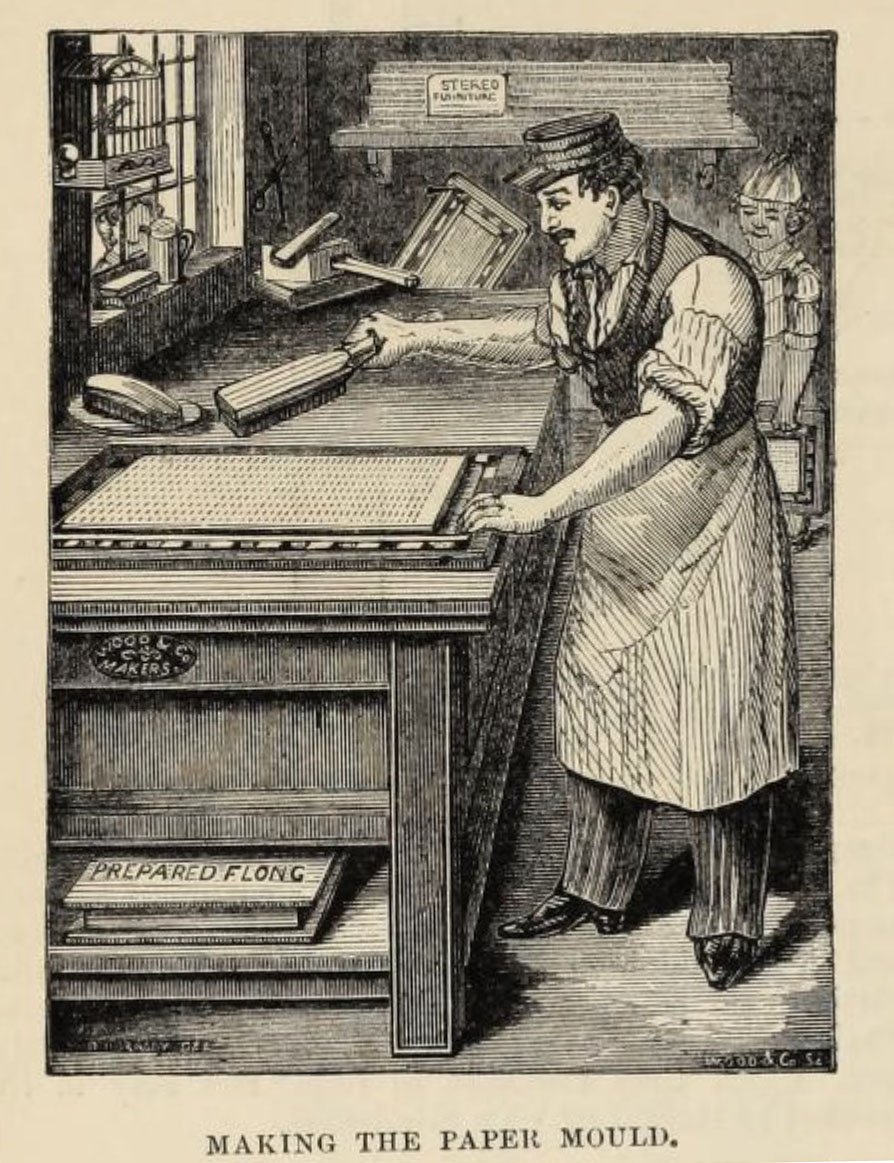
flong: “flong, n.” While the OED entry was updated to 1880, I found a surprising earlier reference. In the Official Illustrated Catalogue: Third Part, Class VII. Manufacturing machines and tools (London: International Exhibition, 1862), p. 106, the label “prepared flong” appears in the upper-left illustration. (A flong is a paper-based printing mold of the 1800s and 1900s used to cast metal plates—one of my favorite words and things.)
boilerplate: “boilerplate, n.,”, 2. b. Boilerplate was originally literally metal plate from which boilers for heating were assembled. Newspapers and syndicates in the 1880s (maybe earlier) began producing pre-fabricated news and columns distributed by “plate,” and that became known as boilerplate as a joke or analogy. Shortly thereafter, boilerplate began to mean something like “talking points” means today. Later, it also referred to tiny legalese in contracts. I have found a citation for the second of those (2. b. in the OED) for “talking points” that predates their 1891 one: the Cincinnati Enquirer (Cincinnati, Ohio), 30 Aug 1888, p. 1:
Columbus, Ohio. August 29.—one of the most absurd attempts to make Republican capital out of nothing that has been seen for a lone time is a long letter that was recently sent out under date of New Straitsville, and which is to form a part of Chairman Cappeller’s boiler-plate campaign literature.”
Update: Adopted by the OED for their July 2023 online edition.
stereotype: “stereotype, n. and adj.,” A. 2. a. The OED’s citation dates to 1800. However, a 1796 review of Firmin Didot’s logarithmic tables book, which introduces the term stéréotype in French, repeats Didot’s definition for English readers and then notes it in English as “stereotypic.” That might or might not be prior art for stereotype. See: The Monthly Review; or, Literary Journal, Enlarged (R. Griffiths: London, 1796), p. 572:
The epithet stereotyptic*, which he has formed from the Greek words στερεός and τύπος, denotes that, in his process, the types are rendered solid.…
*We have already the analogous derivatives of stereography, stereometry, and stereotomy.
Further, the reference from the Annual Register for 1800 (though published in 1798?) accurately quotes the source as mentioning “Herman,” but the person’s name is Herhan. Does the OED use [sic]? (See Armand-Gaston Camus’s Histoire et Procédés du Polytypage et du Stéréotypage [Paris: Chez Ant. Aug. Renouard, 1801], p. 112.)