Glog

Latest

Not a Double Space, Full Stop

I was reminded today of a particular writer who is known for his precision, and wrote a book that was rather about that. I bounced off the book when I reached page 22, and found the following (including the abomination of indented footnotes).
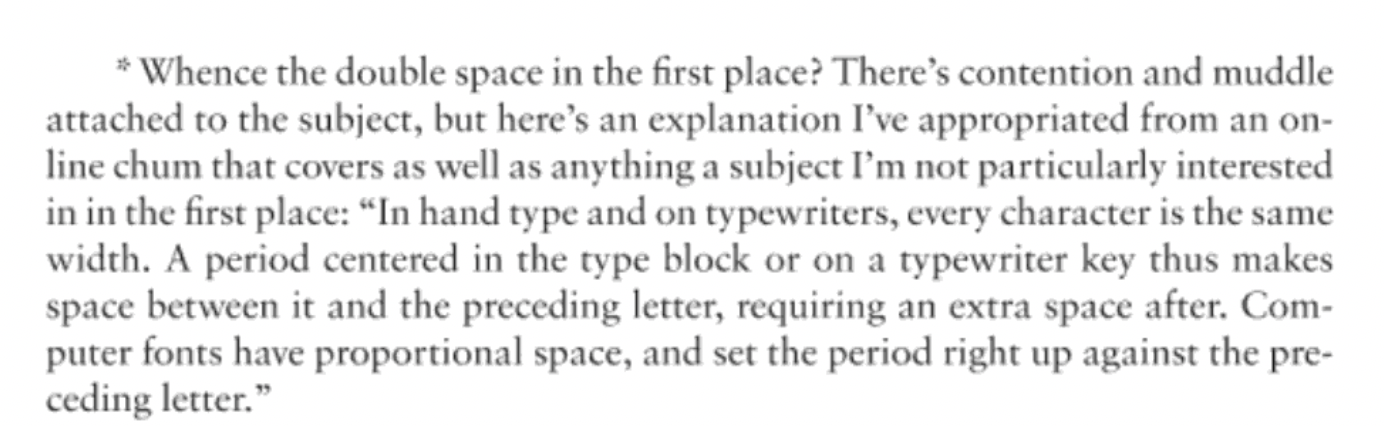
An inaccurate description of several hundred years of typesetting and over 150 years of typewriting

I know of many fights over putting two spaces after a full stop, but the explanation above does a disservice to observation and history. It escaped the interest of the writer, but also apparently the editor, copy editor, and, perhaps, even the proofreader, as those must have existed for this particular book, and should have all known it was false.

First, remember what Ted Lasso said about bullies (see end of post) when you read the lead-in to the footnote above: “All them fellas that used to belittle me, not a single
Glenn’s Voice, Eternally, on Flong (and Comics)

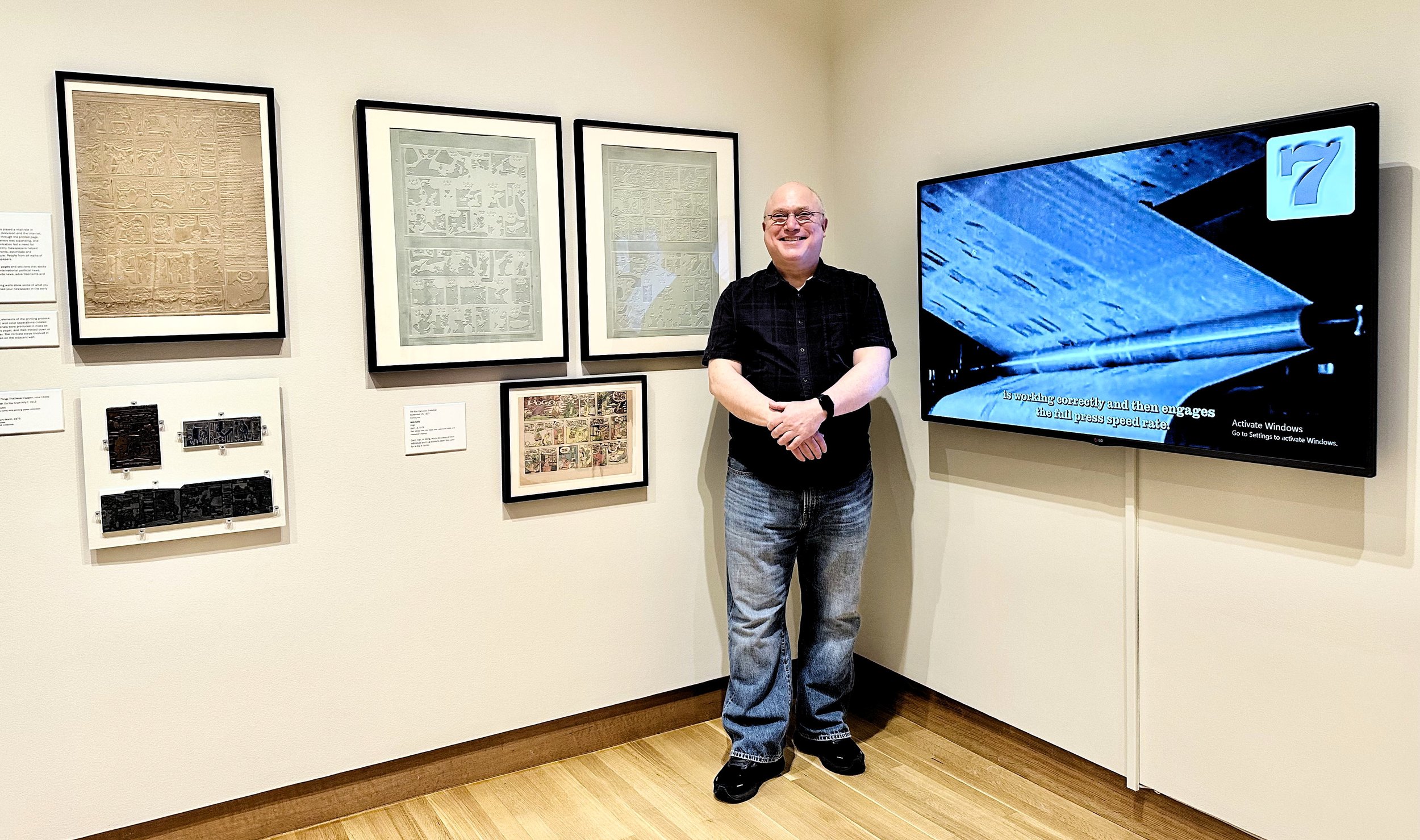
My seeming home-away-from-home, the Billy Ireland Cartoon Library & Museum (at the OSU), re-opens its galleries on May 23 with great one-two punch: a remarkable, first of its kind exhibition of Chris Ware’s work, that he was deeply involved in creating; a new permanent exhibition on the Story of Comics. That second one might sound up my alley—and, in fact, a short video I made about how comic strips were syndicated in the era of metal type appears on a continuous loop in the exhibition. Which means you can hear me talking about flong forever!

You can also watch it here.

The exhibition also includes at least one of the artifacts I donated as part of my research collection to the Billy Ireland—the large semi-cylindrical stereotype printing plate of a page of comics! It’s massive and interesting. The Ware show runs through January; the Story of

Eisner Award Nomination for How Comics Are Made

In 2022, after having created a printed-related video for an exhibition at the Billy Ireland Cartoon Library & Museum at the Ohio State University, I flew out to Columbus to visit, and see their collection of original artwork and comics-related artifacts. I wasn’t sure what I’d find, and didn’t know then that I’d make three more trips over the next two years! What I discovered was a treasure trove of material that didn’t fall into most people’s areas of interest and expertise, including cartoons in plate forms, cartoon-sized and full-page newspaper printing molds (flongs), color guides made by cartoonists or assistants for the syndicate or engraver to follow for Sunday color strips, and a whole lot more. It hadn’t been overlooked or ignored, so much as biding its time, waiting for someone to have the obsession I did.

Glenn standing in corner of museum near pritnin artifacts and a video screen
During a visit to Billy

We Should Improve Society with a Book

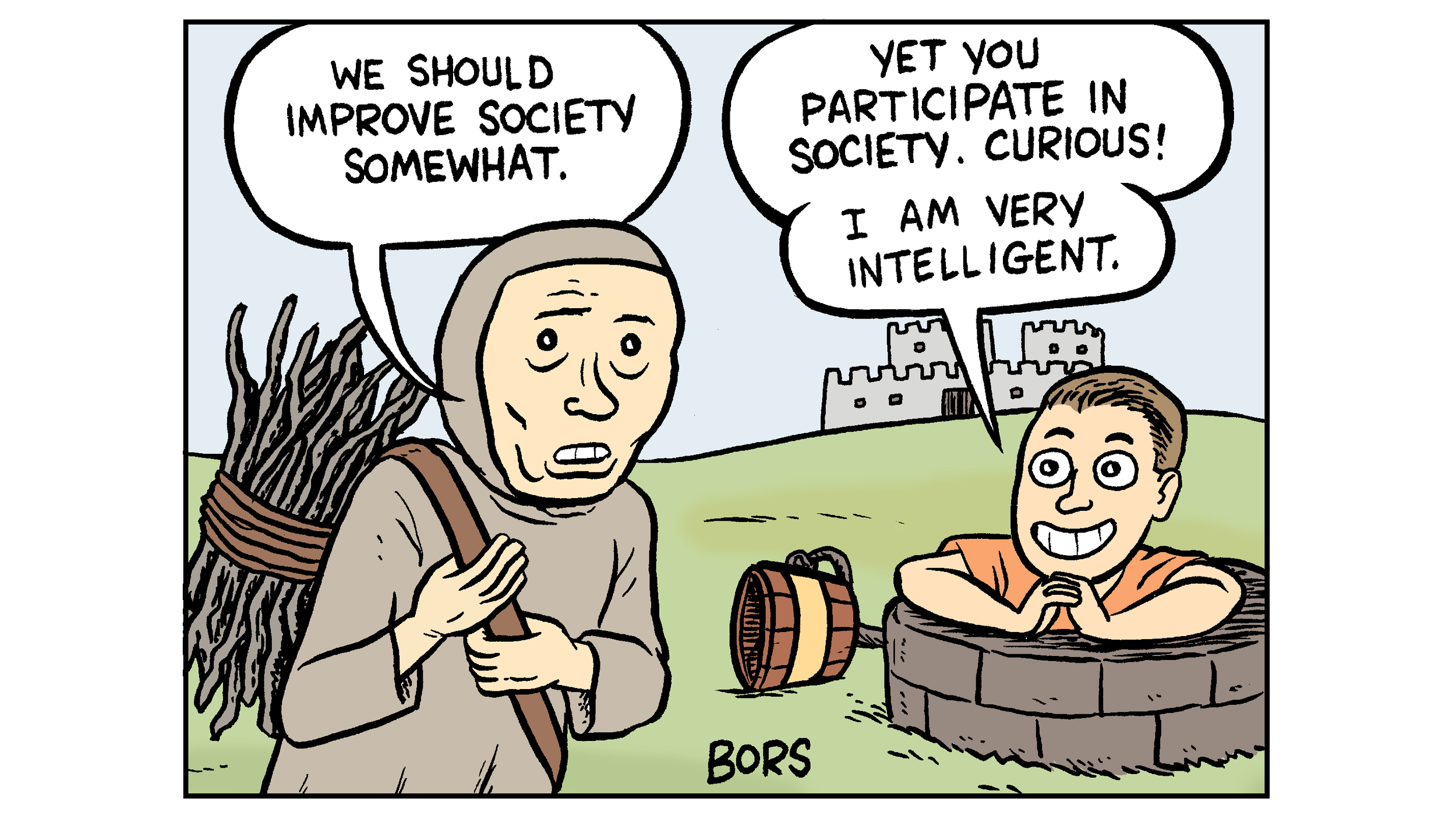
Today I launched a new book project called That One Matt Bors Comic with cartoonist Matt Bors! Matt’s “Mister Gotcha” cartoon in September 2016 became a meme through no fault of Matt’s, primarily for its final panel, in which one character says, “We should improve society somewhat,” while the other mocks him for trying to make any improvement while remaining in society.

Cartoon panel. Peasant in gray outfit at left carrying bundle of sticks in a strap over his shoulder says “We should improve society somewhat.”  Man at right, perched in a well, says, “Yet you participate in society. Curious! I am very intelligent.”
The panel that launched 1,000 conversation stoppers. Or did it start 1,000?

The book will feature over a dozen essays and cartoons by people who think about the terminally online, memes, culture wars, neoliberalism, effectuating change in a fallen world, and more.

We think there’s a lot to say, and have signed up an initial great cast of contributors, with more who will be announced over time. The full initial list is on the Kickstarter campaign, and includes K.C. Green, Anna Merlan,

Say Ahoy, Ahoy to Mister Plimsoll

Writing a column for Six Colors this week (appears Monday) in answer to a reader question, I realized the utility I wanted to recommend that they use didn’t exist. So I wrote it. Please welcome a new, free Mac app called Mister Plimsoll. It has a single-minded purpose: you set a threshold as a percentage of storage full for any volume you want to monitor. If that threshold is exceeded, Mister Plimsoll can pop-up a Mac alert, send you an email, and post an iMessage. You can choose one, two, or three of those options.

The app is in beta. It will remain free after beta, too! I’m actively looking for feedback on improving while keeping mission creep at a minimum. (I have too many utility apps with one purpose in mind that also let you map any keystroke in the system, provide weather updates, etc.) There’s

History

Considering Apple at 50

Many friends and colleagues have written recent reminscences of their first experiences with the Mac as Apple celebrates its 50th anniversary. See:

Apparently, I wrote my reminiscence in 2011, when Steve Jobs died. Below is an updated version,

Not Wikipedia Entry

Glenning

Not Wikipedia Entry

I had an entry at Wikipedia for years, then it was removed in what I think was a 1–1 vote. Big ups for the person opposed to my notability.

People have tried in the years since to add an article about me back, but they continue to be challenged on that issue. You’re supposed to be covered by media, particularly interviewed or reviewed, in order to be notable.

Despite many entries being about people who just do things, and who have rarely had published interviews! I’m sure the Wikipedians are flooded with garbage, so to make it easier, I’ve written a Not Wikipedia entry, which, in no way, is an entry on Wikipedia. But it scratches an itch for me. If you know me, you know I’m proud of the work I do, but not incommensurately proud of it.

Cartooning

Snot-Nosed Kid Tries To Teach Cartoonist about Internet in 1994

Back in 1994, the internet had existed in some form for years under different names, but commercial use had just been allowed in 1993, and I started a web hosting company in mid-1994. Because I was snot-nosed kid, however, I liked to write famous people, like Dan Perkins, a.k.a. Tom Tomorrow, who penned one of my favorite alt-weekly strips. He replied politely in February 1994, and wrote back:

> Something you may be interested in on the Internet is this new 
> distribution system for information called World-Wide Web (WWW). It 
> allows the integration of different media: sound (live and stored), video 
> (live and stored), text, graphics, etc. all through one interface. People 
> are using this progam called "Mosaic" (developed by the NCSA: National 
> Center for Supercomputing Applications...why they're doing PC 
> applications? For scientists to use to access supercomputers, apparently) 
> on
Round-Up

Round-Up

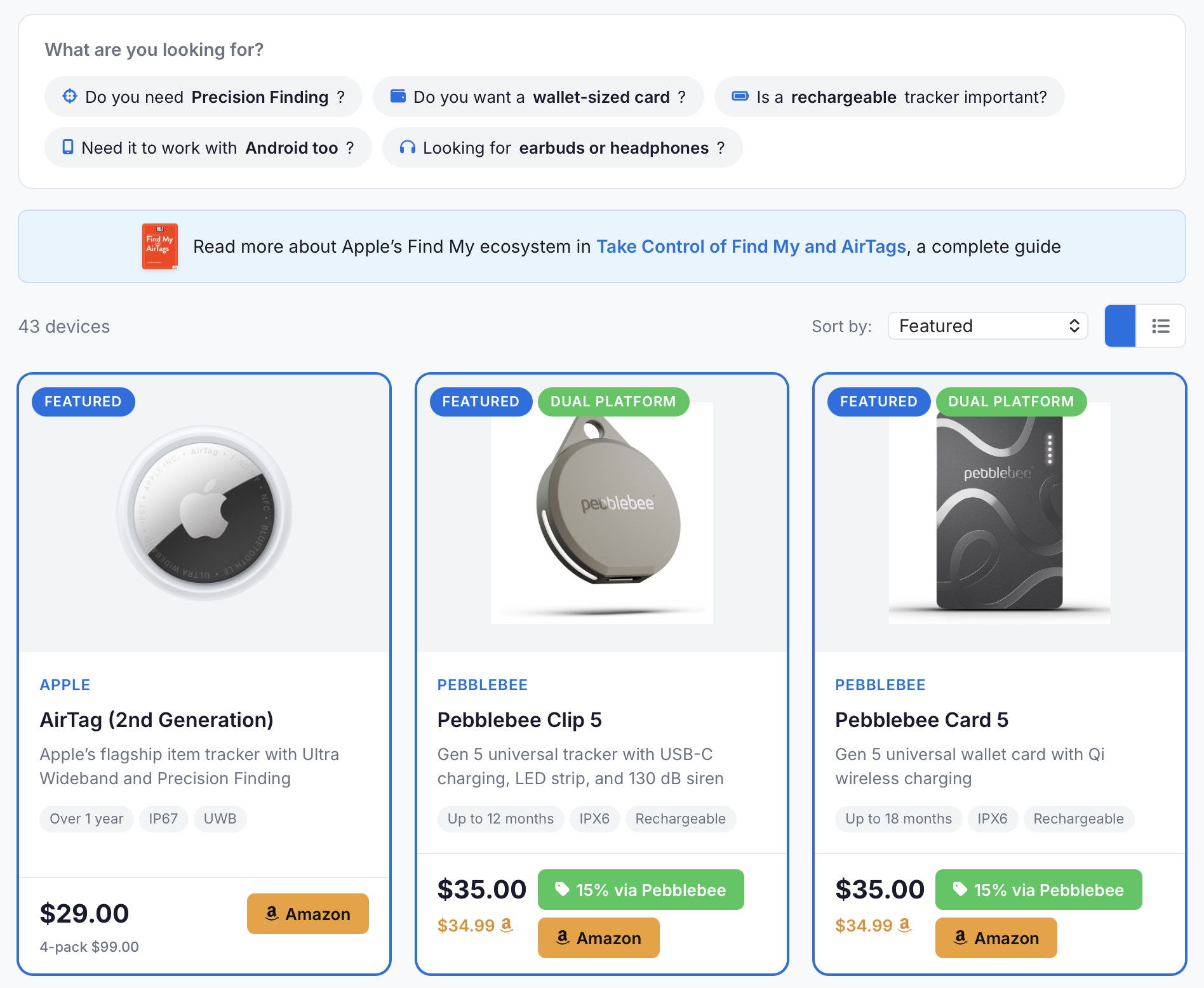
First up! I launched a new website, FindYourTag, that lists all devices that support Apple’s Find My Network, the crowdsourced location-tracking system accessible via the Find My app on iPhone, iPad, Mac, or Apple Watch. This includes Apple’s own AirTags—now available in a 2nd-generation model—and audio hardware, as well as a few dozen trackers, eyeglass cases, and esoteric form factors from third parties that go through Apple’s Find My certification program. This serves as a complement to my book Take Control of Find My and AirTags, which is impossible to keep up to date with Find My Network items! (I receive affiliate fees from purchases made via Amazon and some other site links.)

 FindYourTag lets you discover all the kinds of supported items, and filter by type.
FindYourTag lets you discover all the kinds of supported items, and filter by type.

The campaign for Flong Time, No See, my new collection of expanded and updated reported essays on type,

In the Works for a Flong Time

Books

In the Works for a Flong Time

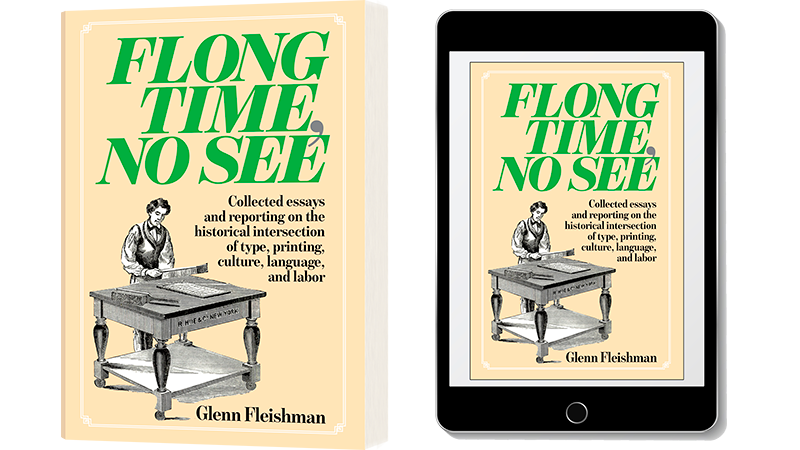
I’m happy to announce the launch of my latest book, Flong Time, No See! This book is a collection of reported work and essays I’ve written over the last seven years about topics as disparate as how a New York Times printer had a job for life for over 50 years, when magazine publishers thought they could replace typesetting with typewriters, how to find and eradicate type lice, and how boilerplate transformed from a literal piece of metal into a metaphor.

 The book comes in print and ebook editions (simulated previews)
The book comes in print and ebook editions (simulated previews)

There are over 12 stories in all, including the flagship essay on flong, a printing mold used to cast metal plates that helped speed up print production, leading to newspapers with more pages and more editions, and which was a driving force in comic strip syndication.

For more information, take a look at the campaign page, which