Glog

Latest

Print

Chromatic Type

I've posted my first patron-exclusive item at Patreon, where you can help directly support by work by pledging as little as $1 a month (you cancel at any time). Here's the start of the post:

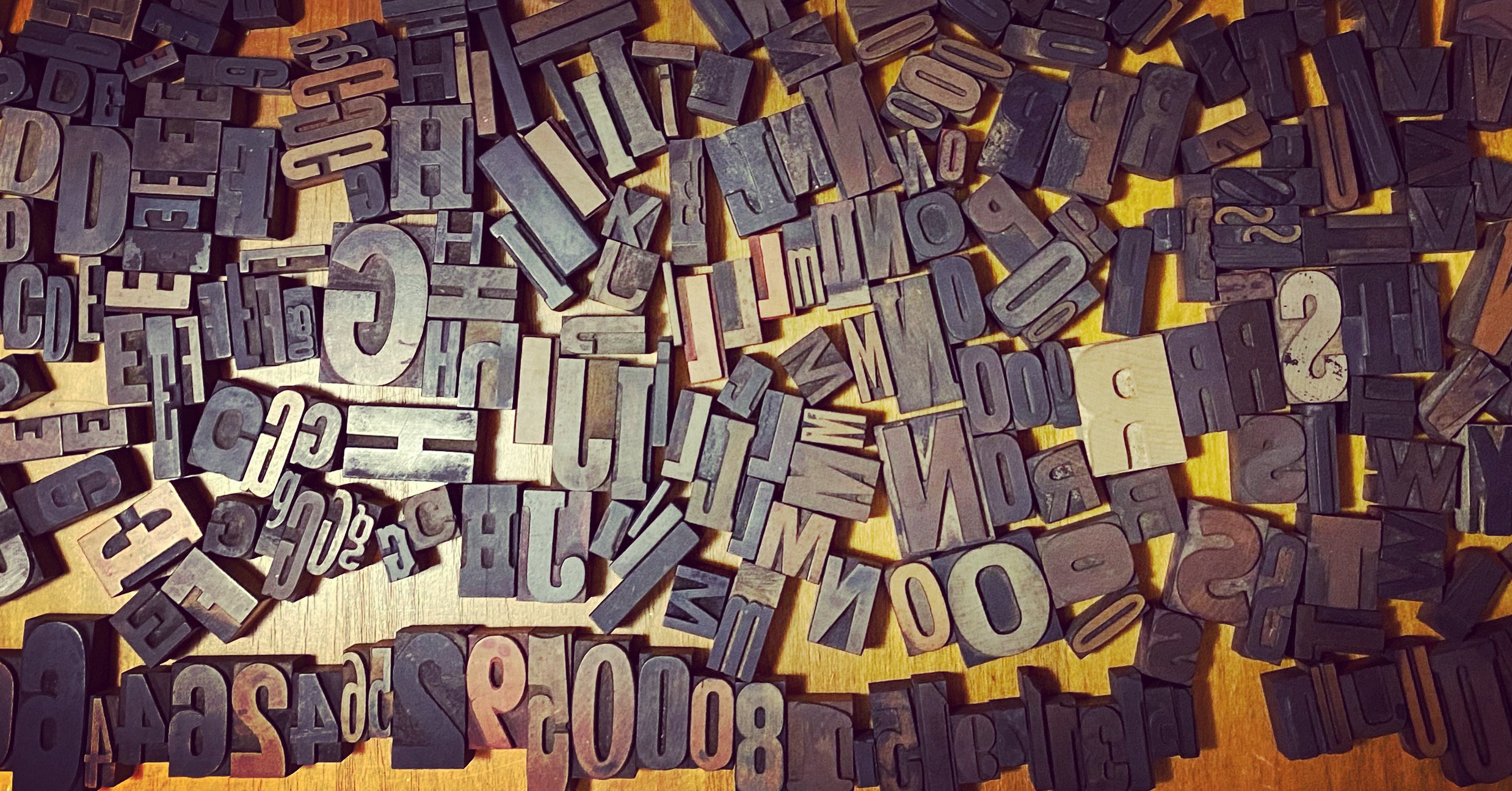
When we think of the past, we often imagine it in black and white. Seeing early color photos or ones that have been realistically colored often jars the way we perceive historic events. The same is true with type and printed works of the past. We think of 19th century and earlier letterpress-printed works as being largely in a single color, and that color is black, sometimes with accents in a second color. Occasionally we’ll see a fancy example of multi-colored printing, but it stands out from that period. Any full-color images typically would have been printed by lithography and added later (“tipped in”) on blank pages reserved for the purposes.

But type could

History

Finishing the Project

I haven’t updated this blog since I finished printing in September, but have been writing about completing the project elsewhere. Thank you for following along!

If you’d like to see a talk I gave on January 3, 2018, about my year making the book (and the complete history of printing), you can watch it on YouTube.

general

Printing Finished and Binding Begun

I’ll have more to say about this soon, of course, but I finished printing the book’s last piece—the cover, naturally—on Wednesday. Everything is in the hands of the bookbinder, and she’s started to work.

Once the letterpress book starts shipping to backers, I’ll talk about next steps: the ebook release, an offset edition, and some elements of the letterpress book that will be available separately, since I wound up with a bit more than I needed to fulfill the numbered edition. (No other copies will be numbered, but I will have some artist’s proofs.)

This week was also busy because the School of Visual Concepts screened the movie Pressing On, an emotionally fulfilling and deep film about the end of an era of letterpress paired with handing off the torch, as much as feasible. I moderated a panel with four of our local

printing

Know When To Fold Them

Last Tuesday and last night, I hosted folding parties at SVC, where letterpress friends came and help me fold and collate the roughly 3,000 folios (folded sheets with two pages on each side) that will wind up comprising about 125 to 150 books. The numbered edition is 100, and then I need additional copies to give as gifts, and to have copies for myself and as artist’s proofs that I’ll offer on a very limited basis. I’m also planning to sell a few special copies and donate the proceeds to local nonprofits that I’ll describe later.

I tried to print between 175 and 200 copies of each press sheet, because problems invariably occur that will make a given folio unacceptable or unusable. With some sheets have three colors applied, that made the odds high I'd have to discard some number even after having done so

paper

Cut pages and set endpapers

Progress continues, and some of it can be really exhausting! In the last two week:

  • I printed the first side of the keepsake in two colors. I’ll have side two finished soon and then will be shipping those out.
  • A week ago, I set the type by hand for the endpapers, which took about eight hours, including corrections. It’s a great experience to have. I should be printing the first past of those on Saturdays. I have a second color for them, too, and that may wind up being on a different day, depending on how it goes.
  • Today, I cut the interior pages down to size. This was incredibly nerve wracking. If I made a mistake on a single press sheet, it might add 12 hours to the project. If I made a mistake consistently, I'd have to…redo everything. I believe I cut everything correctly. See

printing

Interior Page Printing Finished!

 The last impression of the last interior page!
The last impression of the last interior page!

There were times when all that stretched in front of me seemed to be an infinite number of turns of the crank of Eve, the name for the semi-automated Vandercook proof press on which I’ve printed the entire book.

But cranks pass, impressions pass, pages fill up with black and then color, and, one day, I’m done.

That day is today!

I finished the interior page printing today at around 3 pm, reprinting the one faulty folio in the book. I also used this opportunity to insert an Easter egg. My children asked me whether a particular thing would be in the book, and I was shocked when I realized it wouldn’t! They encouraged me to include it, and I was able to make that happen today. When you find it, you’ll be happy. (The Easter egg is

printing

The Start of Color

I had a couple days off from printing and returned fresh to start the 13 passes of the second color, which I’m using for illustrations, photographs, and one big period on the title page. This coffee color will also be matched to the thread used to bind the book. (My bookbinder, Jules, created a binding dummy using a thread she had on hand that’s great, but she only had a bit. I matched the ink to the thread and will now match the thread to the ink!)

The second color is far, far easier to print, as I expected. Because everything is already registered and backed-up front and back in black, I’m just dialing in very small areas. It takes much less time and it’s easier to make adjustments when I’m off on the order of 1/72nd of an inch (1 point) than with

printing

The Last Pass (in Black)

Momentous day today! I printed the last black-ink pass of the book — the 16th of 16 passes! I was able to take one of each sheet, cut them (badly) to size, and fold them as they'll be bound in the book, and, well, it’s pretty exciting. After hitting the doldrums at the end of my printing sprint, I was refreshed and in a few sessions printed the remaining passes. Over time, I’ve been able to control the page “color” better (relative darkness and overall evenness), but variation is less noticeable when the book is folded into pages as you don’t see the up to four pages on a sheet at once. I was definitely pushing the capability of the 70-year-old-plus press.

(After printing thousands of impressions on “Eve,” the name of the particular Vandercook proof press I’ve used throughout, I have its serial number memorized: 10017.

printing

Presses live and breathe

About 11 days into printing, with me on press for about eight of those days, for three to nine hours per session, I’ve hit some walls. The printing is still going well (I'm about half done with the black passes), but I’m discovering the limitations of printing large pages with fine type on an old proof press.

Before I get into details, here’s a time-lapse recording I made of several hours of printing the other day. It’s pretty cool! My friend Jeff Carlson came in and shot a ton of photos a week ago Saturday, and I should be able to share some of those with you, too.

A proof press runs rollers over type following by pressing paper in a continues line across print surfaces. On a platen (or clamshell) press and similar full-impression presses, pressure is distributed simultaneously between the entire print area and

printing

Printing underway!

I started printing yesterday morning and have already chalked up about 16 hours on press. What did I accomplish? Printing one side of each of the first two press sheets of the book.

The book has eight press sheets, which need to be printed in black on each side; 13 sides also get a second color for illustrations and other uses; 5 sides will have chapter numbers printed (6 chapters, but two happen to be on one side of a press sheet). That adds up to 34 passes, and I took 16 hours to carry out two of them—roughly 6%! That's not sustainable, you must think!

 Planning is critical—and it consumed a lot of overhead time in getting set up in the first couple of days.
Planning is critical—and it consumed a lot of overhead time in getting set up in the first couple of days.

It's not. I was learning a lot about the parameters of printing this particular book, including sorting out issues with ink and

printing

It takes a village to make a book

Everyone stands on the shoulders of others (sometimes giants!) to make anything. None of us mine iron ore and smelt it, create silicon designs from our chips and build fabrication plants, or cut down trees, mill them, and make our own plywood. We’re all part of a big industrial and economic ecosystem.

But it's true at a micro level as well. This was a big, big day in progress on the book, which I would like to reveal will be called Not To Put Too Fine a Point on It. While the project I called "Hands On," the book has a different nature and thus a different title, and encompasses the book, the keepsake, and the village and community that’s been nurturing me.

Why such a big day?

 Scott Hill, owner of Evolution Press, dialing in the automated cutting program. My mentor did the cutting.
Scott Hill, owner of Evolution Press, dialing in the automated cutting program. My mentor did the cutting.
  • We cut the

laser cutting

Cut It Out

My friend Dan Shapiro co-founded Glowforge, the makers of a remarkable laser cutter that I can’t pretend to be impartial about. I met Dan when he was finishing up Robot Turtles, a Kickstarter-funded, chart-topping board game to teach programming principles to kids in a really fun way, and he had bought a large-format laser cutter to deliver some of the rewards. He found the software…lacking.

Fast forward not that many months, and Dan is showing me a wallet he made through programmed cutting and a bit of sewing that inspired him to find co-founders and start Glowforge. And now two more years have passed, and they're nearing a point, not yet announced, where they move into full production and ship thousands of them.

The idea behind Glowforge is that a laser cutter (which they call a “3D printer,” because it can cut variable depth, from engraving to scoring