Glog

Design

Design

Closing in on a print date

It’s allergy season in Seattle, which has unfortunately knocked me out at times, delaying some of the work on the book, keepsake, and other projects. Nonetheless, things are moving forward, and I’ve made decisions and am proceeding towards a final design, binding choices, and the rest.

  • The keepsake. I’ve decided on what it will be: a setting of Walt Whitman’s “A Font of Type,” a poem from 1888 that has a lot of resonance in his life, as he started work at age 13 apprenticing as a typesetter. I created a design, but after consultation with my mentor, am reworking it entirely from a small poster into a folio, or a folded sheet. The book design is a gating item at the moment, to get plates made for printing, which will push the keepsake design finalization and printing back into late May or possibly into June.

Crowdfunding

Follow along on my book and printing progress

 I’d like to point out that these are called printers’ fists.
I’d like to point out that these are called printers’ fists.

Thanks to the generosity of over 200 people, I funded the expenses to make an interesting, beautiful letterpress book and other printed pieces along the way. One hundred of those folks get a limited-edition, numbered, signed book plus a separate printed keepsake (suitable for handling or hanging) and an expanded ebook edition. The other 100-odd patrons receive either the ebook or the keepsake and ebook.

I promised to keep them updated along the path I take from upgrading my printing skills, making design choices, learning about binding, and facing challenges of all kinds, and I’ve been posting those updates regularly to a patrons blog. But I felt like I letting the rest of the world down, in that part of my mission this year with the project and with my time as Designer in Residence at the

Print

Books and Movies about Graphic Design History and Typesetting

I just saw the movie Graphic Means last night at its world premiere, and I am so excited about it. It’s about the history of graphic design production during the transition from the hot metal era to high-quality digital output. I worked part-time as a typesetter from around 1984 to 1989, and then as a compositor, imaging center supervisor, color separator, and graphic designer part- to full-time from 1989 through the late ’90s. I lived through this transition, in which major changes could happen every few months. It was delightful to see that period so well explained, and learn a lot of new things, including how phototypesetting was opposed by unions and how it provided an entrée for women into the printing world.

Graphic Means is in limited theatrical release before it goes to digital downloads and DVDs. So I have recommendations for other books and movies:

paper

End of quarter and scheduling apace

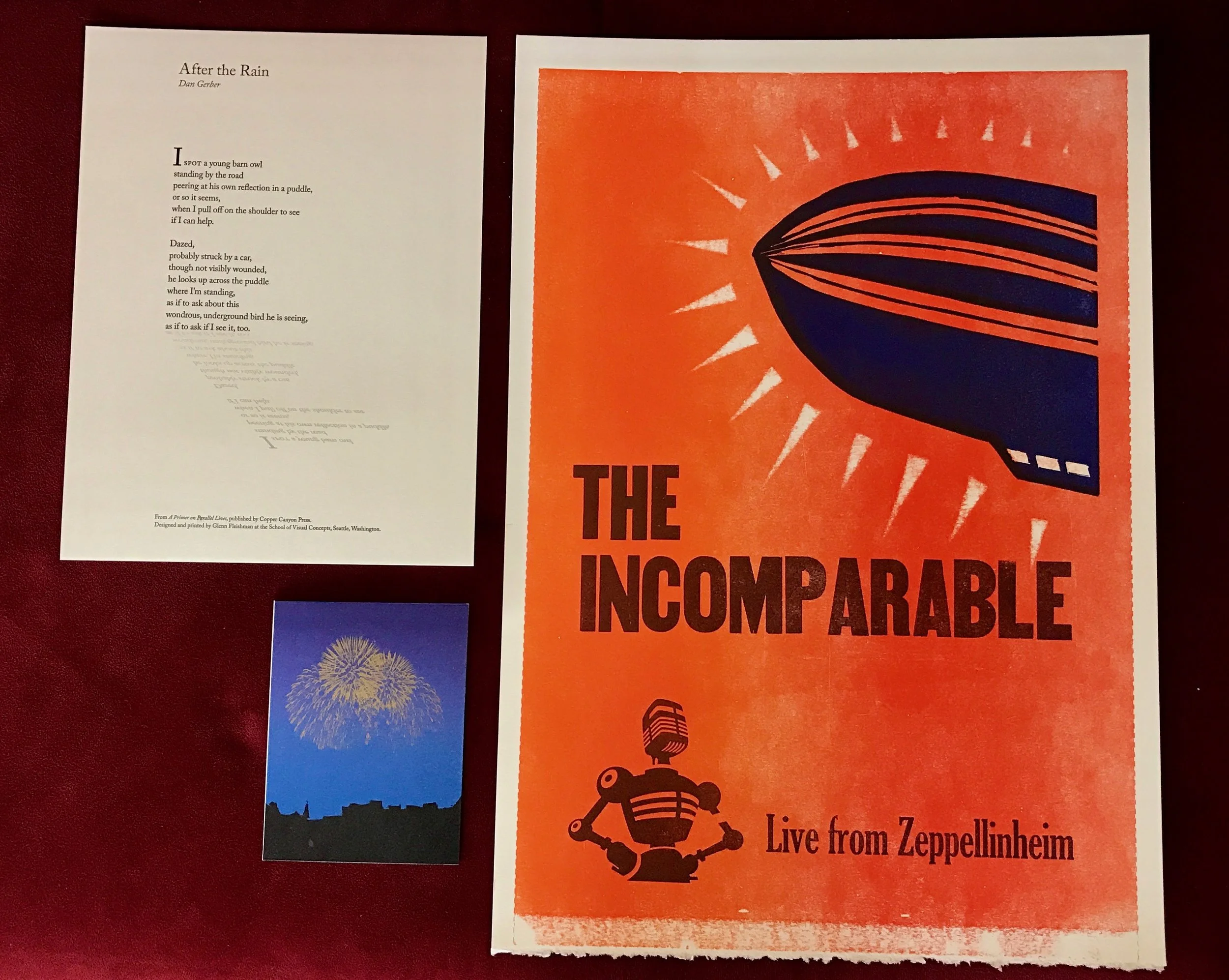
The quarter at SVC ended a couple of weeks ago, and I thought I’d share in one place the three projects I created. I’m very happy with all of them, but the greeting card is probably my favorite, because it’s totally original. The three items (clockwise from upper left) are a poetry broadside (poster) as part of a fast workshop in cooperation with Copper Canyon Press; a broadside celebrating The Incomparable podcast network, using elements from our logo; and a greeting card that relies in part on photos I took.

The next quarter starts this Thursday, and I'll be taking a single class as I gear up to get “signed off” to use the presses on my own by my mentor, and dig in on the details of getting the book from conception to finished.

I'm close to deciding on the paper I’ll use. Because the

Print

A quarter’s worth of printing

The collected work from my first quarter at the School of Visual Concepts as its designer in residence from the three courses I took. From upper-left, clockwise:

  • A broadside (poster) as part of a workshop focused on Copper Canyon Press poets’ works that related to water (part of a set of eight). The workshop was taught by Ellie Matthews of the North Press in Port Townsend.
  • A broadside celebrating The Incomparable network of podcasts, where I’m a regular panelist and a host, using elements from its logo and an inside joke about a fake city name.
  • A greeting card that I chose the theme of fireworks and celebration. The skyline is from a photo I took in Cal Anderson Park; the fireworks from a picture I took from my home's balcony a few July 4ths ago.

The spring quarter starts this week, and I’ll be taking a single

paper

My second project this year

I just completed the third pass on a broadside, a fancy word for a poster, that’s a tribute to The Incomparable, a podcast network I’ve been part of since the founding of the flagship eponymous show. It now has many podcasts in the network, and we’re mostly professional amateurs: shows are produced with high quality and a lot of care, but the money that comes in mostly de minimis — we cover editing and some other expenses, but it’s not a living.

The broadside involves multiple printing techniques and elements:

  • The background was printed using a pressure plate, a sort of reverse stencil placed under the paper during its impression against a large solid block that was inked on press. This created a white space for the zeppelin, and the little pointed rays around it.
  • That pass used a split fountain, in which two different ink colors

Design

You can still become a patron of my letterpress book project

My project to letterpress print a book of my reporting on type, printing, and punctuation reached its funding goal weeks ago and then finished out a couple weeks back. All 100 copies of the book have been spoken for, though I am working up plans to produce a few special copies sales of which I'll donate 100% of the proceeds to causes that need help right now.

However, those who want to still come in as patrons at the two lower levels offered in the Kickstarter campaign are very welcome.

  • Ebook-only reward ($15). Receive an ebook that contains the full text of the letterpress edition plus articles I write over the next several months about producing the book. (Link to book ships by August 2017.)
  • Keepsake plus ebook ($30). Receive a letterpress-printed keepsake I make that will be interesting to look at, hold, and share with others, and the ebook

Design

A Weird, Inspirational Book from 1927

Carl Purington Rollins was the University Printer at Yale University from 1920 to 1948, and left an imprint: when I arrived in 1986 as an undergraduate, his name was still on the lips of people involved with printing, letterpress, and the art of the book (a distinct concept inside of graphic design and book crafts), despite his passing in 1960. Though well known in his time and celebrated alongside other printers and designers, it's his contemporary Bruce Rogers, who designed both typefaces and a prodigious number of books, who is recalled best from that day.

I was looking up a detail about Rogers the other day, remembered Rollins, and found a bizarre little tome that intersects the two. It's called Bruce Rogers: America's Typographic Playboy. It's a tribute by Rollins to Rogers in 1927, printed in an edition of 500; I was able to purchased a slightly worn copy numbered

Design

Sped-Up Letterpress Typesetting

For the opening shot of my Kickstarter campaign video, I had flashed upon a time-lapse or fast-motion sequence of me setting letters. In the end, I did a combination of cuts and various speeds to achieve the affect, while filming with an iPhone 7 Plus overhead on a tripod. I'm pretty pleased with the results!

Design

Letterpress printing a book of my writing

I first studied letterpress in the late 1980s, when it was barely used commercially and seemed to be a dying craft, as no new equipment was being made, metal type foundries were fading, and hot-metal systems required parts that no longer existed and maintenance few people knew how to handle. (The movie Linotype tells this story very well.)

 The letterpress shop at SVC
The letterpress shop at SVC

I thought it would disappear for good. But it was saved through a combination of digital and analog factors that I'll be bringing to bear in my new crowdfunding project, Hands On: the Original Digital, a limited-edition book of my reporting on type, design, and punctuation that I'll be letterpress printing at the School of Visual Concepts. SVC asked me to be its 2017 Designer in Residence, inaugurating a program to bring in outside experts to make use of their facilities to learn, create, and teach.

Here's

Design

Glow Little Forge, Glimmer, Glimmer

I'm long past the point in my life where I want more stuff. My goal is less stuff and more creativity—more exploration of making ideas and things without accruing more material objects. This comes after watching my parents shed their house and pare down and do more paring over time; my mother passing away, leading to my dad going through her stuff; then my dad finding a new partner and marrying and helping her comb through her house, bring her stuff west, and then move to a smaller house they bought together. And my in-laws going through a move a few years ago that required sorting through decades of meaningful possessions.

Lynn and I probably own less, even with two kids in the house, than we have at any point in the last decade. I no longer even need much office furniture, because most of the stuff I had

Design

The Blandification of Scalable Logos

Google introduced a new logo today.

 The memory of charm, but quite efficient.
The memory of charm, but quite efficient.

At first glance, it seemed exceedingly bland to me; the longer I look at it and a new font that's related, the more I think they made a series of good choices. It's still bland, but it's a well-thought-out bland that makes sense for their company.

Google has never had a strong design sense; Android developed one when Google hired Matias Duarte, who helped bring style, simplicity, unity, and some pizzazz over there. He art directed the creation of Roboto, a bespoke Android font, designed by Christian Robertson. I had the same reaction to Roboto as I do here.

 It runs the gamut from a to b.
It runs the gamut from a to b.

His involvement with the new logo seems remote (he congratulates the team and his name isn't on the designers’ post), but it was clearly informed by similar principles. The logo