Glog

Journalism

History

Viruses of the Mind (1996)

Originally appeared in the June/July 1996 issue of Adobe Magazine, the archives of which Adobe has scattered to the four winds.

Net myths die hard. "Hey, I got this great cookie recipe for you, from Neiman Marcus! Not interested? OK, let me tell you about this boy in England who's dying and is collecting postcards. Wait, wait, don't open that E-mail—it has the words 'Good Times' in the subject!"

All three of these are Net myths, which are analogous to urban myths: made-up stories with enough of a ring of truth that they get spread by the unsuspecting. You've probably encountered some or all of these (and more) on the Internet, which is a medium capable of spreading information far and wide with great speed. Peter H. Lewis, the New York Times's Internet correspondent, put it well when he wrote almost a year ago that the Net

Journalism

The Value of an Editor

I wrote a round-up of reviews of Google's new OnHub Wi-Fi router today for TidBITS, as I (and TidBITS) didn't get a review unit, but I like to help people make informed decisions about purchasing new gear, especially Wi-Fi stuff. The reviews are mixed, but it's pretty clear the unit isn't fully baked. And Wi-Fi routers are tough to test fairly beyond some built-in features; testing coverage and performance (actual data throughput) requires lots of devices, moving equipment around, and having identical tests in the same circumstances with other base stations. Only a few of the reviewers were able to do that.

It was clear that reviewers who did more thorough testing were finding less to like because of inconsistent performance and behavior. In my original draft, I wrote:

The reviewers who apparently tested coverage and features the least had the best things to say about the router, as well

Journalism

Interview Advice for Those New to Reporting

My dear friend Swoozy has started out on her writing career, and was preparing to interview someone for a focused piece related to sex education. She asked for my advice, and I wound up writing up a fair amount for someone who wasn't trained in being a journalist, but has good instincts for representing someone else accurately.

I just kept adding to this and structuring it, and thought it was worth sharing, as I couldn't find anything that was quite as focused on how to interview people for a written article (print or online). Most of the advice is a basis for podcasting and in-person interviews, too. I've now published it at Medium, where you can chip in with comments or advice.

A New Economy Discovered in My Own House: Derrick Dollars

Humor

A New Economy Discovered in My Own House: Derrick Dollars

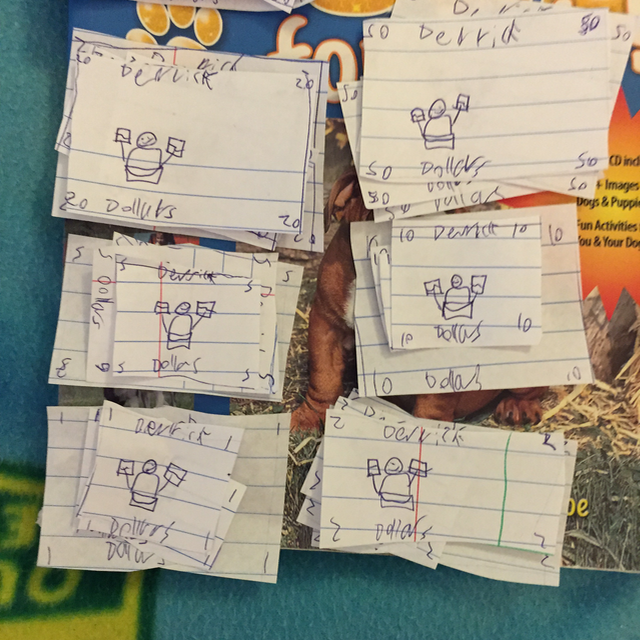
 Derrick dollars in production.
Derrick dollars in production.

As a business reporter, I’m always looking for unique economic angles in the new economy. Recently, while walking through my house, I encountered a new economy worker producing a form of scrip for an economy I was unaware of, denominated in Derrick dollars. Here’s the interview, published with the subject’s consent.

Glenn: Who makes Derrick dollars?

Rex (age 8): Any valid Derrick dollar worker. You need a membership card to create valid Derrick dollars.

G: What is Derrick’s role in Derrick dollars?

R: First in command. There are commands. The reason people make Derrick dollars for him is to get higher in command. By the time I finish all of these I am absolutely certain he will rank me second in command

G: What do you get for being higher in command?

R: It means if Derrick is not at school, if

Space

Space Gets Farther Away

 New Horizons, bound for Pluto
New Horizons, bound for Pluto

This week's Economist features two articles by yours truly about SPACE — and humanity's shortened reach.

You see, in the 1990s, America's budgets were flush, and we funded a ton of projects to send probes and landers and orbiters and oh my all over the place. Those missions came to fulfillment through the 2000s, and even as budget tightened, the early funding helped carry through missions that might take 10 years to plan and then several years to reach their target.

So Cassini is currently still active around Saturn, New Horizons reaches Pluto next month, and Juno orbits satellite in 2016. But nearly all current NASA missions outside of Mars start winding down after that. And then nothing heads out very ambitiously until the early 2020s, when the European Space Agency (ESA) and NASA separately send missions to Jupiter, arriving by 2030, under current plans.

My

Journalism

Recent Glenn: Podcasts, Writing, and a Book!

In the spirit of collecting my work across many sites, here's the latest in Glenn!

Articles

Calculating Newtons: The Physics of Force with the New MacBook Connector

Journalism

Calculating Newtons: The Physics of Force with the New MacBook Connector

The MacBook that Apple unveiled on Monday has a single port. Many connections are gone, but the MagSafe power hookup is the one people are already mourning the most. But I wondered: what if this USB-C connection was designed for a quick pop-out if someone trips over the cord?

I talked to a consulting engineering, an aerospace engineer, a sci-fi author/computer-scientist with a deep scientific background, an industrial designer/manufacturer, and an astrophysicist. The answer? Well, the cable is probably not going to pop out (or shear off) before the laptop is dragged off a surface. But the physics of it are quite fascinating. You can read my whole account at Macworld.

Journalism

Recent Writing and Podcasts (mid-January to late February)

On the heels of the news that I'll be writing (and talking) more about Macworld, here's a summary of recent articles and podcasts there and all over.

Articles

Journalism

Big Hair to Fill

You may have heard that veteran Macworld staffer Chris Breen joined a fruit company in the Bay Area. (Raisins? Apricots?) Chris spent 30 years as writer, and nearly 20 at Macworld. With him gone, who would fill his big hair…I mean, shoes?

Who has two thumbs and eight other fingers and loves writing about Mac stuff? No, not Two Thumbs Eight Fingers McGee. (I hate that guy.) Me! Because I'm not in California, it didn't work out to take over his job. Instead, in addition to the security and privacy column I've written weekly for Macworld since late September, I'll be co-hosting the weekly Macworld podcast with executive editor Susie Ochs and other Macworld staff, and writing the Mac 911 column, where reader questions are researched and answered. You should subscribe to the podcast right now, shouldn't you?

It's a good shift for me, as a long-time senior contributor

Podcasting

There Is Not Enough Time in the Week for My New Co-Hosted Podcast!

Update: We had to put this on hiatus after just two episodes. I was signed on to the Macworld podcast as a regular host, which has quite a bit of overlap; and Christina wound up competing commitments for her time as well. Thanks for everyone's interest!

I've been absent from a regular podcast for a while as I wrapped up The Magazine and sorted out my freelance career. But I'd been incubating an idea for a while, and enlisted my friend, Christina Bonnington, a staff writer at Wired, to co-host Not Enough Time in the Week. She and I have complementary technical backgrounds and interests, and we'll quiz each other each week to explain the events of the last few days — why is China blocking VPNs (and what is a VPN)? If Uber is planning self-driving cars, is that realistic in the near future? The FCC is changing how it

Journalism

The Freelance Life: Pushing a Rock Uphill, But the Slope Seems To Be Ever Shallower

Let me preface this by saying that I'm extremely happy and grateful with all the interesting and varied work I've been getting; that word rates and effective hourly rates for flat fees are up substantially for outlets to which I contribute (old and new) over 2013/2014; and that I love what I do.

With that out of the way…

I've been writing for hire since 1994, and writing for anyone who would publish me since I was a wee child in elementary school. I wrote for mimeograph, photocopier, offset press; I became a typesetter (paid!) for my high school newspaper because I had a high typing rate and was technical. This pulled me into very early desktop publishing in 1985 in school, and themes of programming (as typesetting then was a form of coding, like HTML), graphic design, and journalism have remained at the core of what I've done

The Latest in Glenn Writing & Podcasting

Journalism

The Latest in Glenn Writing & Podcasting

My latest batch of articles from all over: