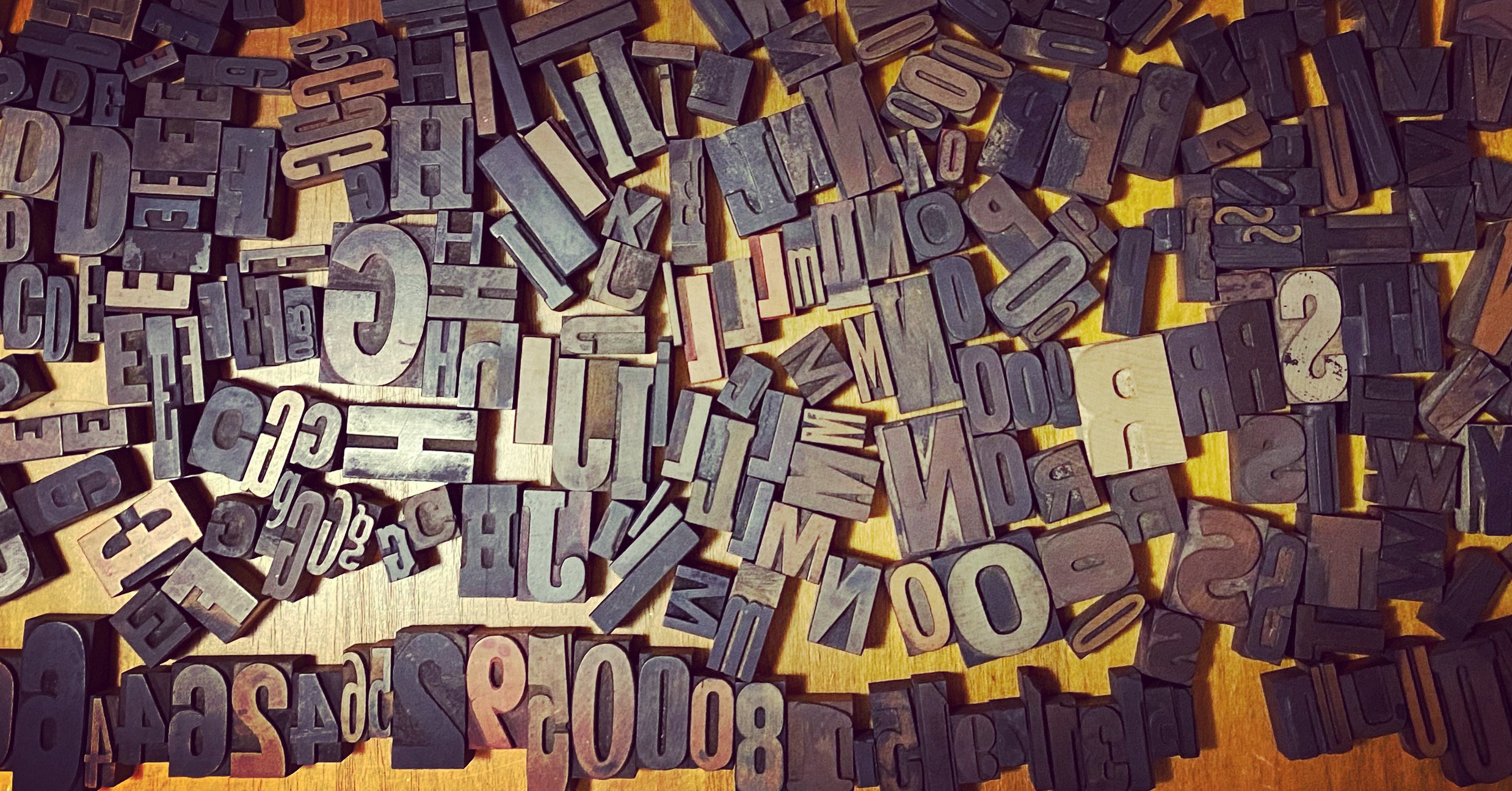
Transcript of an interview between Glenn Fleishman, host of the Tiny Typecast, and David Shields. The episode was posted 19 April 2021. (Transcript generated via machine transcription and then reviewed to improve accuracy.)
Glenn Fleishman: Welcome to The Tiny Typecast, a podcast about printing and type history, past and present. I’m your host, Glenn Fleishman. Joining me on this episode is David Shields, an expert on wood type history and a teacher of graphic design.
[ sponsorship message omitted ]
David Shields is the chair of the Department of Graphic Design at Virginia Commonwealth University in Richmond, Virginia. He previously taught at the University of Texas at Austin, where he was the design custodian of the Rob Roy Kelly American Wood Type Collection. David has engaged in extensive studies of the history of wood type production in America and Europe. David, thank you for coming on the podcast.
David Shields: It’s super great to be here, Glenn, thank you so much.
Glenn: It’s a lot of fun. Nice to reach out to folks when we can’t see each other in person at a Wayzgoose or something. It’s great to chat to you remotely. I’ve known your work for years, and I met you a few years ago at a Hamilton Museum Wayzgoose, and I consult your work regularly when I get wood type in my house. I’ve got to start with this basic question, which is: how did you get here? It’s a kind of interesting thing for someone to be doing in 2021. There’s a rich history behind it, but I would love to know what winding path—you don’t wake up at 18 and go, I’m going to study wood type for most of my life. What was your background that led you this way?
David: Well, I wish I would have woken up at 18 and said I should study wood type because I missed all the end pieces, the really end pieces. And I’ve sort of charted Kelly. Rob Roy Kelly passed away in 2004. I realized, like, there were moments where I was geographically close to him and had I had an interest, then it realized, like, well, what would have happened if I would have I never got to meet him.
It all happened—sort of two things. One, when I was in grad school, a fellow student gave me his copy of the 1979 reprint of Kelly’s text. It was in a binder. He had worked at a type house in New York, and he was like, I’m leaving. I don’t want to move with this. You take it. I was like, wow, this is great. This is amazing. That was sort of my first introduction.
That was sort of early nineties. Fast forward to I got a job offer to teach at the University of Texas. It was my first full time position, and it was a tier one research institute. I get there and they’re like, okay, what’s your research? Because I’d been a practicing designer, and so it was like, my practice. They were like, no, what’s your research? The weird thing was they were sitting on the Rob Roy Kelly. The actual physical collection that Kelly had put together in the for me, that was just like, oh my God, this is the most amazing thing. I want to work here. It didn’t dawn on me at the time. It was like, oh, you can research this stuff.
Glenn: Oh. Because it was physical artifacts that you could put your hands on. It wasn’t the same thing as, I’m going out in the field, I’m digging up stuff. It’s right here.
David: Yeah, it was all there. Kind of in the same way that Kelly writes about the reason he got into it was students were asking questions. I had the same thing where students were like, well, why is this thing this way? It’s like, I don’t know, read the Kelly book. It was like, I read the Kelly book. It was like, hey, he doesn’t really say, like, oh, wait, this research thing.
Glenn: Yeah. I should sidebar for a second too, because we speak familiarly of him. You particularly, because Rob Roy Kelly is an amazing guy. I was just actually reading history because I only kind of knew the wood type part. I read his biography but he was an interesting chap because he was of a Johnny Appleseed of American graphic design. So he sort of built departments. I remember my undergraduate design teacher who ran the undergraduate program was Philip Burton. Oh, who I think is still at University of Chicago, maybe, right? He’s still unless he’s retired, he may be retired. I might have retired, but retired might not forget how old I am.
He went off to Switzerland and did the Swiss thing and came back after having been in a program that was commercial art in the late 60s. He comes back, and suddenly it’s graphic design. And he’s like, this is great. I just studied with the Swiss. I know what this is. Rob Roy Kelly seemed like at the same time as he was a design educator, but at the same time as he was digging in and discovering this kind of lost subject matter, wood type, as it came, it was boring and coming to an end, but he was also building design programs in multiple places. What’s his influence on design history?
David: Really phenomenal, actually. I write about this in my book. That’ll be out in January. We can fill up a much bigger plug.
Glenn: Right. We can talk about that.
David: I write specifically about his collecting and collection, but yeah, Kelly started three influential graphic design programs from scratch. He started the first undergraduate program at what has become the Minneapolis College of Art and Design. He left, and he went to the Kansas City Art Institute and started the second one. I mean, left is a very generous word here. There’s all sorts of he was his own diaspora in a particular way. When he left Kansas City, he kicked around for—that was in the 80s, he gets hired at Arizona State and starts its program. Right. All of these were really, at the time, certainly in the 20th century, majorly influential and really set the tone for how graphic design curriculums work. He was so influential, and so many people modeled their programs on him and what he was doing.
Glenn: Amazing. I didn’t encounter his name before now, in that context. I only knew him from the wood type front, even though I went to a program that was probably shaped. I mean, Yale’s undergraduate and graduate program was certainly shaped because they went through major transitions in they went a very Swiss direction. There’s a very strong American school that was there as well.
David: Yeah, I think because Robert Kelly pissed off all the right people in all the best ways, and so there was this just institutional suppression, I think, of his name. Wow.
Glenn: Oh, they just didn’t want to talk about him anymore.
David: No, he was and I really missed the opportunity. On one level, it’s like, man, I wish I would have met him. The other is like, I can be as romantic as I want about this mythical figure, because he really talks about the reason he did it. He cares about his colleagues, and he cared about the students, and first and foremost was the students. Just as a teacher, I really resonate with that. With my own contentious relationship with upper management and administration, it’s like, oh, I get it. Yeah.
Glenn: People with strong opinions in colleges don’t always go that closely together. Right. Especially when you’re trying to change the nature of a program, right. You’re not brought into even if you’re brought in to do it, those people are often kicked out, and then the program runs without them. This is, I think, a great pulling together is Rob Roy Kelly wasn’t a historian per se. He wasn’t some guy who was, oh, I’m very interested in the history of printing, and I’ve spent all my time in libraries and occasionally go into printing shops. He was a practicing designer. He’s a design educator. He set the direction of what we think of as graphic design in America, which changed enormously in the was commercial art. It was you’re going into advertising, basically, or newspaper work, and then suddenly it was like, oh, we can do typography and refine things, tiny little strokes and whatever.
In the middle of this I mean, this is neat to me to hear how his career and yours intersect like this, too. You have this great echo. In the middle of this, he happens upon wood type as an unstudied area, and 40 years later, sounds like you kind of happened upon his or 30 years later, his study of that. Both have that kind of, wow, this is a thing. What was it like to get your hands on the stuff that he had painstakingly collected that was at Austin?
David: Well, I think first and foremost, the fact that I could even get my hands on this stuff was kind of phenomenal. It was a study collection in the design program, and I have had any number of conversations with folks that don’t teach or that are printers or whatever, just like, Are you insane? Like, 150 year old type in the hands of an undergraduate. Like, Are you nuts? I think the thing is, were always very open. Like, this is a study collection. This has lasted 150 years. It damn better well last another 150. So just respect it. And everybody did. We had very little problems with students engaging. I mean, it was a locked door, and you had to get access. Were very open about having students use it, and they loved it. It was so great, and were able to bring some interesting folks in to work with the collection.
David: And so it was just marvelous. For me, the other great thing was it was disorganized. It hit all those designerly moments in my head, like, oh, we’ve got to organize this, and it’s this wall of boxes, and can we turn that into a teaching tool? In kind of thinking about the organization, thinking about that tells a story of type development. How do you build labels that kind of communicate that? It was all these great layers of learning and teaching. It was so wonderful.
Glenn: It was like, oh, you are such a design professor. I love it because I love design professors. Well, there’s a picture of you that people can find if they search on David Shields name, you’ll find a picture. Well, actually, there’s multiple David Shields. Search on “David Shields wood type.” There’s a picture of you standing in front of this wall of boxes that are neatly labeled. I didn’t know what they were originally. I was like, that’s an interesting photo. I’m like, oh, that’s the collection. Because I’m so used to seeing stuff in type cabinets that this was a teaching collection. It wasn’t a working collection, so it was organized. You reorganized into something comprehensible.
David: Yeah. Katie Salin, who is another important designer, she had worked at UT for a short period and kind of came at the point, early enough, when the collection had moved into the design program. And she and Gloria Lee. Gloria was another Yale graduate who had started teaching at UT. The two of them were really kind of primarily responsible for saving the collection, keeping it as a study collection, and then beginning to organize it. Katie had just started I say it like, I know Katie. I’ve never met Katie in person either, just slightly missing ships in the night, but had started organizing it. When I got there were about 80 boxes of type. Through unpacking and poking around, realized like, oh, we actually have enough type for 160 boxes. They were just piled on top of each other because they basically had gone untouched from the time they arrived in Texas and stored at the Harry Ransom Center, which is the Humanities Research Center there on campus.
In the early 90s, they were going to deaccession because they were shifting gears, and they weren’t quite interested in that kind of physical collection anymore. It was a bit problematic. That’s when Gloria stepped in and said, no. Kelly wanted it as a study collection. Let’s make it a study collection, bring it over to design. It got moved over one spring day in a van. All the faculty went over and moved it, and that’s where it is today.
Glenn: It was sold elsewhere, though. Right. And it’s housed at UT Austin. It’s it is it’s like this it just sounds like another Rob Roy Kelly story that somebody got mad at somebody, maybe, but it’s not owned by them or something.
David: It’s sort of, he was in his mid 60s. He’d done all this collecting, and he realized he didn’t have the room for it himself.
Glenn: Oh, I see.
David: He was really close friends with Bernard Keppel, Dr. Bernard Keppel, who was the head librarian at MoMA. They had worked on a project together in Minneapolis. Again, this is in the book.
Glenn: Awesome preview.
David: Yeah, exactly. Through that relationship, basically facilitated the sale as a in between person and got it to UT through a series of friendships. And it was kind of the first. His was an important collection because he wrote the history about it. It was also first because it was kind of the first large scale accession of old wood type like that. There were several important ones after the fact that Kelly had really played the role of the appraiser. Those happened like when the Smithsonian acquired the Morgan’s collection, or when the South Street Seaport Museum acquired the TriArts collection. Those are sort of big things. Kelly had his hand in all of those based on his experience with the UT. He never was in conversation with the folks at UT at all directly. It was all sort of through Keppel.
Glenn: Oh, that’s funny. I think context for listeners, too, is that we think of wood type as, let’s say it’s highly prized and praised today. Right. It has an incredible aesthetic effect. Designers want to work with it or want to work with simulacra of it, and it’s valuable. There’s this resurgence in letterpress printing of the last decade, and wood type is perfectly suited for the resurgence because it’s big and bold, and we’re not setting tiny type by hand, which is not feasible for most projects. The thing, I’ll tell you, this very sad story will make you cry slightly, probably, but I’ve probably heard it a thousand times before. I was talking to this retired printer in the Imperial Valley of California a couple of years ago who had some old phototype to sell me for my tiny type project, and not very much. Are you looking for phototype?
David: I see your future.
Glenn: Look, I’ve got 27 VariTyper discs behind me that I need to do something with. So, eBay is a wonderful thing in the modern era, but so I’m talking to this fellow I’d found through, I think, Briar Press, which is a great online resource for letterpress printers, and you can post wants and needs and stuff for sale and he just want like my goal at this point in my life, I’m in my fifties—anybody who’s older than me who just wants to shoot the breeze, I’m going to talk to them because I feel like it’s my duty. So especially these older printers and typesetters. I met a printer’s devil who was in his 90s before he died.
David: Wow.
Glenn: This guy had literally, when he was a child, had worked in print shops, was at my in-law’s assisted living place. And, I’m just going to listen to your stories. Tell me anything you want to tell me. I got time. Anyway, I talked to this fellow and he said, oh yeah, my dad was a printer also, and the guy now does some offset, letterpress, embossing and whatever—he’s like, my dad was a printer. My dad would come home from the newspaper and he’d bring these buckets of wood type home from him, and he would use it to light the barbecue and run the barbecue. I’m like, that is the worst thing. He’s like, I know, but we didn’t know this was like he’s talking about the 1950s, right? He’s like, it just wasn’t valuable at all. I mean, I tell that story because it’s horrible to people who are historians and printers.
In that era, I mean, even by the time Robin Roy Kelly’s working, he’s writing his book in the late sixties. Wood type is so much dross, except in the remaining newspapers who are fading out, offset by the stuff that’s being thrown out the window. Literally. Sometimes. So I guess that’s that question. This is, again, it’s a great parallel, too. In the late 60s wood type was starting to become meaningless by the 90s. When you discovered this collection, it’s kind of the same thing it was before that resurgence in letterpress. It was just, I think, just starting to see people get back into the field after it almost entirely collapsed. It collapsed at a commercial thing.
Where does I guess I want to know kind of how did it’s like both tiers, like, how did Rob Roy Kelly say, this is something we’re studying? When you discover this 30 years later and get in this place, you say, this is going to be my life’s work. You want to start with Kelly? You’ve written about you can be dispassionate about him.
David: He also kind of stumbled into all of it. His first kind of exposure to it was when he was at Yale as a grad student in early the program at that point was about two years old, but they had a collection of wood type at that point that they used as part of their teaching. Figure ground relationships and being able to move big pieces of type around on the page before you made decisions was a really great visceral and tactile tool. He liked that idea. When he started teaching at MCAD, that was his ideas, like, oh, I’ll just get some wood type, and that’s what we’ll do. It worked. He realized he had no budget to do that. Kind of in having a conversation with a colleague, the colleague’s like, oh, you should go to this printer, they’re getting rid of that stuff.
Glenn: Yeah.
David: And it was just necessity. It was right. It was cheap because it was the last previous technology that was being subsumed by the new technology. And the new technology was cool, phototype. You could do everything with it. The old wood type was the old way of doing things. It was really just completely being devalued, which is why I get excited by phototype now. It’s like, that’s the last previous technology that’s absolutely devalued and it’s going to be the next big thing.
Glenn: Yes, exactly. I think compared to wood type, there’s very little phototype because people cared about phototype much less than they did wood type?
David: Oh, yeah, no, absolutely.
Glenn: There’s a line in the Shipping News about something like nobody hangs a picture of an oil tanker on the wall or something. And that’s how I feel about photo. I mean, I love phototype. I think it’s a great aspects of it, but it’s how people feel. Thank God for Frank Romano at the printing museum.
David: Amen.
Glenn: Amen. In Massachusetts, because he has examples of every kind. Thank God for that, man. Rob Roy Kelly, he happens upon it, but so let’s fast forward 30 years, and you wind up in this environment. And, I mean, I know this is the thing. What are you going to research? What’s your research project? How are you going to spend that part of your life here? Did it click for you? You say, wow, this is something. I get my teeth. I was like, wow, this is interesting, and it’s an organizational project, but suddenly it’s 20 years later. Whoops. Okay.
David: Right. Well, it was one of those things where I was a good two years into the work before. Luckily, I had really great, at that point, super amazing colleagues that were much further along their trajectory and kind of sat me down and had these great talkings to. I was doing it because it was fun. It was big, it was tight. I loved it. It was fun to play with. It was an organizational thing, so it was hitting all the different receptors in my brain. I was getting students involved. They were having fun with it. It honestly didn’t dawn on me that it was a real research until I had these conversations with other folks, and they were like, no, what you’re doing is really important. You should write a book. You should build a website. You should catalog it. That’s when it dawned on me, like, oh, I could turn this, and it would be really easy because I’m enjoying it, and I’m spending all my time in the labs working with it.
Like, great. I worked with two my third summer at UT, but my first summer really in the collection had gotten of funding to work out with some students. They mostly volunteered, thank the Lord, and they just worked with me all summer. And we printed everything. Mostly it was just like, we have no idea what we have. We’ll figure it out. It was just the most fun and talking about the best moment. I embarrassed them all the time by retelling this story. I came in one morning. We would work these flexible shifts because it was the summer and it was Texas, so we’re mostly swimming all the time. I came in one morning, and they both happened to be there. They decided to meet me, and they’re like, both sheepish and they’re kind of not as talkative of normal. It’s like, Are you guys okay? Something’s wrong.
What’s going on? Let’s chat. And they’re like, Something happened yesterday.
Glenn: Oh, no.
David: Are you both okay? They’re like, oh, no, we’re fine. They’re like, we did this. They show me this piece of type that had cracked into, and they were like, we broke it. Okay, what’s wrong? They’re like, no, we broke the type that’s like, yeah, we’ll glue it back together. They’re like, Wait, you’re not upset? It’s like, you’re fine. The type will fix it’s. No big deal. They’re like, oh. At that moment, it’s yeah, it’s 150 years old, but it’s a tool. We keep the tool alive by continuing to work with it. And it was the best. It was just the most fun moment. Also for me, realizing, like, oh, this is going to happen. If we’re using it’s going to happen.
Glenn: Yeah. Well, it’s interesting because wood type—I mean, this is what I find fascinating about wood type, maybe even as opposed to metal type, because I think metal type is even more is, like, kind of ephemeral. Like, it’s much more fungible. Yes and no. I mean, I know there’s unique pieces of metal type, but wood type is, like, the most handcrafted industrial project that you can get, and it has everything about it. It’s tied up with industrial history, with business history, with development, editorial. I did some extensive studying and writing this book for my tiny type project a couple of years ago. I didn’t understand I had this question in my head. Why did the speed of printing increase? How do we go from the iron hand press where you could pull a couple of hundred sheets an hour or something? It was very slow to being able to print hundreds of thousands of newspapers a day.
This is my fundamental question, and I answered it for myself. Part of it is the improvement in mechanical process, the improvement in metallurgical processes, industrial development, mass production, reproducible, molds, this whole thing. In there, so presses fit in there. It’s very obvious because you’re like, well, we could print 200 sheets an hour here, and now we can do 20,000. And here’s the presses in between them.
Wood type fits as an interesting spot in there, I think, because it’s a totally different thing. It gets mechanized. It was always mechanized, but it traces like, why do we suddenly in the late 1800s, you get into this huge spurt of advertising, and it’s because you could suddenly reproduce stuff right. Had a different tools to reproduce. I wonder how much of that as you dug into the history, the fact that wood type is an overlapping level of different kinds of history and some kinds of history that aren’t studied. Was that appealing to you?
David: Absolutely. One of the best things that’s happened within the last couple of years is I didn’t realize there was a thing called industrial archaeology.
Glenn: I learned about that at Hamilton.
David: Yes, right.
Glenn: At the Hamilton Museum. Yes. I was so fascinated by that.
David: Oh, my God. It’s a thing people study this they study technologies in an archaeological mode, in a sociological mode.
Glenn: Wild. It sounds a great field. There’s a fellow at Hamilton, I’m forgetting his name. You must know him. Yes, it’ll come to us. He figured out he reverse engineered how the wood border stamping tool worked because they did not know how to make it function, even though they had the machines at the Hamilton Wood Type and Printing Museum. He reverse engineered through—he found manuals, I think he found diagrams. Now they can produce bordered wood type, or that’s pressed, it’s produced through pressure as opposed to cutting. Anyway. I heard him give a little talk about it one of the “Wayzgeese” and I was like, Wait, you could do that for—what have I been doing in my life? I should be an industrial archaeologist.
David: Yes. That’s my next career.
Glenn: You sort of are, though. You are an industrial archaeologist. Right. Because you have to recreate and understand all these different aspects to understand what you’re studying.
David: Right. And sort of that framing. The thing that’s so interesting is it is a craft, it’s a skill, but it is also something that was industrialized. That notion of how it changed the process changed the motion of the worker in the space and how the worker was organized in that space. A bunch of folks just didn’t come in and sit down and start working. It was all processed and laid out pre-Fordist notions of assembly line and just fascinating that was being worked out in that typography was the thing that drove that in particular ways. There’s a funny relationship in wood type that it was cheaper and quicker to develop typefaces because the front end was the barrier had been lowered, it was less skilled than foundry type. You didn’t need the same capital involvement on the front end. It was more time consuming to produce but cheaper to ship. There’s all these weird contrasts to the rest of the industry.
Glenn: It had a relatively high value to newspapers, too. Right. Billboard makers and so forth.
David: Yeah. That’s why I think that’s the places that you look now, like newspaper shops that are going out of business or have been out of business and mothballed or old print shops, those were really important. The high impact, the wood types are really sturdy. It would also degrade. It was not the threshold to refreshing your collection wasn’t as high as metal type in that same way.
Glenn: Yeah. I mean, metal type goes to this great transformation. Again, the speed of printing thing. It’s like you increase the speed of your presses, but you can’t get type on it very fast. You can’t get type at the right time. The limit with metal type was how fast can a punch cutter cut punches? And it’s not very fast. (I love that rhyme. She cuts punches down by the punch door.) But it’s an extreme limitation. By the late 1800s, you start to overcome that because electrotyping is developed and then pantograph based carving of letters and so forth. Suddenly you can make molds, you can make punches, and you can make molds much faster. That allows you this massive reproduction of metal type. Wood type goes through I mean, it seems like a similar evolution that the early wood type would have been more I mean, actually, this is the part I don’t know the feel like the origins of wood type seem to be and we want bigger type, and metal can’t go beyond a certain size.
It starts to warp and it’s heavy and it’s not transportable. I kind of know when you get into the late, after the 1850s, 1860s, and it seems like there’s more of a process of cutting it. I’ve got a tiny bit of type from that era, and I can’t distinguish it with my amateur eye from stuff that comes 50 years later, because it’s kind of the same thing. Why did people develop or what were the early techniques, I should say, in developing wood type? Where did it come out of necessity to do this right?
David: Well, I mean, you go all the way back to the Chinese and the Koreans. Wood was the original material. It was metal that replaced wood in the history of things. Only later did we come back to wood as something that could be reengaged as a material that got around the limitations that they’d bumped up into with metal type. A lot of it is job printers were just doing it on their own. There’s a history of folks, just out of necessity, carving stuff that they needed. It wasn’t very efficient. It was the vagaries of the skill of the printer at the time. It took the organizing force of finding a limitation or how to get over a limitation that was supported in some ways by the industry. In New York City, David Bruce and Darius Wells end up as two plucky upstarts start trying to figure out a way to make bigger type, and they ended up figuring out a way to cut wood consistently.
I think that was the thing is the consistency is how do you deploy this so that you can get a lot of people doing it but even about the first ten years or not quite ten years, but of production that Darius Wells was making. There’s a couple of historical competitors that he had in New York City that don’t really get talked about, but they were all basically doing it in these really limited ways, making dyes and cutting and then using the router that he had developed that he had invented to clear away the rest of the material. It wasn’t until the mid-1830s that Leavenworth and N&R Gilmore up in Syracuse combined the older technology of the pantograph with the newer technology of the router. That kind of set the technical baseline that you needed for mass producing this stuff because it allowed you to copy a template, and anybody could copy a template.
That provided the change in the marketplace that allowed for this stuff to be mass produced. And then it kind of stabilized there. Like that is the same technology. All those tools are at the Hamilton Museum. It kind of was this great innovation and then not a lot of change after that. It sort of stabilized. The stuff that gets made today on a router pantograph looks just like the work, basically that was produced 150 years ago. There’s no real difference.
Glenn: The big leap was to 2D engraving or CNC and 2D engraving, which is we should talk about the end of the podcast because I think that’s kind of the future of but yeah, I’ve seen Pentagon. I was at the Type archive in London where they have the—oh, you’ve been?
David: Oh, nice.
Glenn: Yes, I got into the sacred inner chamber there. Right now, they’re obviously closed, but I think their attempt is to constantly be more open and there’s been more people let in recent years. They not only have the Monotype plant, like all the manufacturing equipment and the Monotype archives, but they also have the DeLittle collection, which is everywhere—you just go in there, you pull stuff off the shelves and it’s all the templates of the preeminent wood-type manufacturer in England. That’s a funny story. I should probably do an episode entirely about DeLittle because it’s this wild thing. I took a tour— just a sidebar—in Acton, kind of the west part of London. The London Transport Museum has the Depot Museum, which is only open for special things. They were doing a “Johnston Journey” at the time and they took you through their archives to show all the signage, which includes some shelving at one point of wood type from Stevenson Blake and from DeLittle that was used cut for the London Underground and that so it’s a very interesting the DeLittle panograph is very different than the Hamilton.
I understand looking at pictures, I was watching part of the Wayzgoose from Hamilton recently. I’m catching up still. It’s only March when we record this. I’m catching up from November. And I was like, oh, yeah. There are these pictures of these guys standing at different kinds. So there are many kinds of pantographs. I should explain listeners, if you don’t know what a pantograph is. I had one of these as a kid. I was desperate for this, and my parents bought me one. It was this plasticky thing. I realized now, of course, it was a pantograph. It was, like, trace anything. Of course, it was impossible to use as a child. It was a scam. It’s a set of interconnected levers that let you essentially trace one end and cut or draw on another with a magnifying effect, because everything you trace is essentially carried through the motion of these interconnected levers, larger or smaller.
If you have a router at one end and a pointer at the other, you trace a wood or other template, and it carves into the wood at whatever size you’re trying to make. In the show notes, I better put some links to graphs, because once you see it, you’re like, oh, that’s how it works. It’s a very weird concept to explain, but it was revolutionary for wood type and then later for metal type.
David: Yeah, such a simple tool. I mean, I think I had one as a kid that came probably came in as cereal box toy.
Glenn: It’s ancient tool, right? I mean, the pantograph, whenever you could make something that was straight and of metal, you could have made a pantograph. The principle is obvious to anyone doing math. So maybe the Greeks had pantographs. I don’t know, but it wouldn’t be surprised. It’s like the camera lucida and the camera obscura, which are great, weird tools. We don’t really use enough today, I think principles of light work, whether you have technology or not, and so principles of mechanics work. I think the lack of technological innovation is a fascinating aspect of that. Right. Because when I’ve studied the history of metal type foundries one of the things that’s neat, I think, or not neat, but wild, is that there are only a few hundred, maybe ever, in the United States, and they produced a billion pieces of type, and some of them had large numbers of employees.
It was a relatively small number of people employed in metal type foundries at the height relative to, say, the printing industry as a fraction. You look at wood type, and wood type was a small fraction of that because you didn’t need a ton of wood type to do interesting things. As you pointed out, headlines don’t have a lot of letters in them. Also the multiplying effect of this direct manufacturer. Most of your people in the wood plant who weren’t curing wood and shellacking it, right? They’re out there cutting and refining it. How labor intensive was it? If you take the we have to get lumber and produce in a certain form that’s obviously a big part. The actual production of type, once you have this supply of raw materials, how labor intensive was that?
David: I think the weight of the bulk of the labor was all on the finishing. On the back end or the last steps, the cutting with the pantograph was fairly unskilled. This isn’t to diminish the skill that was inherent in it, but it was a low threshold. You could very quickly kind of master it. You follow the cutter along with the tracer, and you’re in the ball game. It was from there to finish the type, because it was a round bit, it could only ever cut a round cut. If you wanted to have any kind of acute angle, you would have to do that by hand. They’re just very traditional wood carving techniques, engraving techniques, of just using a couple of simple wood cutting tools to finish that. That was really where the skilled labor was, and I think also the bottleneck in production. They could do it rather quickly, but they could only do it so quickly.
That really couldn’t be mechanized in the same way. There’s not a lot of evidence that shows that they were making punches or counter punches in the way that you see in metal typography. It was really kind of reliant on simple cutting tools to just cut straight lines.
Glenn: As a historian, this must be irritating to you, but also glorious is that if you look at the history of metal type, again, there’s documentation. You can read The Inland Printer, the trade publication for many decades, and they’re constantly talking about, this wasn’t provided. Here’s a new patent. A Scientific American in the late 1800s is running articles about patents on different kinds of typesetting, machines, and metal cutting, whatever. When I try to find things, I mean, I’m relying on Google and not going into libraries pulling stuff out. It’s pretty good these days, Google and Hathi Trust and other sources. Occasionally I’ll call, like I’ll call Stephen Coles at Letterform Archive and say, do you have a copy of the 1865? Surely just pull it down off the shelf, take a picture for you. Wood type in all the research that I’ve done, which is a fraction of yours, I’m positive, but I just don’t find it discussed as much.
It was very idiosyncratic. Each factory seemed to have its own secrets. When Hamilton consolidated around the turn of the 20th century and kind of owned most of the wood type manufacturer sand bought out all these other companies which is a whole story, I know, but it doesn’t seem like there’s much documentation in the way that I can find a manual for a 1908 monotype or whatever. I can’t find a manual for a pantograph that was owned by the William Page Company.
David: Right, exactly. In my dream world, there is an archive with all of that. We just haven’t found it yet.
Glenn: I don’t know if they were proprietary secrets, but they weren’t necessary to teach anybody outside of the factories. Creating them was even I mean, not that type manufacturing, metal type manufacture was not industrial, but there were machines. You could buy stuff. There were people making products for the industry, and the wood type industry seems like no one was making products. There just weren’t very many people making wood type or many companies.
David: Yeah, I mean, there were never really more than about seven manufacturers in the country at any one time, and I don’t know if that’s that there was only so much growth possible. It naturally kind of kept a limit on who was working and when they were working. It kind of just naturally, while there was secrecy, I think it was one of those open secrets where, because it was openly acknowledged, people didn’t really write about it, they just knew it. Why would you write a magazine article about it? Even the stuff that you find in the inland printer is all written historically like back in the olden days, like Darius Wells, who invented this process, there’s very little articles, and really not until the later part of the 19th century that you get any kind of contemporaneous reporting. It’s usually on personalities rather than on techniques and tools.
Glenn: Oh, that’s hilarious. Yeah, but it means it’s rich fodder for the historian, because you have to discover all the or architectural, industrial archaeologists, too. I’m going to drill down into drill down as you don’t say that around wood. I know, but I want to drill down into some aspect of your work that I think is fantastic. It’s fantastically useful. I’m going to hold up a piece since we’re recording audio, of course. I’m going to hold up a piece of this is my and I’ll put this in the show notes, folks. This is a piece of type I acquired in just a totally mixed lot.
David: Nice.
Glenn: It’s from the 1870s, from the Bonne Company, somewhere in Switzerland, I believe. Right, right. In the end, Geneve (Geneva). And it’s a stamp on the side. I’ll put a picture of it. I say the stamp on the side. I know in Rob Roy Kelly’s book in the late 60s, he had documented some of these metal stamps that were hammered into some pieces of type in a set. You’ve expanded that tremendously. I guess there’s a couple of different questions around this. One is, as a historian, obviously, you’re encountering this and you’re answering questions for yourself. Another is as a kind of public historian who is working with an active group of people who are passionate about this, both from, I think, a historical standpoint and a practical standpoint. Not just there are collectors in this space, but a lot of people are practical printers who want to assemble sets of things that are all the same.
How does this study of these stamps that appear on the side of wood, how does that help us understand, I guess, the history of it and maybe the utility of it?
David: Right. Well, I think the best thing about this is we only have kind of the artifacts of the process. Right. We have the wood that’s been stamped with a metal stamp. As to my knowledge, no one has recovered a stamp that was actively used.
Glenn: Oh, wow.
David: There’s a couple of stamps at the Hamilton Museum, but those were used for their printing equipment rather than the wood type. It’s another fantasy of mine that it’s sitting there somewhere and somebody just has to realize it means something. Which I think is also part of talking about the history and publishing as much as possible because then it gets the word out and maybe somebody no.
Glenn: One would know what this was unless they were you or someone who’d studied what you do because it looks like nothing to do with wood type at all. No.
David: Yeah, exactly. It would be any other die stamp that would be used in any industrial production. Like, not very important.
Glenn: Right.
David: I think the importance for it, for me, it’s always about kind of finding origins, beginning to date, how old a thing actually is there’s, I think, a funny overlap about how and I’m grossly generalizing. Right. Folks who say they’ve been reincarnated, often they were reincarnated from someone famous, which may or may not be true. I don’t know, but I feel like that’s the same kind of anecdote I can play. When folks have collected wood type, they think it’s the oldest possible version of that type. Right. Like, this is the oldest. You look at the types like, oh, I’m sorry. That was made in the 1950s, which is also still important. Right. They’re really deflated, like, oh, not the 1840s. Like no. I’m sorry.
Glenn: I’m excited. I look at the side of every piece of type I get, because even though it’s usually the capital A’s and sometimes lowercase A’s right. Are usually stamped, but sometimes random things too. The Type Archive, by the way, just posted a couple of days ago, they posted a little information about DeLittle and including a letter from Stevenson Blake had a wood type manufacturing plant, and it burned down. They contracted after that to other companies, including DeLittle. The Type Archive posted a letter in which A, Stevenson Blake sent their metal stamps to DeLittle and said, stamp your type with our mark, which is fascinating. All the DeLittle type or some of the DeLittle type is stamped Stevenson Blake, which is confusing for historians. The other is they explicitly said or his response was, yes, I will stamp the uppercase A’s and the lowercase A’s which I guess may not have been typical, or at least in England.
Glenn: So I’m always looking. So I got this random, umlauted, ü. It happens to have this donate stamp on the side. I’m very excited about that because, I mean, it looks like I couldn’t tell the era, and it’s in great condition. It doesn’t look like anything different than any of the type I have. That’s probably from the 1950s, and yet it’s from the 1870s. There’s a frison if it’s French type about it. This gets you always to the nature of the authentic. From your standpoint as a historian. The need for the authentic is to understand how things were made in that time and where they fit in as just a user, a collector, whatever. It has no value except, oh, it’s old. Right? Old is useful to you when you’re establishing a history, I imagine trying to understand the sequence of things that happen.
David: Right? It grew out of my work with the Kelly Collection of just in general trying to establish he collected this type, but he didn’t take a lot of great notes on the actual age of any of the type. He was mostly interested in the visual output. I’ve just found that as a place that needed to be explored so that we could really talk about how old is this stuff, actually. That’s kind of where my interest grew. Realizing, like, oh, this is one of the tools that a collector or a printer or just about anybody could use reasonably well to establish for themselves how old a piece of type is. Now, unfortunately, not everybody stamped their type. Not everybody stamped all their pieces of type. American manufacturers tended to only stamp A’s. Europeans were much more progressive and so interesting, more stuff that they would stamp.
Oftentimes those N A got used fairly regularly and so would often kind of fall out of disuse. It’s tricky, but it ties into a couple of other methods that then grew out of the process of wanting to date material. The Kelly collection at UT, only about 40% of the type has a stamp, so that we could establish that 60% didn’t. It was like, well, what are we going to do? Through a process of working, kind of gathering information and looking realizing that all the manufacturers, certainly up until Hamilton or the late 19th century, they were making their own equipment, or they were getting equipment custom built to plane their type down. That idea that a custom tool may make a custom mark let’s see if this works. On the back of a piece of type, you have the pattern of the blade, the carving tool that was used to carve the block down to type high so that it would fit on a press bed and ink properly.
That’s held up as a pretty good tool. There are clumpings. The tool was unfortunately inconsistent. Even within a manufacturer using the one tool, there’s a degree of affordance you have to provide in the pattern that it made. It’s pretty distinct that you can see like a Hamilton piece of type shows up as a pretty clearly different pattern than the Page type or Vanderburg Wells type. Yeah. So it’s a great thing. I had this amazing conversation at UT before I left with somebody from the engineering program, and he was overlooking at pattern recognition.
Glenn: Yeah.
David: Just stumbled in because somebody had told him that there was something going on and you should come by. We had this great conversation about how do we develop a tool for pattern recognition? It was like, oh my God, we can do this. We digitize it all, we run it through some algorithms. It’s going to be amazing. He and I both left the institution right about the same time and we didn’t stay in touch.
Glenn: This is my exact feeling is like, this is so perfect for machine learning. It involves a ton of effort because who’s scanning the back? Most people are not looking at the backside of a piece of type. Right. It could be user contributed, in that I can scan the back of every piece of type I have that’s useful in a certain raked lighting, feed it all into the algorithm, all the known stuff, and potentially match them and figure out also, the other part I think would be is reassembling type collection or type sets. Right. So, type made at the same time. You’ve even gotten down to the level, which I think is like if it’s not recondite enough to study wood type or the manufacturing stamps on type or the wood grain patterns, you’re looking at the individual employees making the type as well.
David: Yeah, well, because it dawned on me that all of the 19th century is this great generalized type got made. Like type from the 19th century just got made it’s anonymous and digging in and realizing like, oh, wait, no, human beings made this. Human beings have free will and they have choice. There were designers in the 19th century. We don’t think of them designers because we don’t call them designers, but they were people that were designing type.
Glenn: Yeah.
David: Luckily, a place like Connecticut—Norwich, Connecticut, where William Page based his company for the bulk of the time that the company was involved, had great recordkeeping, luckily from just before William Page moved there. City records directories of who lived where and what they did, luckily, there weren’t any other wood type manufacturers in Norwich, Connecticut. In the directory for 1860, when it says they worked at the wood type plant, it’s pretty easy to narrow down. I’ve used Page as kind of there’s the most information there. That’s where I really focused my interest, but uncovered through digging through records about 120 employees oh, wow. Roughly know what they did at the company. Whether they were working on getting the type into the typehouse, of finishing the material and preparing it for production, if they were cutting it or if they were finishing it or if they were a designer.
Those are all pretty clear manifestations of how it worked. Now, Paige was really interesting because more than a quarter of his workforce was female, which, again, another route of information I need to study is, like, is that an important number in context of 19th century East Coast America, or is that pretty standard or not? The problem was following employees that were females, they would work, and then they would get married and through 19th century habitats, change their name. It was hard to follow some of those workers, but he seemed to hire a lot of them in this situation. Also then using the work that I’ve done to figure out when a typeface was made, who made it, and there, through the catalog record, the sales catalog record that the manufacturers would put out to sell their type, to looking at the stamp record to find out when an actual piece of type was made and then tying that to the record of employee of like, oh, I know this person.
Lewis Davis was one of the people that worked there from 1865 until 1867. I know that because of these records and he was a type designer, that’s very likely that he was responsible for one of these typefaces. It’s sort of slowly narrowing the frame. I think it’s really important to names and show that these things didn’t just grow out of market pressures, that it was designers functioning a lot in the same way that designers work now, where they speculatively design something that they’re aesthetically interested in and get it okayed through some manufacturer that can help distribute. It gets distributed out in the world, and it drives the culture. Looking at the 19th century very much like we’re accustomed to looking at the 20th century, that’s what I’m really interested in. And that seems a wide open field. Like, I would love to meet other people that are doing this, because it would be really helpful to get some help on this.
I’ve only worked with the Page company just access that I’ve had through city directories and business records in Norwich, Connecticut.
Glenn: There’s a terrific book along these lines, actually, about the history of the Hitchcock Chair and Furniture Company that was up in northwest Massachusetts sorry, Connecticut. The company was founded and run in the 1800s and had a very varied history and then shut down the owner. It all kind of fell apart. A fellow in the 1930s came across the factory, which was in disrepair, and he wound up in this ridiculous story, raising money, rebuilding it and bringing Hitchcock back to life, using some of the original stuff that was there, reinventing the stencils. A lot of women were employed in that factory as well, in the 1800s, doing the stenciling, doing the fine work, of course. He wrote this book in the I want to say the 1970s. I think about it. I just read it a few months ago. What do you do during pandemic? You read books about 19th century history, but it’s weirdly parallels.
This whole wood type thing is the same kind of thing as there were designers, but the designers are unsung, although he knows some of the names because the records there are enough records kept and there was design involved, but it was not seen as something separate from the work itself. When I talk to people about the history of design, I mean, contemporary people can say, if you’re a graphic designer, you’ll name typeface designers, but even normal people would just say, oh, yeah, I’ve heard of Matthew Carter. I’ve seen his name, or Zuzana Licko or something. You might know a name or two. Graphic designers, we can name 100 type designers from the 20th century. You go back and like, well, the design office. The idea of a design office designing type is like a late 1800s invention, only in certain places, maybe the Bentons or something.
All the previous I mean, you say, like, who designed type in the 1500s? Well, we know a couple of names, and there’s the other 1,000 people who are cutting punches. We don’t know their names at all. It’s wonderful to try to humanize history and understand more of that particularity, that it’s not just wasn’t a machine stamping out cogs this is aesthetic, industrial process.
David: I think, for me, a lot of that grows out of being a teacher or being a professor in the classroom and working with students and trying to teach history. I think a really important thing is to history can be daunting for a student new to the discipline. Very much they separate out this idea that history only happened in the past and only important people did that. I’m living in the present and I’m not important, so I’m completely disengaged and so really trying to demystify all that and being like, no, you live in a historical moment. You’re human being just like them. Those are just a series of choices that were made. You’re making choices, too. Like, we’re all in history, you see.
Glenn: Those people who colorize photos, black and white photos, and so you’re like, oh, my God, Abe Lincoln. Actually, it was. Flesh and blood, right?
David: Yeah. Like, wait, what?
Glenn: Yeah, it’s unsettling, but it’s a good thing. It’s a way to reevaluate history. I want to finish up with two things I want to make sure we talk about. One is the future of present and future of wood type, and the other is about your book, and I want to hear more about that and where people can get that. Let’s just talk about I mean, I got a laser cutter sitting to my left here, about 3 ft away, and I don’t do a lot of it—it’s a Glowforge, so it’s relatively low power. You can do if I have prepared wood, I can do some wood type cutting on it. I have to get it on a router or something and table saw to cut it into shape.
There are people out there like Scott Moore, who’s doing laser cutting. There’s a lot of individuals doing it more informally. You’ve got folks still running pantographs, including Scott and Virgin wood type in Hamilton. I mean, I contracted a bunch of Hs from Hamilton for the type museum that were made by Georgie Brylski and David Carpenter. And I’m forgetting the third person’s name. I’ll put it in the show notes because we got to know who made the type. I know exactly who worked on that type. That’s in everybody’s type museum. Wood type was forgotten for a while. Then it becomes impractical. Who’s going to learn to use a pantograph except for demonstration purposes, in the most cases, during a period when no one’s buying type, then suddenly people are like, hey, we want type again. Vinyl records are cool. We want wood type. Have you studied this resurgence? Even if you haven’t studied directly, what do you see as the future of wood type?
David: Yeah, well, I think it’s another one of those moments of kind of demystifying and dehistoricizing is that it’s not a thing that was historically important, so we can’t use it anymore. It’s still just as viable today. The context is completely different, but I see a really vibrant future for it, narrow and fairly focused, and it will never attain the industrial importance that it had in the 19th century. All of that aside, it’s still super viable. I think it has an indefinite history in some ways. I don’t think it will ever go away. I look at someone like Dafi Kühne’s work, he’s so flexible with the material, and in some ways he disregards history or he doesn’t approach it in a nostalgic way. He sees it as a technique that can be applied and misapplied and then reapplied. I find him to be really very flexible with that approach and doing interesting things.
He’s got a laser cutter. He’s got a pantograph like those things in his shop, but just seen as a tool. He doesn’t see or I’m generalizing and speaking for him, but he’s not making history, he’s just making work. I think that’s the that’s kind of the vitality of what was really going on in the 19th century. They weren’t making history either. They were just trying to feed themselves and make stuff. People were buying it, so let’s make more.
Glenn: He doesn’t have this sentimentality about it.
David: Correct.
Glenn: Which is great because I feel like sentimentality can lead to fetishization. Modern letterpress printers, by and large, are not printing because they are in love with the idea of it. They’re in love with the reality of it. Like you print because it’s a real tangible thing. Dafi is like one of the greatest examples. He’s like, I’m going to do every kind of thing to make my work. There’s all these different techniques to make. I mean, I’m saying wood type and you are rightly pointing out there are all these techniques to make type. We can make plastic type and Rosin injected. The folks at P22 in conjunction with Jen Ferrell, they came up with that modern rendition of the modular type, the P22 blocks that’s die-injection molded. But they did a bunch of tests. Rich Kegler showed like he’s tried like 15 different ways to make the blocks before they settled on die injection molding.
Wood type doesn’t have to be, I mean, the same wood type, but it’s like type that’s carved out of something as opposed to cast and carved in any method. Like that seems when I say it like that, I’m like, oh, of course I’m asking about wood type. You’re thinking about it as this history of surface raised type that’s carved me down, deposited but not cast out of metal.
David: Right, yeah, because the big problem process.
Glenn: Yeah, well, the big problem is I look at like Scott’s work, Scott Moore’s work, and it seems like one of the biggest things that would prevent this is what’s happening with monotypes or line of types. Like keeping those running is you have fewer and fewer people who know the ins and outs and so at some point it may be they don’t run anymore. With wood type, it seems like the manufacturer could be limited by people being able to make wood rounds. To cut type from that are exactly the way they need to because there’s some very particular machinery, as you were describing, and people are keeping that alive. I’m sure there’s other machinery that could be used in its place. But it’s just this eight. You can’t just go out and say, I want to buy type. High wood. That’s perfect in shellac. Some people will sell you of it, but you got to make it.
That to me, seems like a bigger thing. That’s where something like a CNC router or a laser cutter or other molding processes, 3D printing at some point would be a way to achieve that.
David: Yes. It’s a funny thing where it’s, again, that kind of internal contradiction that comes along with wood type. Is there’s another contradiction in that? People perceive it as an easy process, like, oh, it’s just cutting some wood, or, oh, it’s just printing some plastic, which on the surface like, yeah, no, absolutely. I’ve heard any number of people over about the past ten years oh, I’m going to just start making my own. Very quickly they hit this roadblock of like, oh, it’s really tricky. And you have to be consistent. You have to have a supply that’s consistent. You have to develop the mechanisms to stay consistent. It really continually narrows the field. Folks like Scott Moore, who has an understanding he was a shop teacher, right, gets all that stuff. He’s viable because he has the skill, the technical industrial skills, and he has ready access to some great wood that can get sized.
The same for Gerry at Virgin, right? She’s got access to the material and the tools to do it. But you need those things. But it’s also not rocket science, right?
Glenn: I’ve messed around with it. I mean, I’ve printed from some wood that I’ve laser cut, and it’s entertaining. I wouldn’t want to do it for a living. I wouldn’t want to make sets of things. It’s also I mean, this is I keep talking about I love things that are from the past that are extremely hard or impossible to do today. To me, that strikes me as a wonderful thing. It’s like, well, make a Vandercook proof press today. It’s like, well, you can’t it would cost you $2 million, right? I don’t know if you could I mean, you could make one, but the amount of money to make one from fresh but wood type, we can. It’s not going to be the same. We have to redevelop techniques when we’re using new machinery. To finish up, though, I want to hear tell us about this book that’s coming out in January 2022 and what’s it about and how can we buy it, more importantly.
David: Well, when I was at UT, I started a great conversation with the director at UT Press. Before I left, were going to work on a book together about the collection because that’s part of UT Press’s mission is to illuminate things that are going on campus. And then I moved to Virginia. Things got shelved and just through a few accidents and lucky happenings, I got back in touch with Dave and he was like, yeah, I was waiting for you to call me. We still want to do the book.
Glenn: It’s like, oh, that’s amazing.
David: Here I started at UT in 2004, and I set 2006 is kind of when I actually started the work. Now finally, in 2022, the book is going to come out. It’s really a look at the collection at Kelly as a collector and as an educator. I’ve written an essay about his process, the trajectory of his work. Had really great essays by Tracy Hahn, who worked with Kelly when she was at Silver Buckle Press, which was at the time housed at the University of Wisconsin, which is where Tracy worked.
Glenn: Her collection is now at Hamilton Museum, which is great.
David: It is. The late Stephen Sale, he luckily wrote his essay for me before he passed. It’s one of his last piece of writings is in the book. It’s really to look at, kind of to fill in the blanks because there was so much about the collection that Kelly didn’t put in the book because he was trying to tell a larger narrative about the whole 19th century. I’m kind of freed of that by I really just want to talk about the collection of what we have and use that as a starting place to fill in all the kind of intimate details about all the types. The book is going to be we kind of jokingly call it a smart coffee table book. It should look great on anybody’s coffee table, great Christmas presents, but also has historical information so it can be used as a reference book.
Glenn: Oh, my gosh. I mean, I’ve got a shelf. What’s? Wonderful. I got a shelf for this, the book on Palatino by Robert Bringhurst. I just picked up I forgot I owned it. I have so many of these, but I’ve got this shelf full of what you wrote is not exactly a monograph, but it’s kind of monographish. It’s like very specific and very deep and interesting. And I learned something from all this. I learned that as a designer, I consider myself an amateur historian. Actually, my line is breaking news from the 19th century. I’m a reporter of the past, as opposed to historians sometimes because I’m looking at it with a feature eye. Anyway, this book sounds terrific because I love insights about design history, both to understand how we got here, but also to learn what is there still to learn from that period that we can use today.
He was a unique person, just like you are a unique person. Maybe you’re the two people in history who study would type history into the level you have. And there’s something neat being sui generis. I think you should embrace and enjoy that.
David: It’s going to make a great T-shirt.
Glenn: That’s right. That’s great. Well, this is such a pleasure to talk to you about all this. This is from the UT press, right? So they’ll be able to find it. This will be on your site is tell me your domain name.
David: Oh, it’s Woodtyperesearch.com.
Glenn: So people can go there now and look at stamps and things, which is fun, and read David’s history and lots of great entries there. I’ve been acquiring as I say random lots. My goal with the Tiny Type Museum was to not break up anything important historically, and occasionally I’ve gotten something that’s important historically and I’m preserving it and we’ll donate it someplace. Like, I’ve actually been talking to the Billy Ireland Cartoon Museum. I have a few pieces of things that I’m holding and photographing, and I will give to them at some point because I am not the right person to keep it forever. My family, when I die, will go like, what the hell is this? Why do you have a Joe Palooka block that weighs 10 pounds? Dad? So that will go place like that. I get random wood type off of eBay, and people have just thrown a bunch of stuff in a box and it’s great.
Glenn: It’s a great thing because I don’t feel like I’m lessening the value of it because it’s already been completely undistributed, but it’s great. I go to your site and I go, what can I learn about this? I pull out your reprint, the reprint edition of the Rob Roy Kelly’s book I got on my shelf. I got a couple of other wood type books. I go to your website. If you want to buy some wood type for yourself, it’s great to not break up sets, but you can go to eBay and you could say, I’m going to spend $50 and get some and hold it and look at it. Maybe it might encourage you, when things are better, to go to find a letter, press program and city, town or country and bring some of your own wood type and print it. It is such a pleasure to talk to you.
Thank you so much for sharing your expertise and your history.
David: Absolutely, glenn, thank you so much for this opportunity. I really do appreciate it. It’s been nice chatting.
Glenn: This is the Tiny Typecast.
This transcript is licensed for use under Creative Commons Attribution-NonCommercial-NoDerivatives 4.0 International (CC 4.0 BY-NC-ND).