Glog

History

History

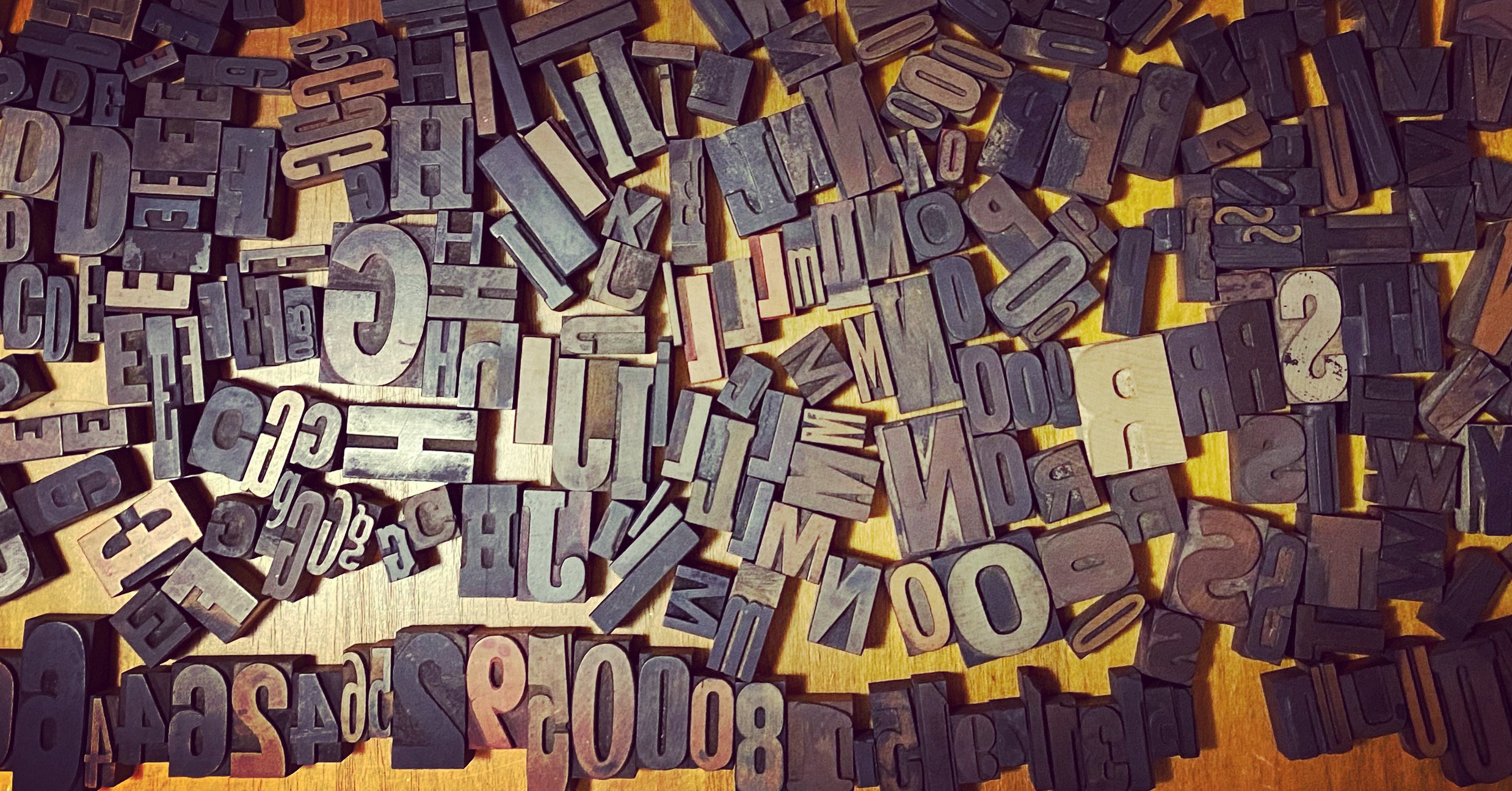
A Type History Talk Featuring the Tiny Type Museum

I was in San Francisco in early June, and the Grabhorn Institute invited me to give a short talk in their gallery about type history and the Tiny Type Museum & Time Capsule. The institute preserves the practical history of type casting and fine-art printing by perpetuating it, fulfilling orders from letterpress printers and producing new books, while running an apprenticeship program, regular tours, and inviting speakers (like me!).

Print

Chromatic Type

I've posted my first patron-exclusive item at Patreon, where you can help directly support by work by pledging as little as $1 a month (you cancel at any time). Here's the start of the post:

When we think of the past, we often imagine it in black and white. Seeing early color photos or ones that have been realistically colored often jars the way we perceive historic events. The same is true with type and printed works of the past. We think of 19th century and earlier letterpress-printed works as being largely in a single color, and that color is black, sometimes with accents in a second color. Occasionally we’ll see a fancy example of multi-colored printing, but it stands out from that period. Any full-color images typically would have been printed by lithography and added later (“tipped in”) on blank pages reserved for the purposes.

But type could

History

Finishing the Project

I haven’t updated this blog since I finished printing in September, but have been writing about completing the project elsewhere. Thank you for following along!

If you’d like to see a talk I gave on January 3, 2018, about my year making the book (and the complete history of printing), you can watch it on YouTube.

Publishing

My Talk on Six Centuries of Printing and My Year in Residence

As the wonderful culmination of my 2017 designer-in-residence position at the School of Visual Concepts, I gave a talk at the school last night. I covered the entire history of printing and my book-printing project, all tied together with the notion of imitation and creation and duplication. You can watch the talk on YouTube. It was an amazing year and I'm looking forward to new adventures in 2018!

printing

Chromatic Type

I tried to keep my plate relatively free this quarter at the School of Visual Concepts (SVC). I’m taking a single class, and while I printed three separate items last quarter, I felt I needed to have the time to work on the keepsake and the book. But I wanted to make at least one thing in class, learn to use the largest platen press on site, and produce something wee and refined, as all my first-quarter projects were relatively coarse or large. I settled on a business card.

 From  an 1874 specimen book  considered the epitome of chromatic wood type shown in print.
From an 1874 specimen book considered the epitome of chromatic wood type shown in print.

In looking at type for the card, I realized what an opportunity I had to use chromatic type, which are typefaces designed in variants that can be overprinted exactly in place with different colors, allowing for insets and knockouts and other neat effects. This kind

History

I held Walt Whitman’s hand today

Through a series of circumstances and research I’ll explain later, I was at the University of Washington library's Special Collections Book Arts and Rare Book Collection, meeting its curator. Unrelated to the topic at hand, I ask offhandedly if they have any Whitman. In fact, they have a very fine concentration of Whitman editions, including a first edition of a book I have particular interest in, November Boughs, which he published in 1888 after his health broke.

She pulled three editions, including that first one, and said there was something special: Whitman had written an inscription and signed it. (J.G. Milligan appears to be a fellow Brooklynite of Whitman’s from my quick research.)

I always think of these kinds of links from one person to the next: having held a book the edition of which Whitman not only wrote and for which he supervised the printing, but

You're Free, Happy Birthday! Except—

History

You're Free, Happy Birthday! Except—

 From the 1922  The Everyday Song Book . Reprinted with permission? No.
From the 1922 The Everyday Song Book . Reprinted with permission? No.

Update: I wrote a fully reported story about this for Fast Company that goes into some of the details in different ways, and includes expert insight from Robert Brauneis and Jennifer Jenkins.

A judge's ruling in a long-running suit about the song "Happy Birthday"—technically, about its lyrics, not the music—came down this evening, and at first glance, it seemed to state incontrovertibly that those words were in the public domain. Then I read the entire decision carefully, and while that's the almost certain reasonable effect, it's not necessary as crystal clear as one would hope. (You can read my earlier coverage about the suit at Boing Boing.)

The good news? Warner-Chappell pretty much lost. The judge said there there was no proper rights assignment for the lyrics traced back to the origin of where there needed to

History

Viruses of the Mind (1996)

Originally appeared in the June/July 1996 issue of Adobe Magazine, the archives of which Adobe has scattered to the four winds.

Net myths die hard. "Hey, I got this great cookie recipe for you, from Neiman Marcus! Not interested? OK, let me tell you about this boy in England who's dying and is collecting postcards. Wait, wait, don't open that E-mail—it has the words 'Good Times' in the subject!"

All three of these are Net myths, which are analogous to urban myths: made-up stories with enough of a ring of truth that they get spread by the unsuspecting. You've probably encountered some or all of these (and more) on the Internet, which is a medium capable of spreading information far and wide with great speed. Peter H. Lewis, the New York Times's Internet correspondent, put it well when he wrote almost a year ago that the Net

The Mouse and John Sculley, an Anecdote

History

The Mouse and John Sculley, an Anecdote

My friend Roman Mars' podcast, 99% Invisible, just posted its latest episode, Of Mice and Men, about the history of the computer mouse. It's a terrific walk through the mouse's success and the lack of interest in single-hand or chording keysets. I provided some feedback to an early script, mostly around the edges of some historical facts, and the final story is absolutely dead on. (You can listen below in the browser.)

This reminded me of a short encounter when I worked at the Kodak Center for Creative Imaging in Camden, Maine. The short-lived teaching facility had 100 Mac IIfx models and millions of dollars of the most advanced storage, scanning, and camera gear available. We also had regular invitational events with artists and others.

At one such event in 1992, John Sculley, then Apple's CEO, attended. (He had a house in Camden at the time, too.) Kodak was using

Netscape Navigator Free Beta

History

Netscape Navigator Free Beta

 Our logo came  before  the AT&T death-star logo of that era. It was design by  Brian Wu . This business card was our first, back when my partner and I were running the business out of my basement.
Our logo came before the AT&T death-star logo of that era. It was design by Brian Wu . This business card was our first, back when my partner and I were running the business out of my basement.

In 1994, I formed an internet Web development firm with my friend, Todd Haedrich. I came up with the name Point of Presence Company (POPCO). We managed to sign up three initial clients at what I recall was $25,000 per year: Peachpit Press (now part of Pearson), Atlas Model Railroad Company (owned then by Todd's uncle), and Faucet Outlet (a client of Todd's father's printing company).

A point of presence is a location at which two or more telecommunications parties meet for interchange. I picked it partly because it avoided trademark issues: the term was of general use in the field, and thus no company had used it, and nor could