Glog

History

Cartooning

Peanuts Flong Unboxing: Live!

I recently bought nearly 200 Peanuts flongs, the molds used to make metal plates back in the days of relief printing, and they arrived from Sweden today! To celebrate this incredible treasure trove, I had a live unboxing on Thursday, May 20 at 10 am Pacific to explore the strips as I saw them for the first time. Along the way, I answered questions and provided some background on how newspaper syndication worked historically with etched plates, flongs, and stereotypes. You can watch below. (Post updated after event.)

I showed off a number of four-color Peanuts color separations, some original etched plates used to make flongs, and the 40-pound-plus newspaper plate of comic strips that I acquired last year!

Crowdfunding

Type Matrix Replicas Now Available

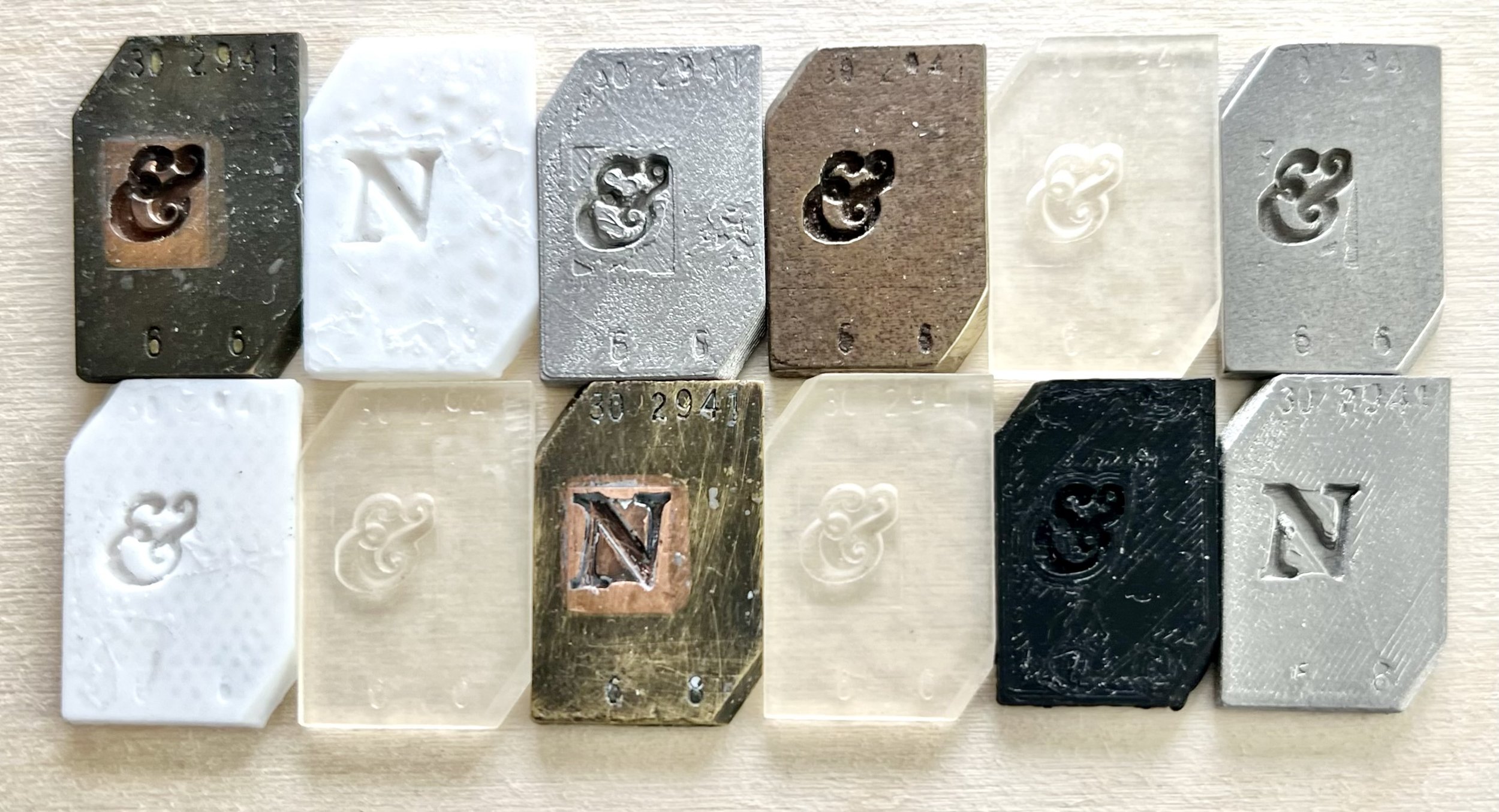
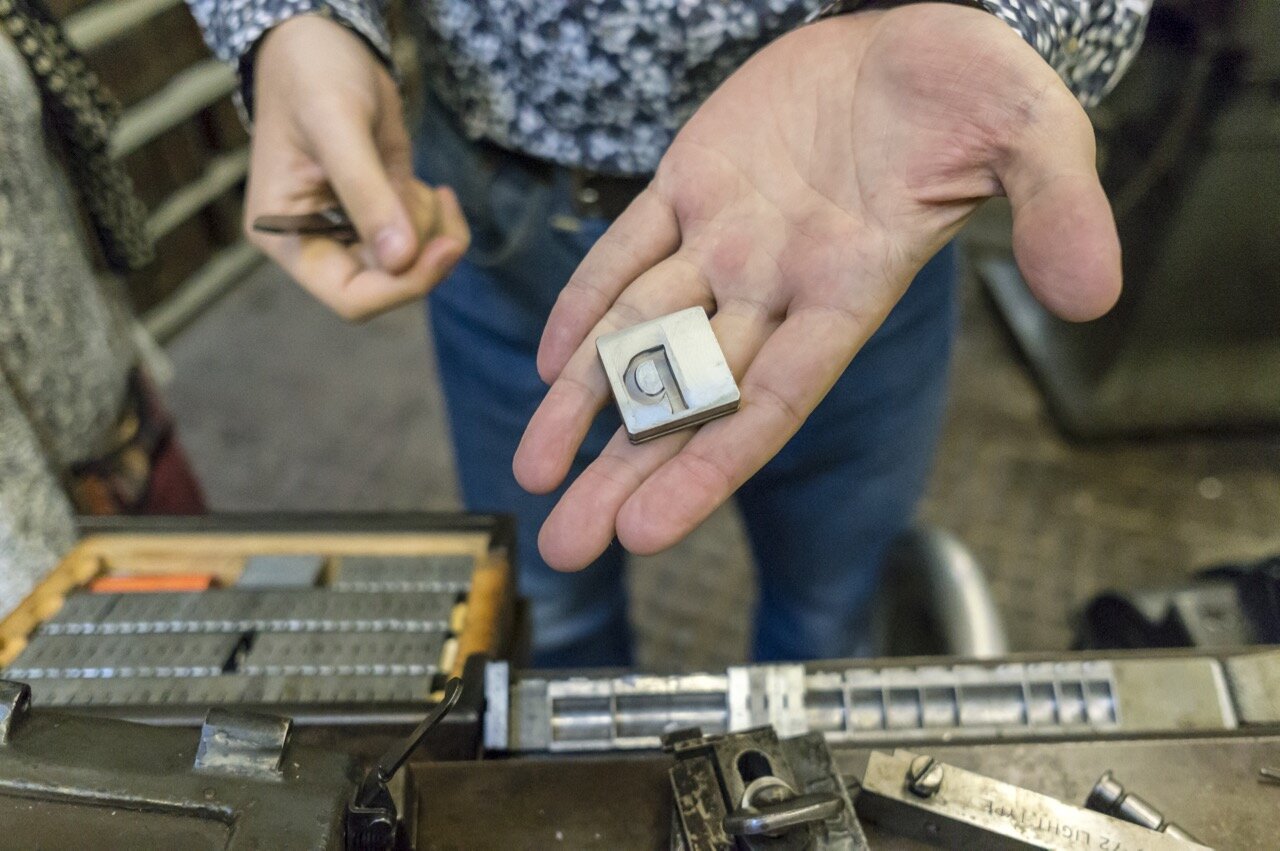
Back in November 2021, I funded a small project to create 3D scans of a few historic type matrices—molds used to make single pieces of metal type—and then produce a high-quality model and prints. That project is now complete, and the rewards for all backers are in the mail. In the process, I made a lot of 3D-print tests.

 A variety of 3D prints of two originals—the originals have copper inset areas in their brass frames.
A variety of 3D prints of two originals—the originals have copper inset areas in their brass frames.

If you’d like a replica piece of type history, you can order one now! I’ll also be releasing the 3D models under a broad Creative Common license in about four months as part of the intent of the project.

Third Anniversary of the Tiny Type Museum & Time Capsule Project

Crowdfunding

Third Anniversary of the Tiny Type Museum & Time Capsule Project

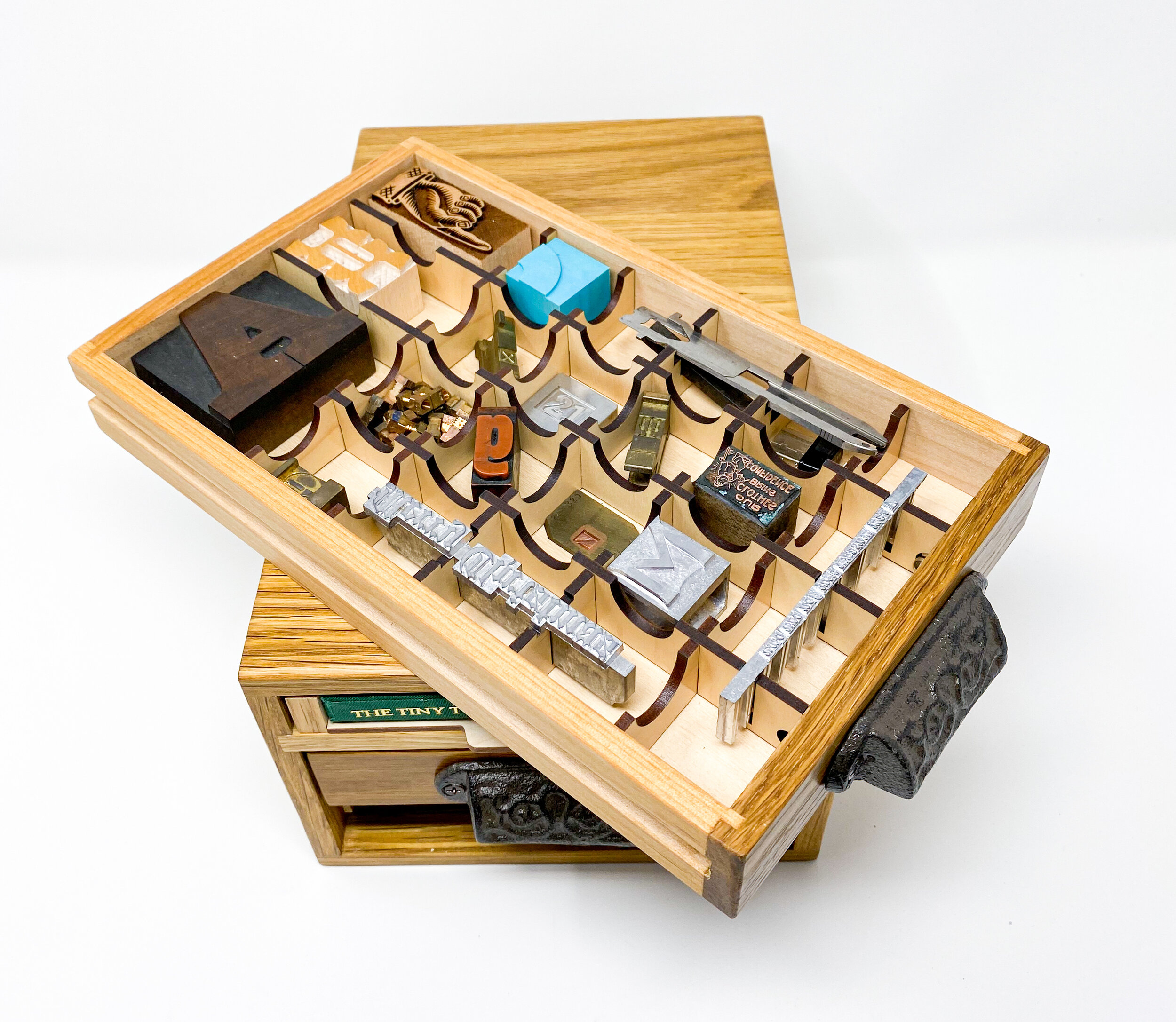
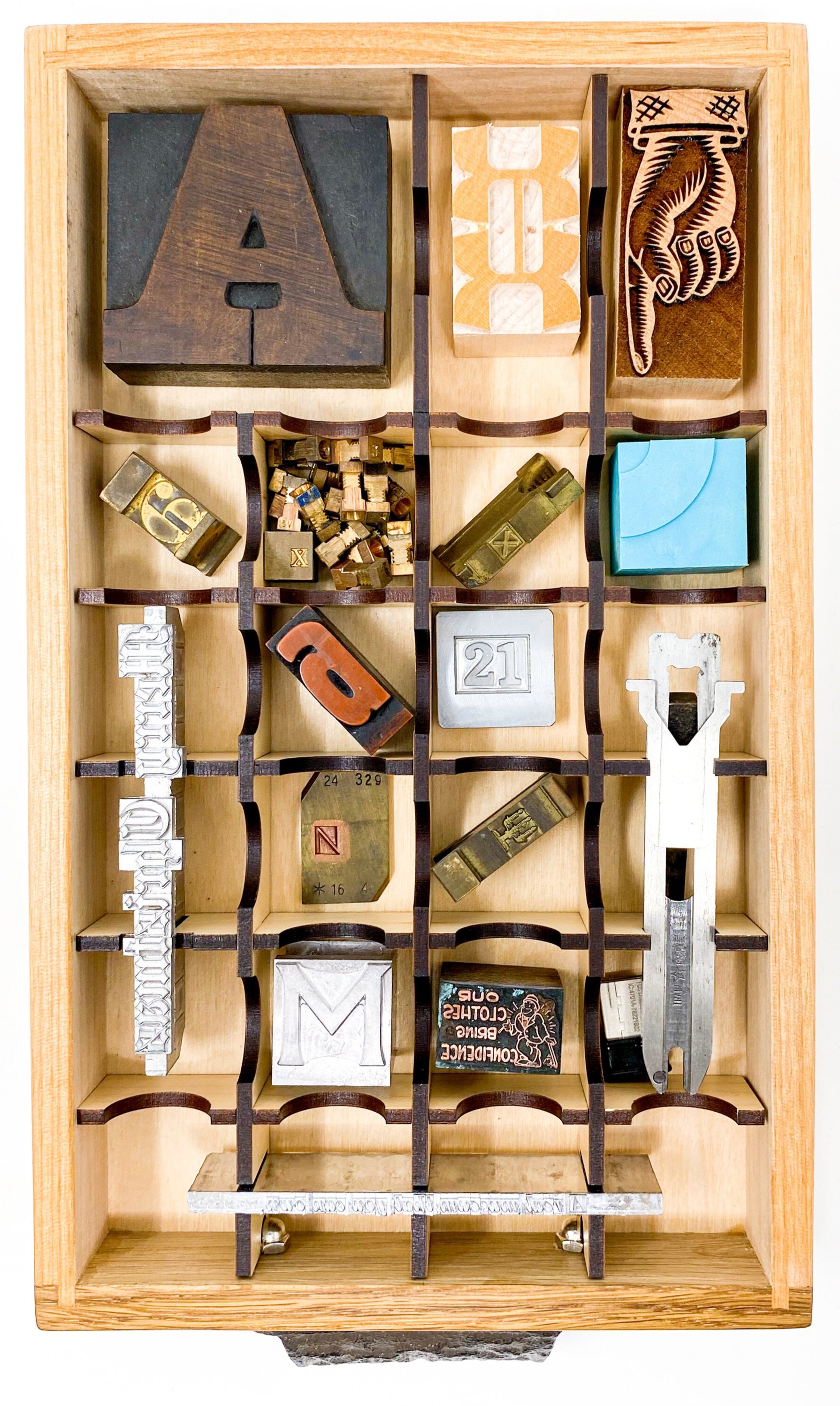
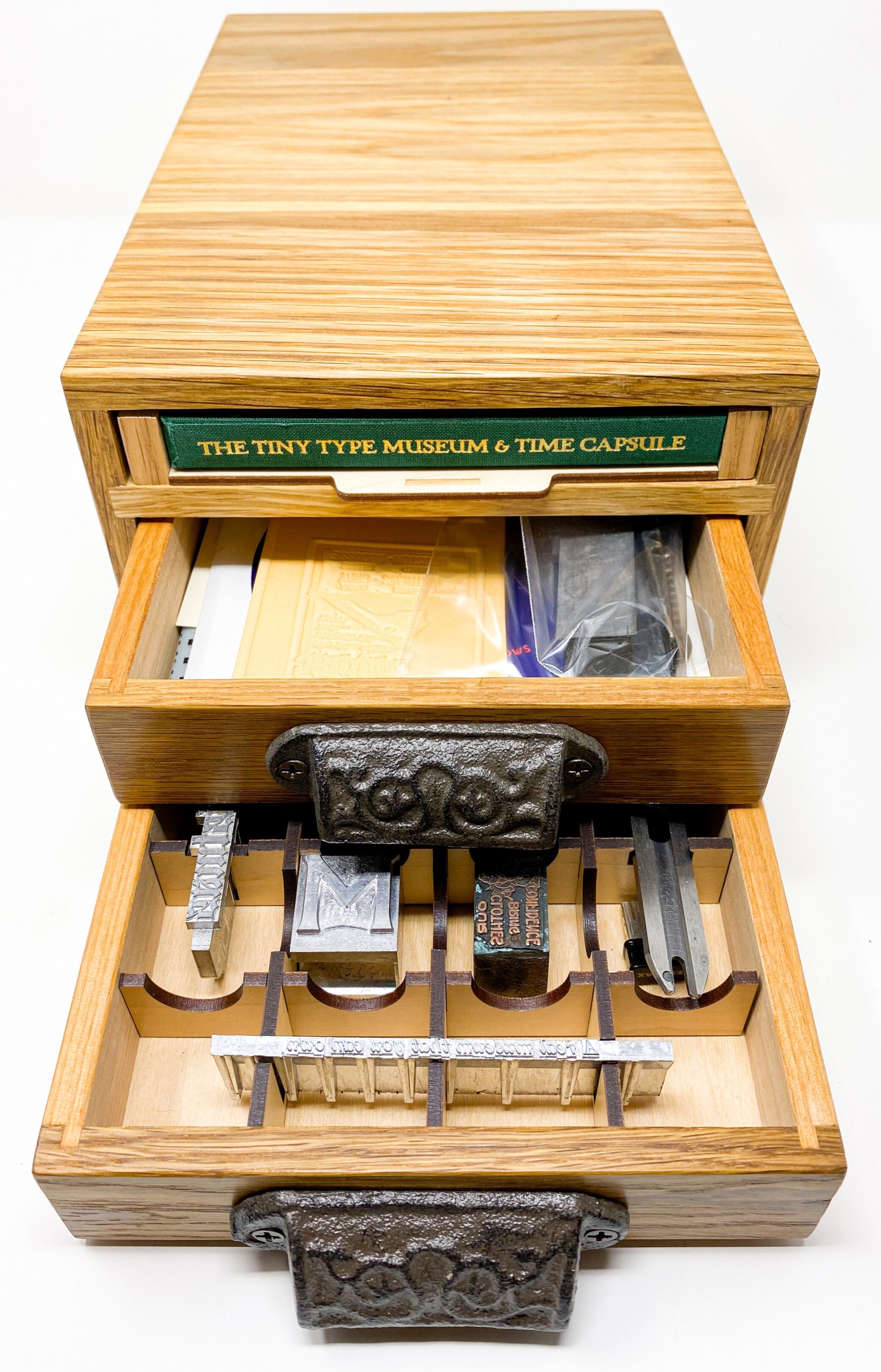
On 29 January 2019, I launched the biggest artistic, writing, production, and commercial project of my life: the Tiny Type Museum & Time Capsule. Conceived of months before with Anna Peterson (formerly Robinson), who provided the woodworking expertise and case manufacturing, I envisioned the Tiny Type Museum as a way for people with an interest in type, typography, or printing to obtain a collection of actual artifacts, historical and modern, that they could use to educate themselves, share with others, or use as a teaching tool. We would make about 100 of these museums, each containing their own unique set of dozens of items.

I talked to a number of people I knew in the letterpress and museum world to get their take on whether this was an interesting idea and to be sure I could acquire the stuff I needed. I felt positive enough to move forward. In addition

History

My God, It’s Full of Stars

Have you ever wondered what the stars, dots, daggers, or other marks on the top of the front page and section fronts in most newspapers mean? Have you ever noticed them? Now you won’t be able to! I wrote an exhaustive article about editions, or the different versions of a newspaper that may appear across an average day. When two to three times as many newspapers were printed each day—and about 20 to 50 more people were employed on the news and production sides—big papers might produce as many as ten editions each day. This tradition hasn’t disappeared. You can read the whole article at my Patreon site.

  Group of newsies selling in front of South Station, Boston;    photo by Lewis Wickes Hines   ; 23 January 1917
Group of newsies selling in front of South Station, Boston; photo by Lewis Wickes Hines ; 23 January 1917
Monotype Electro Type Matrix: 3D Model and 3D Print

Print

Monotype Electro Type Matrix: 3D Model and 3D Print

My latest Kickstarter project to celebrate printing history and ensure knowledge of the past continues to be remembered in the future is now up: the Monotype Electro Type Matrix: 3D Model and 3D Print aims to create a detailed 3D model of a historic kind of type mold used to make metal type for hand setting, and then produce 3D prints from it. The project will model a single matrix as a base form, and then I will distribute the digital file under a broad Creative Commons license to allow others to build upon it. (Backers get exclusive rights to the model for the first six months, then I’ll re-release under the expansive license.)

Monotype created this kind of matrix, the term for a mold in the printing world, to compete in the large-scale production of type larger than its first market, the smaller sizes used for runs of

Books

Guten…Iceberg?

The publisher Taschen, known for its art and photo books, had a massive sale recently. That included discounting its facsimile copy of the Gutenberg Bible that’s in Göttingen, Germany—considered one of the best-condition and decorated ones on vellum, or calfskin—edited by Stephan Füssel, the director of the Institute for Book Studies at the Johannes Gutenberg University in Mainz. Normally $150, the sale dropped it to $60—plus $10 shipping, a bargain for a sixteen pound (7.25 kg) book!

It’s slightly smaller than the original 42-line Bible that paved the way for all European printing that followed and eventually printing worldwide. I was just coming off an intensive week-long class studying the context of what’s called “B42” with two fantastic instructors: Elizabeth Savage, a scholar based in London of early printed works, and author of (among other works) Early Colour Printing: German Renaissance Woodcuts at

A Historic Bit of Peanuts

Cartooning

A Historic Bit of Peanuts

 Charlie Brown, you blockprint head!
Charlie Brown, you blockprint head!

Support from patrons at my Patreon site makes it possible for me to write articles like this, produce podcast episodes, and create other work that I can make available to everyone. Consider becoming a patron, and receive special rewards, exclusive articles, and writing that appears first for patrons.

Updated 16 July 2021: Added a scan of a copy of the printed strip as it appeared in a newspaper that I purchased off eBay.

As regular readers of this blog know, I love flong. (If you don’t know, here’s an introduction and a history.) I’m always on the lookout for unique flongs that help illustrate aspects of printing history. Despite likely 99.999% of all flongs being burned or discarded after use or because they were remade due to errors, judging by eBay and other sources, a substantial number survive. And, clearly, some

Books

New Books; Museums Nearly Sold Out

I’ve written two major updates to ebooks in the last few weeks to reflect some big changes Apple has made to products and services.

Take Control of Your M-Series Mac is now at version 1.1 to encompass the release of 24-inch M1-based iMacs, more information and some changes to the startup and recovery processes, the release of Big Sur 11.3 (which has its own set of changes), and the release of Parallels Desktop 16.5 for macOS, which allows running a pre-release version of Windows for ARM processors.


I’ve also revised Take Control of iOS & iPadOS Privacy and Security to version 1.1 to cover a number of changes made over the last few months that have culminated with:

  • Apple’s roll out of iOS 14.5/iPadOS 14.5, which includes App Tracking Transparency. That changes requires new and newly updated apps to disclose

Podcasting

Rebooting the Tiny Typecast

Last year, I posted five episodes of a new podcast about type and printing history, past and present. It covered pure history (studying the past), how the history influences the present, and how we’re legitimately making history. Between pandemic and Tiny Type Museums and other work, I pressed pause, but restarted the series in March. Three episodes are now out, and another eight are either recorded or scheduled. The plan is to release episodes every other week at least through July, and likely into the fall.

Subscribe to the podcast feed directly via this link, via iTunes, or in any podcasting app.

The three episodes in 2021 so far are:

  • Jim Moran, the master printer and collections officer at the Hamilton Wood Type & Printing Museum in Two Rivers, Wisconsin (iTunes, podcast post)
  • Briar Levit, book designer, author, filmmaker, design teacher, and former art director of Bitch magazine; director

Podcasting

Amy Redmond & Jenny Wilkson on Letterpress, Community, and Injecting New Life (the Tiny Typecast)

The latest episode of my new podcast, the Tiny Typecast, is out. This one features my mentor, Jenny Wilkson, who started the letterpress program at the School of Visual Concepts in Seattle, and Amy Redmond, an artist and designer who is a valued and long-time member of the local printing community. They are buddies, as you can tell from the podcast.

Listen to this episode by subscribing or downloading via Apple Podcasts, search for “tiny typecast” in your favorite podcasting app, or use this subscription URL to add it directly. You can also listen via the episode page.

I get them to talk about what led them into letterpress, which is a fascinating subject for people who are younger than, say, 70 years old. Both started relatively early in their careers and have spent much of their adult lives working in the medium and teaching it to others. Both love

Letterpress, TYPE, and Printing Articles

History

Letterpress, TYPE, and Printing Articles

 The heading type for the  Economist  article uses Albertus, of course. (A piece of Albertus type will be in every one of the  Tiny Type Museum & Time Capsules  I’m currently producing.)
The heading type for the Economist article uses Albertus, of course. (A piece of Albertus type will be in every one of the Tiny Type Museum & Time Capsules I’m currently producing.)

Before you ask, no, I didn’t write that Economist article about letterpress, titled “How the world’s old printing presses are being brought back to life”! It’s a magnificent piece, focusing on The Type Archive in London, explaining how Monotype hot-metal composition works, and bringing in some excellent insights from Japan. It was written by a senior Economist editor, and it’s such a solid account of the subject and so good for a general audience without specialized design or letterpress knowledge. It’s even headed in hot-metal Albertus, a typeface I love dearly, and the history of which is well represented at the Type Archive.

 Toshi Omagari holding an Albertus Monotype Super Caster matrix at The Type Archive in 2017.
Toshi Omagari holding an Albertus Monotype Super Caster matrix at

Print

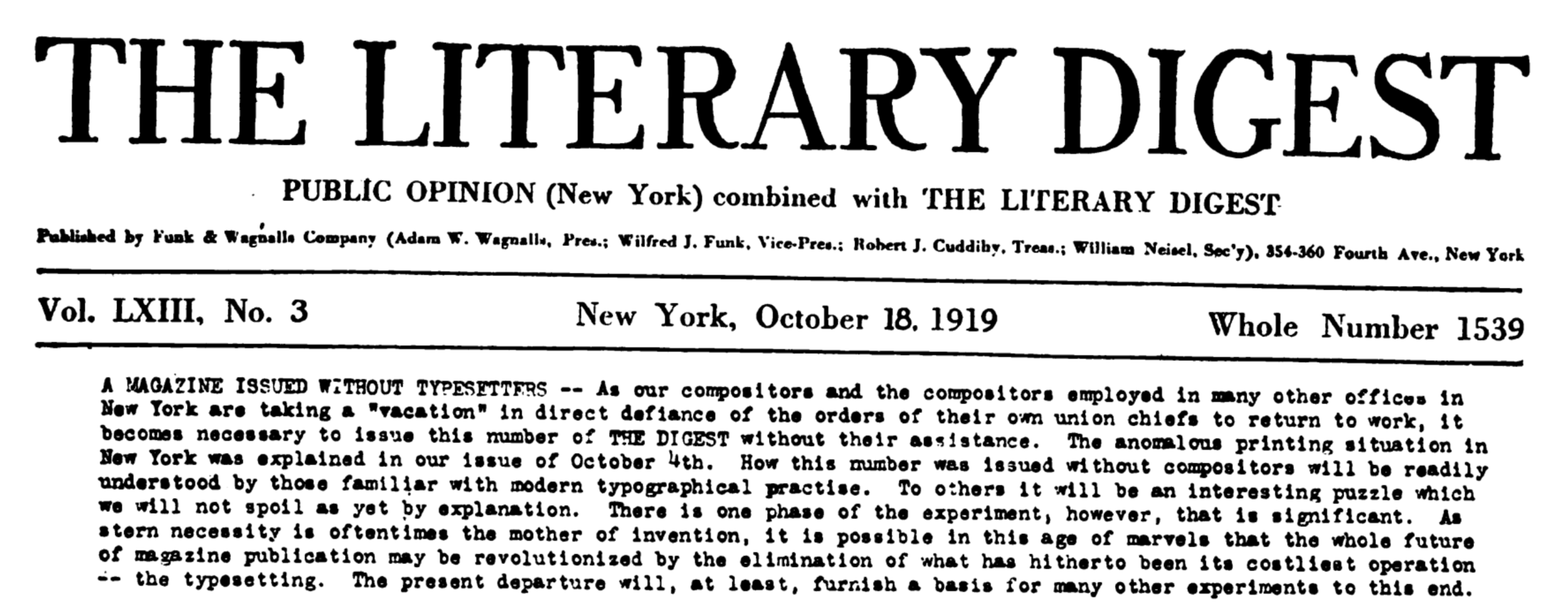
The Typewriter Is Not a Typesetter: the 1919 Magazine Strike in New York

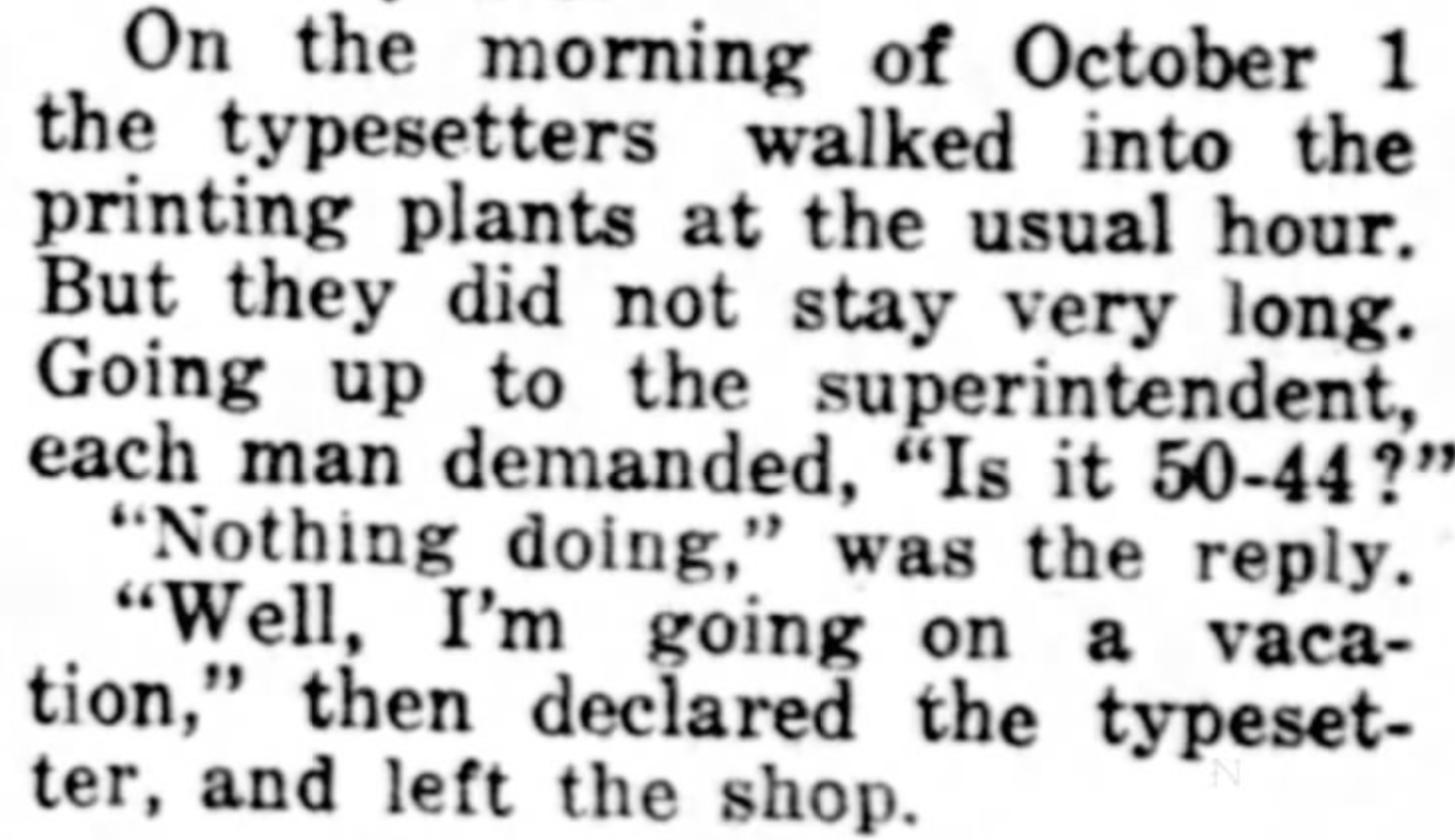
On October 1, 1919, typesetters and printers at job shops in New York said they were taking a “vacation” and walked off the job. This wildcat strike hit dozens upon dozens of magazines, which largely relied on job typesetting, as opposed to newspapers who had composition in house. The international unions didn’t authorize a strike, but “Big Six,” a powerful New York typographers’ local, found a way to cause one in effect.

The reason? These printing plant employees wanted a $50 wage for a 44-hour week, up for $36 for 48 hours—“50–44” was the slogan.

Publishers were aghast, but some thought they had a plan: Replace typesetting with typewriting! It worked, to a degree, but publishers and anti-union advocates promoted the method as a way to replace typesetters and break an effective monopoly. That didn’t happen.

At my Patreon site, I just published a 5,000-word