Glog

Print

Letterpress, TYPE, and Printing Articles

History

Letterpress, TYPE, and Printing Articles

 The heading type for the  Economist  article uses Albertus, of course. (A piece of Albertus type will be in every one of the  Tiny Type Museum & Time Capsules  I’m currently producing.)
The heading type for the Economist article uses Albertus, of course. (A piece of Albertus type will be in every one of the Tiny Type Museum & Time Capsules I’m currently producing.)

Before you ask, no, I didn’t write that Economist article about letterpress, titled “How the world’s old printing presses are being brought back to life”! It’s a magnificent piece, focusing on The Type Archive in London, explaining how Monotype hot-metal composition works, and bringing in some excellent insights from Japan. It was written by a senior Economist editor, and it’s such a solid account of the subject and so good for a general audience without specialized design or letterpress knowledge. It’s even headed in hot-metal Albertus, a typeface I love dearly, and the history of which is well represented at the Type Archive.
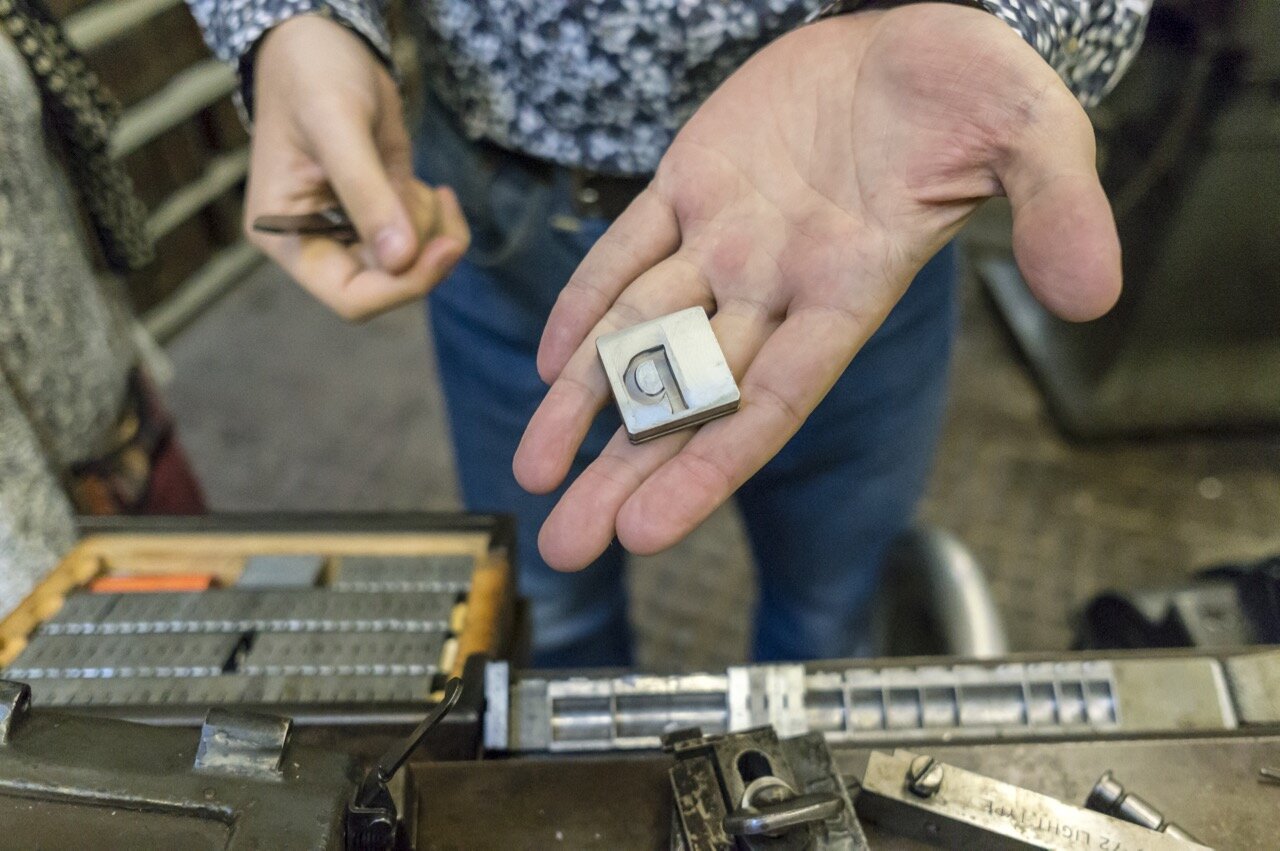
 Toshi Omagari holding an Albertus Monotype Super Caster matrix at The Type Archive in 2017.
Toshi Omagari holding an Albertus Monotype Super Caster matrix at

Print

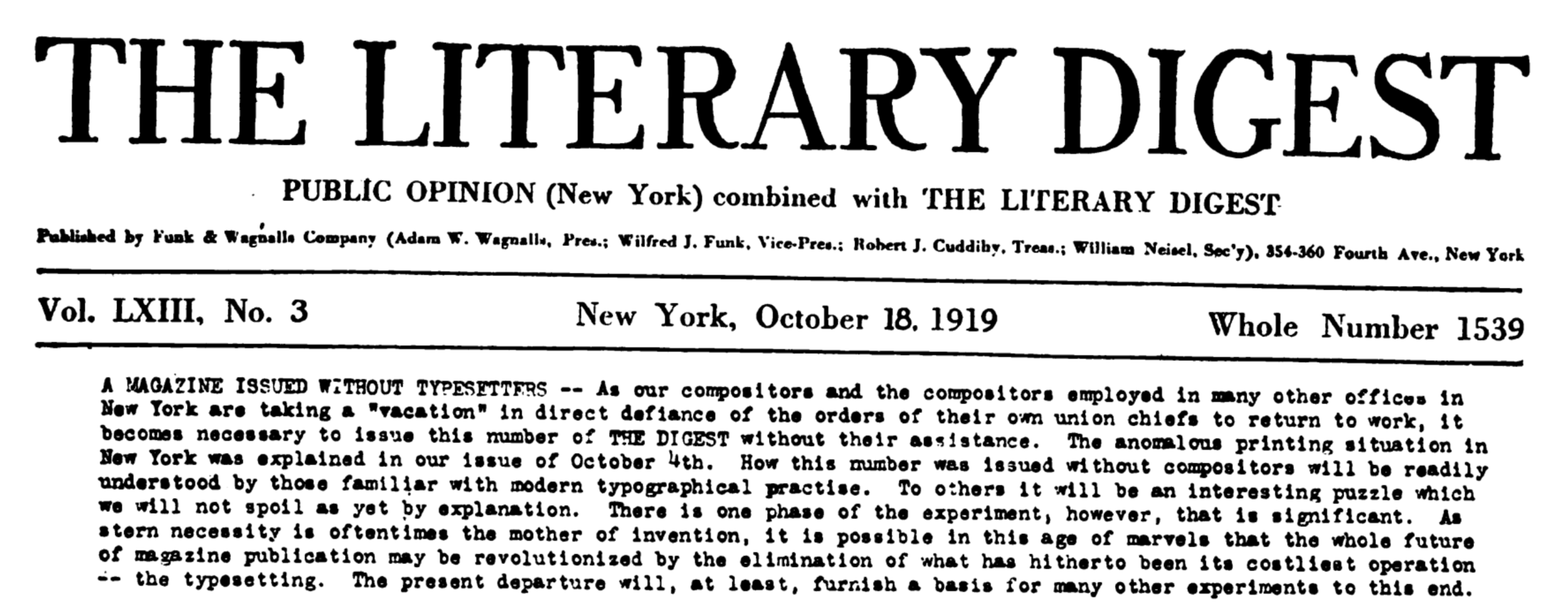
The Typewriter Is Not a Typesetter: the 1919 Magazine Strike in New York

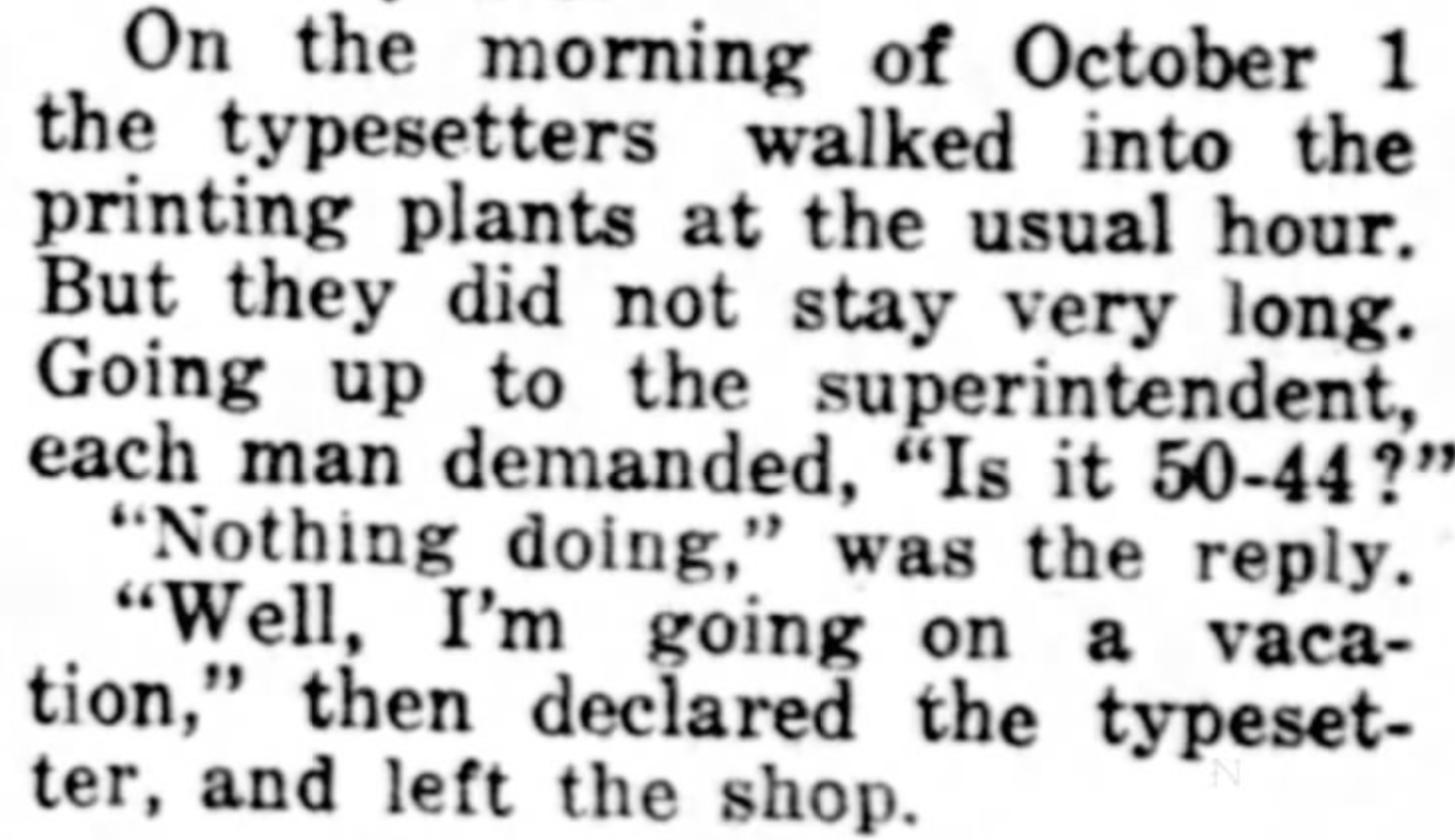
On October 1, 1919, typesetters and printers at job shops in New York said they were taking a “vacation” and walked off the job. This wildcat strike hit dozens upon dozens of magazines, which largely relied on job typesetting, as opposed to newspapers who had composition in house. The international unions didn’t authorize a strike, but “Big Six,” a powerful New York typographers’ local, found a way to cause one in effect.

The reason? These printing plant employees wanted a $50 wage for a 44-hour week, up for $36 for 48 hours—“50–44” was the slogan.

Publishers were aghast, but some thought they had a plan: Replace typesetting with typewriting! It worked, to a degree, but publishers and anti-union advocates promoted the method as a way to replace typesetters and break an effective monopoly. That didn’t happen.

At my Patreon site, I just published a 5,000-word

Books

Ebook out for Six Centuries of Type & Printing

The ebook edition of Six Centuries of Type & Printing is now out and available for purchase! The letterpress edition is moving towards hot-metal composition and printing in the near future. You can pre-order a bundle of the print and ebook editions, and receive the ebook edition right now.

What’s the book about? If you ever wondered how the craft of printing was invented and how it evolved, this book answers that question and many others. Starting with Gutenberg, Six Centuries of Type and Printing traces the development of type design, type manufacture, presses, and printing through the present digital era with many stops along the way. The book explains how many aspects of printing and type remain the same, despite a shift from metal to photography to bits, across almost six centuries of constant improvement.

The book download is a bundle of three formats: PDF, EPUB, and MOBI

History

A Type History Talk Featuring the Tiny Type Museum

I was in San Francisco in early June, and the Grabhorn Institute invited me to give a short talk in their gallery about type history and the Tiny Type Museum & Time Capsule. The institute preserves the practical history of type casting and fine-art printing by perpetuating it, fulfilling orders from letterpress printers and producing new books, while running an apprenticeship program, regular tours, and inviting speakers (like me!).

Design

Live Podcast Taping at Ada’s on January 23: Life of a Letterpress Printer

Join me January 23 from 6:30 to 8:30 as I host an episode of his podcast The New Disruptors live at Ada's Technical Books and Café in Seattle with three letterpress printers as guests to talk about making some or all of their living in the 21st century by working in the past with techniques, equipment, and type that date as far back as the 19th century and earlier.

My panel discussion features Demian Johnston, Sarah Kulfan, and Amy Redmond, and we’ll talk about their work and practices, and how they make the past mesh with the present, especially at a time when authenticity is highly prized. The event will end with a Q&A and informal discussion. The printers and I will have some of their work on hand and available for purchase. (Note that this live event will be taped for later online audio

Letterpress Books Available (Limited)

Print

Letterpress Books Available (Limited)

Folks, last year I printed by letterpress a 64-page book that contained six reported articles on typography, printing, and language I’d written in the previous couple of years. This was part of my design residency at the School of Visual Concepts. Every page in the book was painstakingly printed by hand. You can watch a time-lapse video of me printing.

To fund the costs of this project, I ran a Kickstarter campaign that offered a numbered edition of 100 copies to backers. It was a great reciprocity: the project I wanted to create would produce books that funded the project! That edition was bound by Jules Faye, and I’ve just finished sending out the edition of 100 to those backers.

I have a limited number of additional copies of this book that are essentially identical, and will be marked as author’s proofs in the colophon instead of

Print

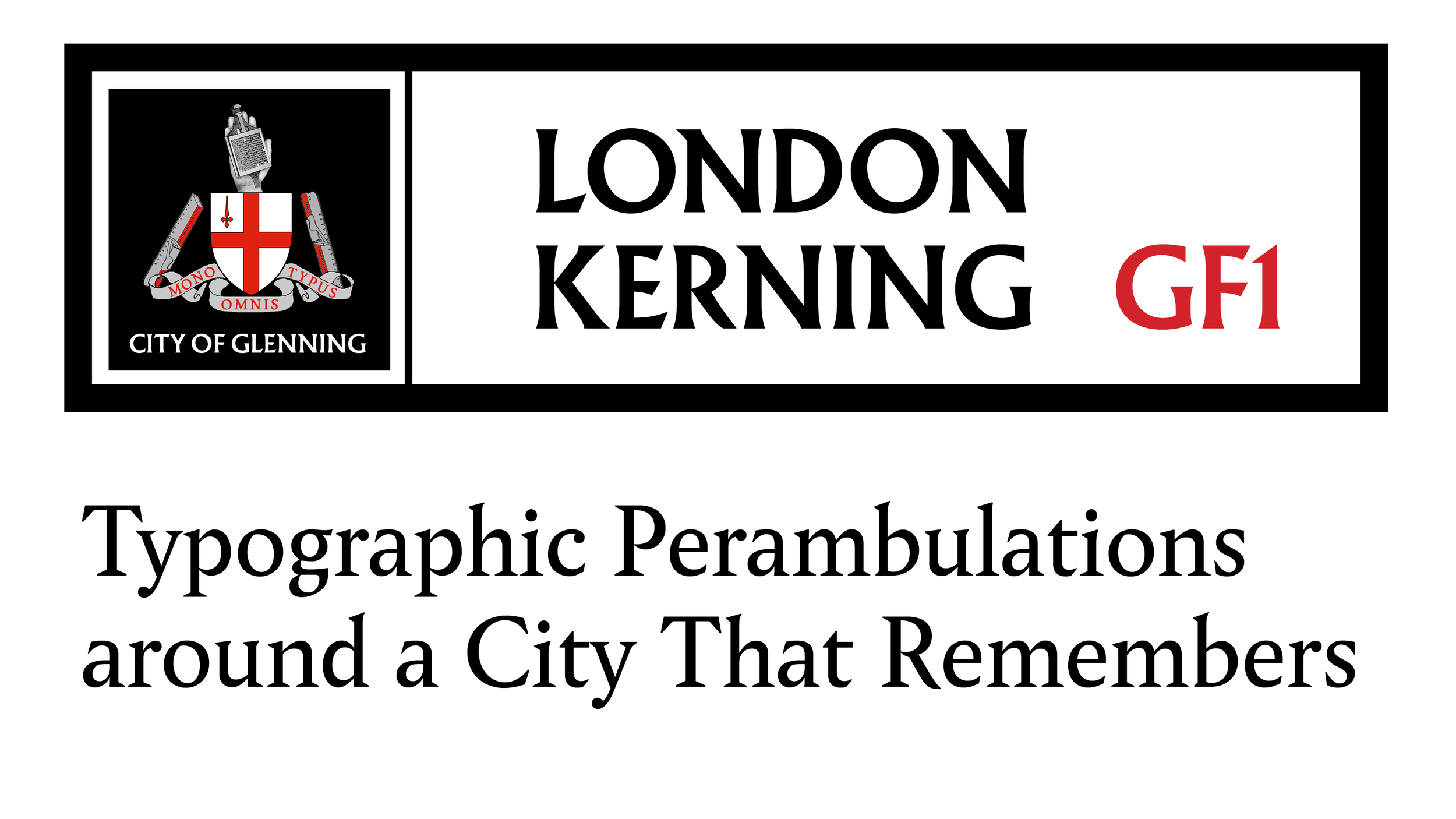
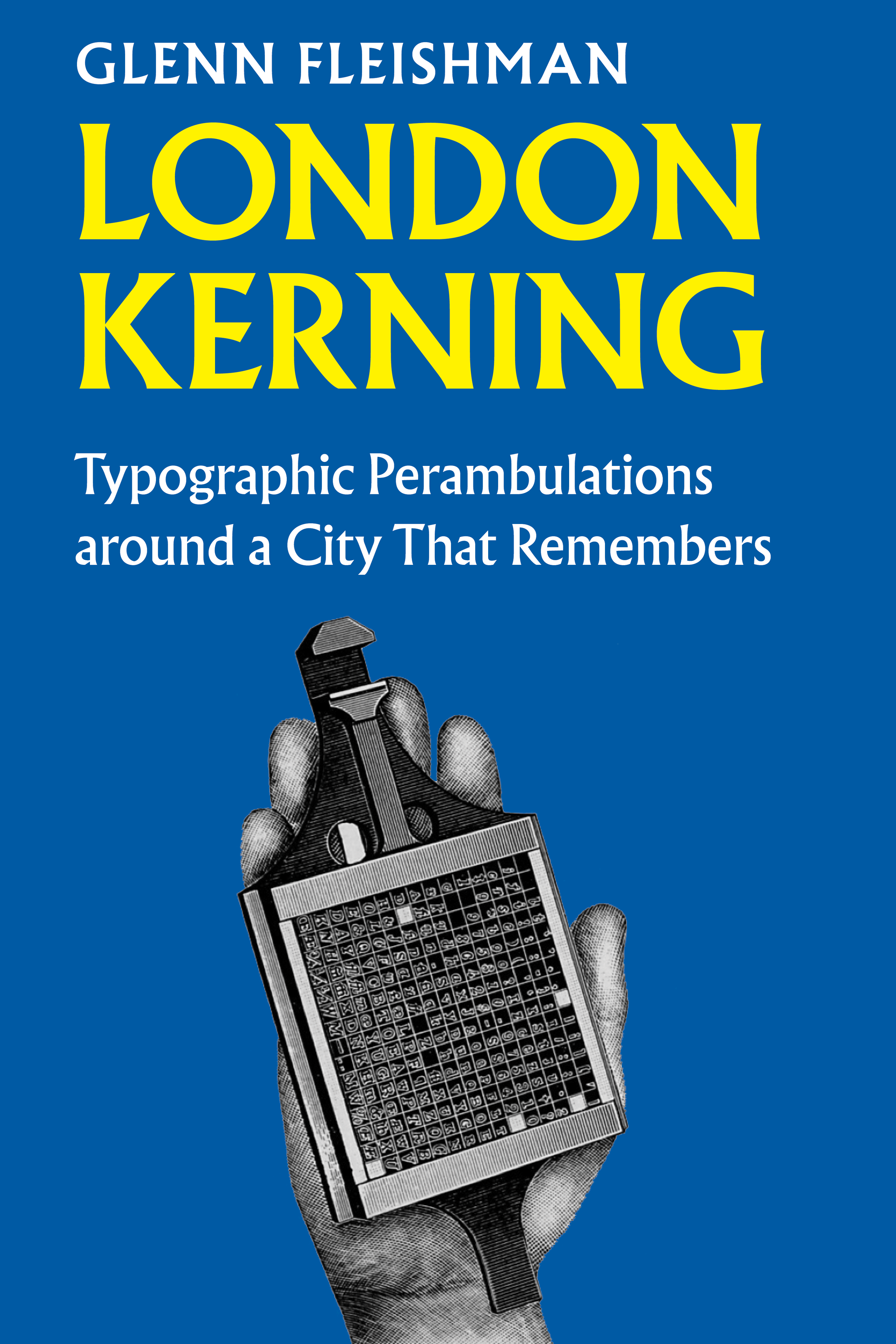
London Kerning now available!

If you recall that last November, I went to London for a week and researched the heck out of 19th and 20th century printing history, visited archives and museums, and met with a bunch of people to write a book? The ebook version of London Kerning: Typographic Perambulations around a City That Remembers is now out! You can purchase a copy for $5. It’s 76 pages long and heavily illustrated with photographs I took along the way.

The print edition started shipping in early March, and almost immediately sold out, but you can order copies from a second printing that ships in early April 2018. Order the print book here.

You can read more about the book, download an excerpt, or read the introduction.

And see two sample page spreads from the book below.

Print

Chromatic Type

I've posted my first patron-exclusive item at Patreon, where you can help directly support by work by pledging as little as $1 a month (you cancel at any time). Here's the start of the post:

When we think of the past, we often imagine it in black and white. Seeing early color photos or ones that have been realistically colored often jars the way we perceive historic events. The same is true with type and printed works of the past. We think of 19th century and earlier letterpress-printed works as being largely in a single color, and that color is black, sometimes with accents in a second color. Occasionally we’ll see a fancy example of multi-colored printing, but it stands out from that period. Any full-color images typically would have been printed by lithography and added later (“tipped in”) on blank pages reserved for the purposes.

But type could

Journalism

New book on typography, language, and printing!

I’ve got a new book out! It’s a collection of 10 researched and reported articles I’ve written over the last two years about the history of punctuation, the future of letterpress, and much more.

The first six chapters are part of the letterpress book I printed this year, and the book was one of the items I committed to make as part of that project. You can download an excerpt that contains a full chapter.

It’s 116 pages long and comes as a bundle of PDF, EPUB, and MOBI. Get your copy here!

Here’s what’s in the book:

  • Nothing Is Lacking: The earliest uses of marking a page as intentionally leaving something out.
  • CAPITAL CRIMES: Why we SHOUT with UPPERCASE. (Included in excerpt.)
  • The Ten-Millennium Safe: A web site plans for the far future.
  • The Quibble with Online Quotes: Will the Internet kill off

Print

Erik Spiekermann invents digital letterpress

You might know Erik Spiekermann from his prolific work in advertising, as a graphic designer, as a typographer, or as a writer. Now he's a letterpress printer. He’s put a year and €150,000 euros ($180,000) into creating a streamlined process to go from digital to letterpress. His method may sound familiar: I did something similar to print my book this summer. But Erik and his colleagues have taken this several levels further. Here’s my write-up at Medium about how he’s making a deep impression.

Journalism

Micro-Project: Kickstarter for London Kerning

Because of a great intersection of timing, I’m traveling to London in late November to view a rare exhibition and meet with a number of type designers and folks involved in letterpress, as well as visit public and private collections, and roam the streets, which are rampant with classic and modern type usages. I’m turning this experience into a small book I want to share with you.

I’ve launched a campaign on Kickstarter to help cover my expenses in travel and research, and to design and create digitally printed and ebook editions. As a freelancer, it’s difficult to fund travel and research, which is why I’m turning to you. I’ll be making a short but terrific book that anyone who has an interest in design history and its preservation will enjoy, but you’ll also get a snapshot of the contemporary scene.

 Mockup of the book cover
Mockup of

Print

A photoshoot on letterpress, a workshop on cut letters, and a Whitman print

Three pieces of printing news.

My friend Jeff Carlson came in to take pictures for his own interest on the first day I started in on printing my book by letterpress in June and then returned on one of the final days. He worked this up into a photo essay that ran at Adobe Create! It was a great pleasure to be photographed by him, as he’s a very fine artist, and neat to be in this feature. It’s really a nice look at aspects of letterpress and the studio in which I’m printing (at the School of Visual Concepts/SVC).

  Photo by Jeff Carlson
Photo by Jeff Carlson

Jenny Wilkson, SVC’s letterpress program head, and I will teach a one-day workshop that explores laser cutting and engraving and letterpress on November 11. The title? “Frikkin Lasers: Letterpress Printing with Laser-Cut Media.”

 Letters being cut on a Glowforge.
Letters being cut on a Glowforge.

Finally, if