Glog

Latest

A Visit to Letterform Archive (The Tiny Typecast)

podcast

A Visit to Letterform Archive (The Tiny Typecast)

 From left to right: Stephen Coles, Amelia Grounds, and Rob Saunders
From left to right: Stephen Coles, Amelia Grounds, and Rob Saunders

The long-delayed debut of the Tiny Typecast is here! Last year, I recorded four episodes for this podcast notion. My focus on keeping the Tiny Type Museum & Time Capsule moving along kept me from pulling the episodes together. But I’m glad to say with the majority of museums on the verge of shipping (in late March), I’ve finally been able to knuckle down.

Subscribe to the podcast via Apple Podcasts or through your favorite podcasting app via its directory or this podcast URL.

This first episode is an interview with three key people at Letterform Archive, a remarkable institution in San Francisco that preserves the history of design as a tool of communication. I spoke with founder and executive director Rob Saunders, associate curator and editorial director Stephen Coles, and then librarian Amelia Grounds. (She has

general

Update about the State of Progress

I posted a long update on Kickstarter that anyone can read (not just Kickstarter backers) about the current state of the Tiny Type Museum & Time Capsule. Anna Robinson will be delivering 80 completed cases to me in about two to three weeks. The books are about to go on press and thence to the binder. The last artifacts have arrived. I have a number of additional boxes to check towards completion, but shipping by January 31 remains highly likely for the first 80 backers and pre-orderers.

Because some people are paying for museums in installments, a few orders placed by the end of January will be shipped as part of the first batch. However, the official shipping date for orders placed today is no later than July 2020. I hope to deliver those as early as April or May, but out of the same prudence in setting a schedule

book

Book in Galleys, Book Production Dates, Initial Slugs Set

Imagine my excitement on returning from the Hamilton Wood Type & Printing Museum’s annual shindig, the Hamilton Wayzgoose (photos here), where I gave a talk about how London institutions preserve type and printing history, to photos of the metal type galleys for Six Centuries of Type & Printing.

 Photo of a galley proof from Effra Press by Nick Gill.
Photo of a galley proof from Effra Press by Nick Gill.

As the book is being set in England, I’m receiving photos instead of actual proofs—the cost is prohibitive and not very sensible to get paper copies. I reviewed the proofs digitally, in any case. A vanishingly few errors need to be corrected, some resulted from the usual vagaries of type being cast rapidly on ancient but well-maintained equipment, and a few last-minute typos of my own.

Because my own timeline on the book’s writing ran late, everything else has shifted back and I’ve pushed compositor, printer,

accessions

Woodn’t It Be Nice?

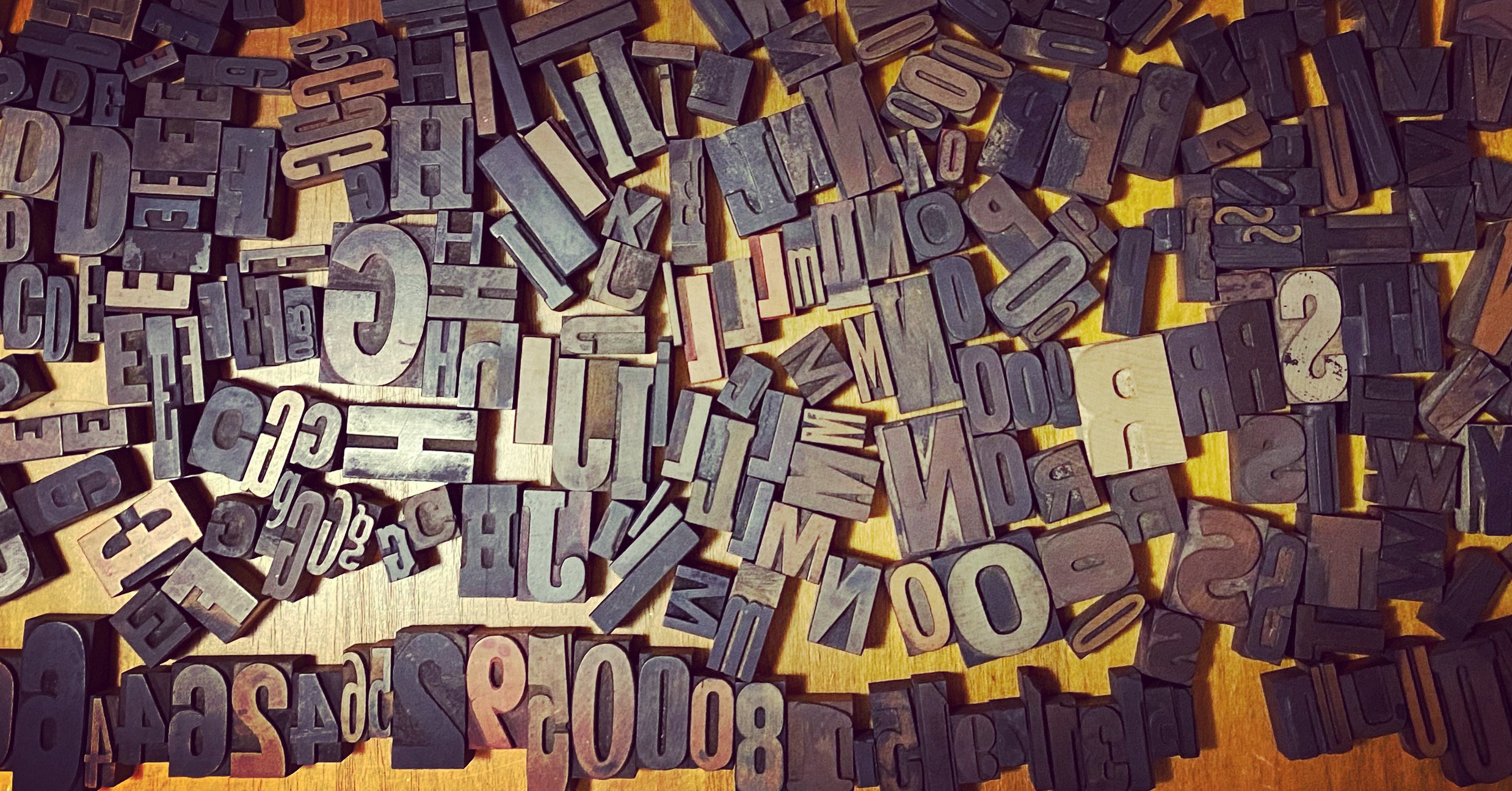
A key aspect of printing history is the development and evolution of wood printing type. It’s a reason why every Tiny Type Museum & Time Capsule will have at least three kinds of wood type included.

Some wood type background

There’s a strong suspicion and good historical evidence that the earliest printing, at least 1,000 years before Gutenberg, involved entire pages carved in wood in China and elsewhere in Asia, and later movable wooden letter blocks.

However, logographic languages like Chinese, Japanese, and Korean had a significant bit of overhead: often at least thousands of unique characters are required for a book of any length. The diversity of logographs in the language overcame the benefits of movable type versus carving entire pages for wood-block printing. Gutenberg may have been a genius, but he had the advantage of requiring roughly 23 characters for Latin and German with some

general

When Doves Cry and Four Films

I’m happy to note five digital accessions to the Tiny Type Museum & Time Capsule. While the museums are largely focused on analog items, there are five digital items that I’ve arranged to include for their historic and informative value. A USB stick included in the museum will contain this items along with a number of public-domain films and books useful for further study.

A Tale of Betrayal and a Watery Type Grave

Robert Green became mildly obsessed with the beauty of the type cut for the Doves Press starting in 1899 and used for all its works. A many of many talents—a graphic designer, book restorer, type designer, and more, who received his master’s from the Royal College of Art—he wanted to take this extraordinary type and produce a digital version authentic to its roots.

The type is legendary, because of a dispute between

plates

How the Book Is Set

You might be interested to know how the book for this project, Six Centuries of Type & Printing, is being composed in hot metal. It’s an interesting interleaved journey of analog and digital. I had planned from the start for the book to be printed by letterpress, but set a stretch goal on the Kickstarter campaign to also have it typeset using Monotype hot-metal composition. That stretch goal was nearly met, so I went with it, and the sales of museums and books since then more than covered the additional expense. (Photopolymer would have been the alternative, but that isn’t necessarily cheaper. It has a streamlined design-to-production workflow, reducing labor and some printing costs. Read up on these rubbery plates in my article on Erik Spiekermann.)

[ You can pre-order a copy of the print book and the ebook ]

There are a reasonable number of people and companies around

printing history

Latest Accessions and Book Update

It’s past the midway point in summer, and my basement is full of lead and wood and books. Most of the items for the museum have now been acquired, arranged for, or are being made by various people. I have a few more special things to find and to order—some of those I want to wait a little longer, as they can be turned around quickly and I can refine my decisions. I’ll soon have samples of Linotype slugs (actually made on an Intertype, a competitor to Linotype after patents expired).

Two kinds of matrices—the molds from which metal type was made—that I’d really wanted to include in the museum recently arrived. One set is for Ludlow, a fairly simple kind of slug-casting machine designed for larger-sized type, typically employed in newspaper work. However, I believe one was in use still until 1990 at

museum case

Case Construction Starts

With the start of summer, it’s also the start of construction of the museum cases for the Tiny Type Museum & Time Capsule. Anna Robinson, the designer and woodworking artist, ordered the wood (white oak), reserved shop space, and has started milling, cutting, piecing, rabbiting, biscuiting, joining, and all the rest. She’s been sending me photos as it progresses.

When I first envisioned this project, it was over appetizers with Anna, as we sorted out a vague idea I had about making type history into something people could hold. It was natural to develop the concept and the case with her, as she pursues a certificate in cabinetry at a remarkable local school, building on her existing woodworking and laser-cutting skills honed over years.

Now owning some type that’s 150 years old and visiting archives with material dating back centuries yet remaining in working form, an intent

accessions

A Host of New Accessions, a Trip, and More

Since the last update a few weeks ago, material has been arriving in abundance for the Tiny Type Museum & Time Capsule. I expect by the end of the project to have collected around 5,000 individual items, which will then be mostly distributed into up to 100 museums. In some cases, I’ll wind up with a lot of material left over because of how it has to be purchased, and that may lead to future sets of different kinds.

(An update on orders: 70 tiny museums have now been pledged on Kickstarter or pre-ordered since. Only 30 remain available, as I plan the edition to be no more than 100 museums.)

San Francisco Type & Archives

Early in the month, I took a trip to San Francisco, to visit the Grabhorn Institute (home of M&H Type and the Arion Press) for an upcoming article for a

printing history

A Talk on Type History Featuring the Tiny Type Museum

I was in San Francisco in early June, and the Grabhorn Institute invited me to give a short talk in their gallery about type history and the Tiny Type Museum & Time Capsule. The institute preserves the practical history of type casting and fine-art printing by perpetuating it, fulfilling orders from letterpress printers and producing new books, while running an apprenticeship program, regular tours, and inviting speakers (like me!).

printing history

The South Bend Malleable Range

While most of what I acquire for this project is intended to go into individual Tiny Type Museum & Time Capsules, as I noted in previous posts, I’m also trying to assemble a small study collection as I write about and provide context to printing history. That led to me purchasing a copper plate with an etching of an ad for South Bend Malleable Range products.

 A copper etching made photographically from an original drawing, c. 1917
A copper etching made photographically from an original drawing, c. 1917

When I saw the plate listed on eBay, I searched to find its era—its provenance is unknown, and the plate has a hook as it were hung on someone’s wall. I quickly found that this ad had run around 1918, making the plate over a century old. The mounting was clearly done after printing, because it’s not type high, which is 0.918 inches. Instead, the raised portion is

Quoins, Wood Type, and Phototype

printing history

Quoins, Wood Type, and Phototype

The latest accessions to the Tiny Type Museum & Time Capsule have arrived!

Quoins and Quoin Keys

From the earliest days of printing, certainly in Gutenberg’s studio, type had to be locked up. You first composed it into lines, columns, and pages, and spaced it just right. But then you had to ensure that it stayed solid and level as it was moved from a composing stone—a level surface that assisted in planing type and other material—to the bed of a press. (For newspaper, it would be into a matrix-making machine en route to stereotyping.)

As you may know generally or from previous posts, a page or pages of type are collected into a forme and  locked into a chase. The locking requires furniture or various sized rectangular pieces of metal and wood to fill on empty areas, and then wedges to lock them into place. A