Glog

printing history

accessions

Woodn’t It Be Nice?

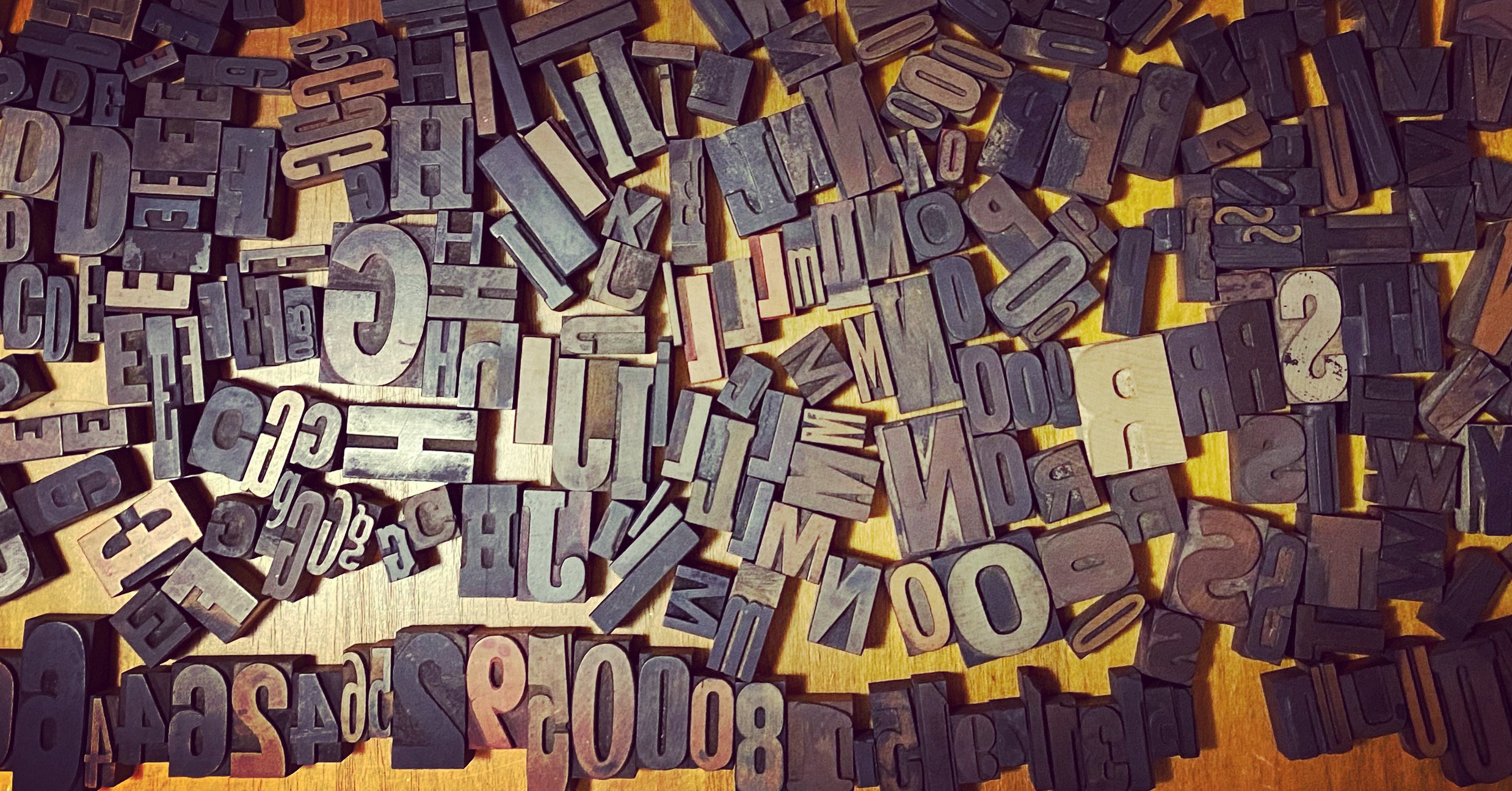
A key aspect of printing history is the development and evolution of wood printing type. It’s a reason why every Tiny Type Museum & Time Capsule will have at least three kinds of wood type included.

Some wood type background

There’s a strong suspicion and good historical evidence that the earliest printing, at least 1,000 years before Gutenberg, involved entire pages carved in wood in China and elsewhere in Asia, and later movable wooden letter blocks.

However, logographic languages like Chinese, Japanese, and Korean had a significant bit of overhead: often at least thousands of unique characters are required for a book of any length. The diversity of logographs in the language overcame the benefits of movable type versus carving entire pages for wood-block printing. Gutenberg may have been a genius, but he had the advantage of requiring roughly 23 characters for Latin and German with some

printing history

Latest Accessions and Book Update

It’s past the midway point in summer, and my basement is full of lead and wood and books. Most of the items for the museum have now been acquired, arranged for, or are being made by various people. I have a few more special things to find and to order—some of those I want to wait a little longer, as they can be turned around quickly and I can refine my decisions. I’ll soon have samples of Linotype slugs (actually made on an Intertype, a competitor to Linotype after patents expired).

Two kinds of matrices—the molds from which metal type was made—that I’d really wanted to include in the museum recently arrived. One set is for Ludlow, a fairly simple kind of slug-casting machine designed for larger-sized type, typically employed in newspaper work. However, I believe one was in use still until 1990 at

accessions

A Host of New Accessions, a Trip, and More

Since the last update a few weeks ago, material has been arriving in abundance for the Tiny Type Museum & Time Capsule. I expect by the end of the project to have collected around 5,000 individual items, which will then be mostly distributed into up to 100 museums. In some cases, I’ll wind up with a lot of material left over because of how it has to be purchased, and that may lead to future sets of different kinds.

(An update on orders: 70 tiny museums have now been pledged on Kickstarter or pre-ordered since. Only 30 remain available, as I plan the edition to be no more than 100 museums.)

San Francisco Type & Archives

Early in the month, I took a trip to San Francisco, to visit the Grabhorn Institute (home of M&H Type and the Arion Press) for an upcoming article for a

printing history

A Talk on Type History Featuring the Tiny Type Museum

I was in San Francisco in early June, and the Grabhorn Institute invited me to give a short talk in their gallery about type history and the Tiny Type Museum & Time Capsule. The institute preserves the practical history of type casting and fine-art printing by perpetuating it, fulfilling orders from letterpress printers and producing new books, while running an apprenticeship program, regular tours, and inviting speakers (like me!).

printing history

The South Bend Malleable Range

While most of what I acquire for this project is intended to go into individual Tiny Type Museum & Time Capsules, as I noted in previous posts, I’m also trying to assemble a small study collection as I write about and provide context to printing history. That led to me purchasing a copper plate with an etching of an ad for South Bend Malleable Range products.

 A copper etching made photographically from an original drawing, c. 1917
A copper etching made photographically from an original drawing, c. 1917

When I saw the plate listed on eBay, I searched to find its era—its provenance is unknown, and the plate has a hook as it were hung on someone’s wall. I quickly found that this ad had run around 1918, making the plate over a century old. The mounting was clearly done after printing, because it’s not type high, which is 0.918 inches. Instead, the raised portion is

Quoins, Wood Type, and Phototype

printing history

Quoins, Wood Type, and Phototype

The latest accessions to the Tiny Type Museum & Time Capsule have arrived!

Quoins and Quoin Keys

From the earliest days of printing, certainly in Gutenberg’s studio, type had to be locked up. You first composed it into lines, columns, and pages, and spaced it just right. But then you had to ensure that it stayed solid and level as it was moved from a composing stone—a level surface that assisted in planing type and other material—to the bed of a press. (For newspaper, it would be into a matrix-making machine en route to stereotyping.)

As you may know generally or from previous posts, a page or pages of type are collected into a forme and  locked into a chase. The locking requires furniture or various sized rectangular pieces of metal and wood to fill on empty areas, and then wedges to lock them into place. A

printing history

Bogus Copy and Baseline Standards

I keep coming across interesting side topics that inform the whole of what I’m writing about in Six Centuries of Type & Printing, the book that will accompany the Tiny Type Museum & Time Capsule, and available for separate purchase in letterpress and ebook editions.

Two recent ones related to “bogus copy” and how type foundries handled baselines. I wound up writing quite a few words about both topics.

Bogus! When Typesetters Were Paid To Set Copy That Was Thrown Away: “Bogus” or “bogus copy” was effectively the result of a mid-1800s conflict between typesetters and management about how to pay for time standing around. Typesetters were paid piecework (by the “em,” as I explain in the article) for well into the 20th century, when hourly and other wages were routine.

But for compositors who were effectively employees, they rejected not being paid when there was no copy to

printing history

Explaining Flong and Stereotypes: How Newspapers Grew in Size and Volume

I’ve been working on this for a while, and finally assembled all the primary sources and material I needed to write it. I explain in some great detail about flongs and stereotypes, a method of effectively duplicating typeset material and engraved images and halftones photographs that was required for rotary presses to make any sense.

A flong is a paper mold made from something that would otherwise be printed on a letterpress (in relief printing). The stereotype is the solid metal cast plate (flat or curved) cast from it. For newspapers and high-volume printing, the curved plate paired with the rotary press, allowing super-fast continuous printing fed from large rolls of continuously made paper.

Making paper in rolls, rotary presses, the Linotype, and the largely forgotten flong/stereotype process together allowed periodicals to expand in size (number of pages) and volume (number of copies per volume). Newspapers benefitted most,

printing history

Type Artifacts, Assemble!

As I pursue all artifacts I’ll need to assemble in quantity for tiny type museums, I’m also gathering unique ones that I can document and use to better understand through first-hand experience and research how they fit into printing history.

In the previous post, I posted pictures of flong sheets I’d acquired for the museums. These paper molds were made from metal, wood, and etchings, and then themselves would be cast into metal for printing.

But sometimes people did odder things, like insulate the side of a house with them or use them to bind a book. While I haven’t been able to find out more about that house, I did purchase an affordable copy of the 1904 book, Fairy Tales Up To Now by Wallace Irwin. To my knowledge, it’s unique in having a binding made of dry flong, which had only been introduced

printing history

Photos of Flong and a Brief History

Every Tiny Type Museum & Time Capsule will have a piece of flong, a kind of letterpress-era mimeograph transfer sheet, only for metal. I haven’t written about flong comprehensively yet, but I’m preparing to, both as a freestanding article and as part of Six Centuries of Type & Printing, the book I’m writing that will be part of the museum project and available separately.

In brief, flong was a paper mold. Perfected in France in the late 1700s and then used increasingly extensively through the 19th century, flong allowed printers to set a portion of page of type and engravings, and press (or beat) a kind of paste-infused paper into the surface. Flong originally was a form of papier-mâché. When dried, the flong could be lifted off and then be used as a mold to create a metal printing plate, known as a stereotype (or, in France,