Glog

Books

Bookselling

A Tense Change in My Book

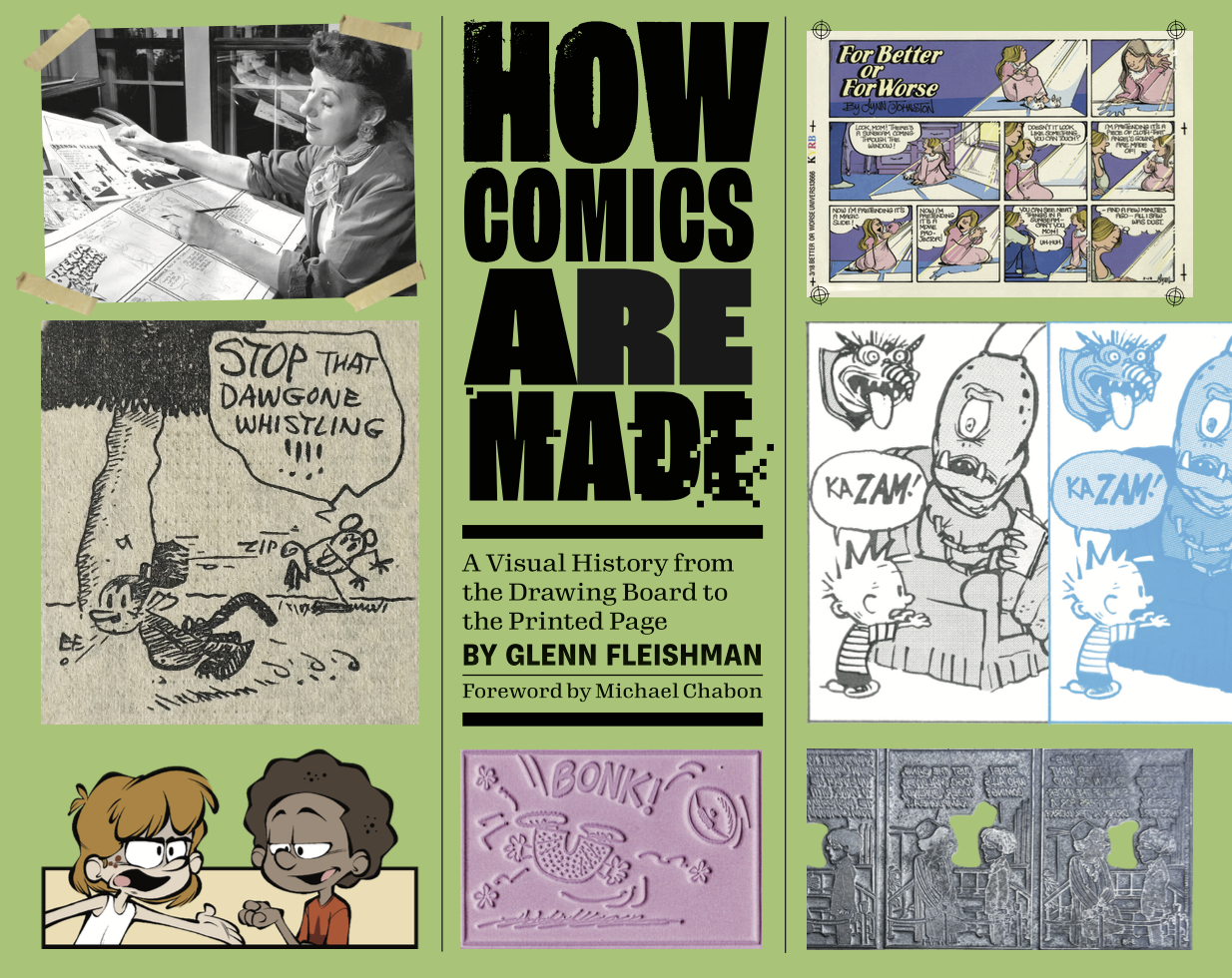
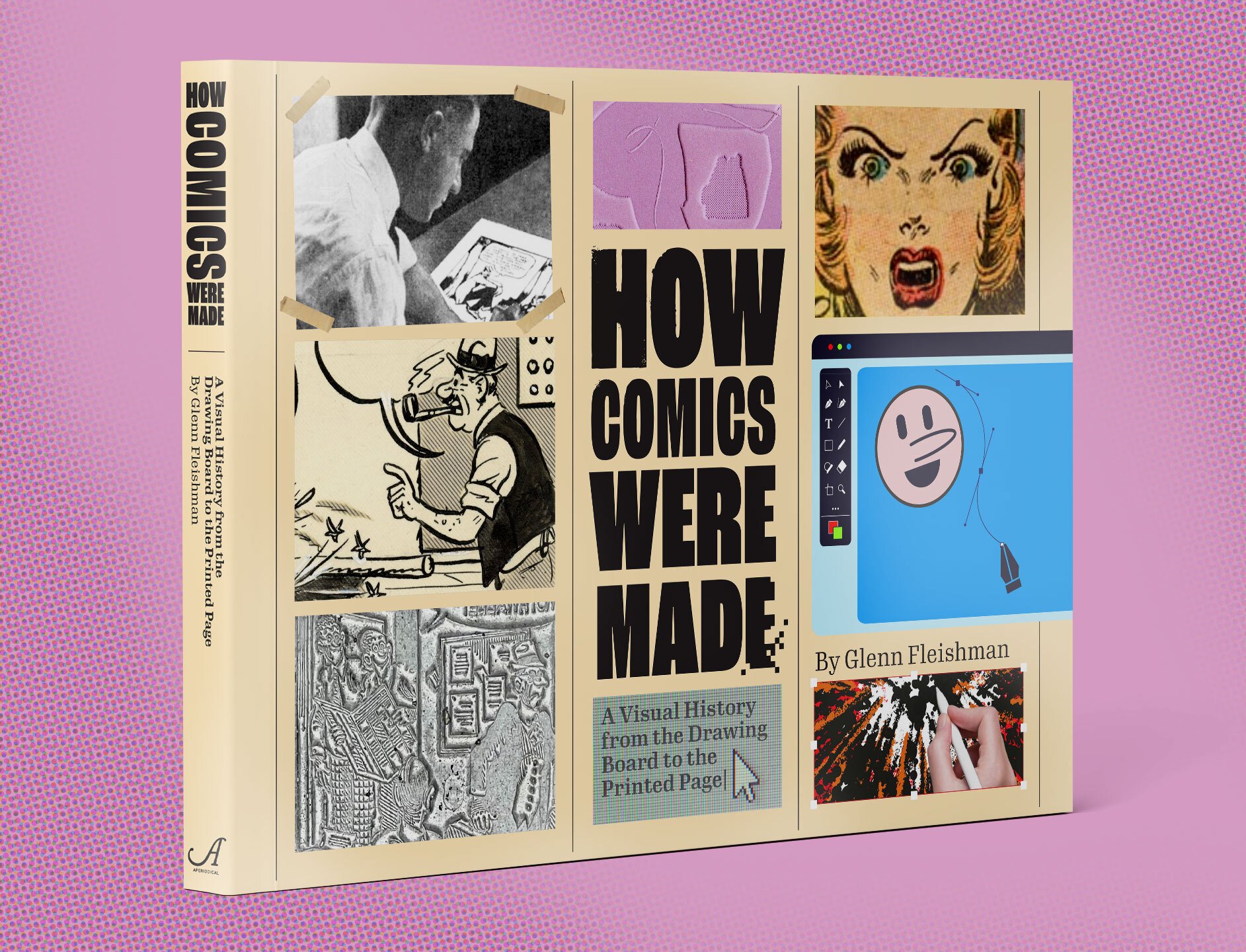
Wait, tense as in the time indicated by the verb—not as in the action! My book How Comics Were Made has been acquired by Andrews McMeel Publishing and will be issued in a second printing, shipping in June 2025. My Kickstarter edition—which remains for sale while copies last—is a laminated softcover with French flaps. The Andrews McMeel retail version will be a hardcover with a dust jacket—a nice contrast. It will also be sold under the name How Comics Are Made with a refreshed cover to which I updated design elements.

 The new cover of the “trade” edition, available in bookstores in June 2025
The new cover of the “trade” edition, available in bookstores in June 2025

The new printing will have almost exactly the same content but reach a far broader audience. Among other things, Andrews McMeel has international distribution directly and through partnerships, so if you live outside of North America, you’ll be able to get

Books

A Post of Gratitude

When I started working on How Comics Were Made in 2023, I realized quickly that there were a lot of people I would want to thank later. I started taking notes. Those notes eventually led to nearly two full pages in the completed book in the smallest legible type I could manage. So many people offered their time, artwork, insights, and moral support. Many artists and photographers licensed their work for use without fees; others set very modest rates due to the historical nature of the work and how it celebrates the industry.

To thank all these people again, I’m reproducing the text of those acknowledgements here.

Backer Thanks

This book would not have been possible without the support and encouragement of literally thousands of people who participated in the crowdfunding campaign or later pre-ordered the book. Thank you for your trust in believing that this very out-there idea

Books

How Comics Were Made Ships!

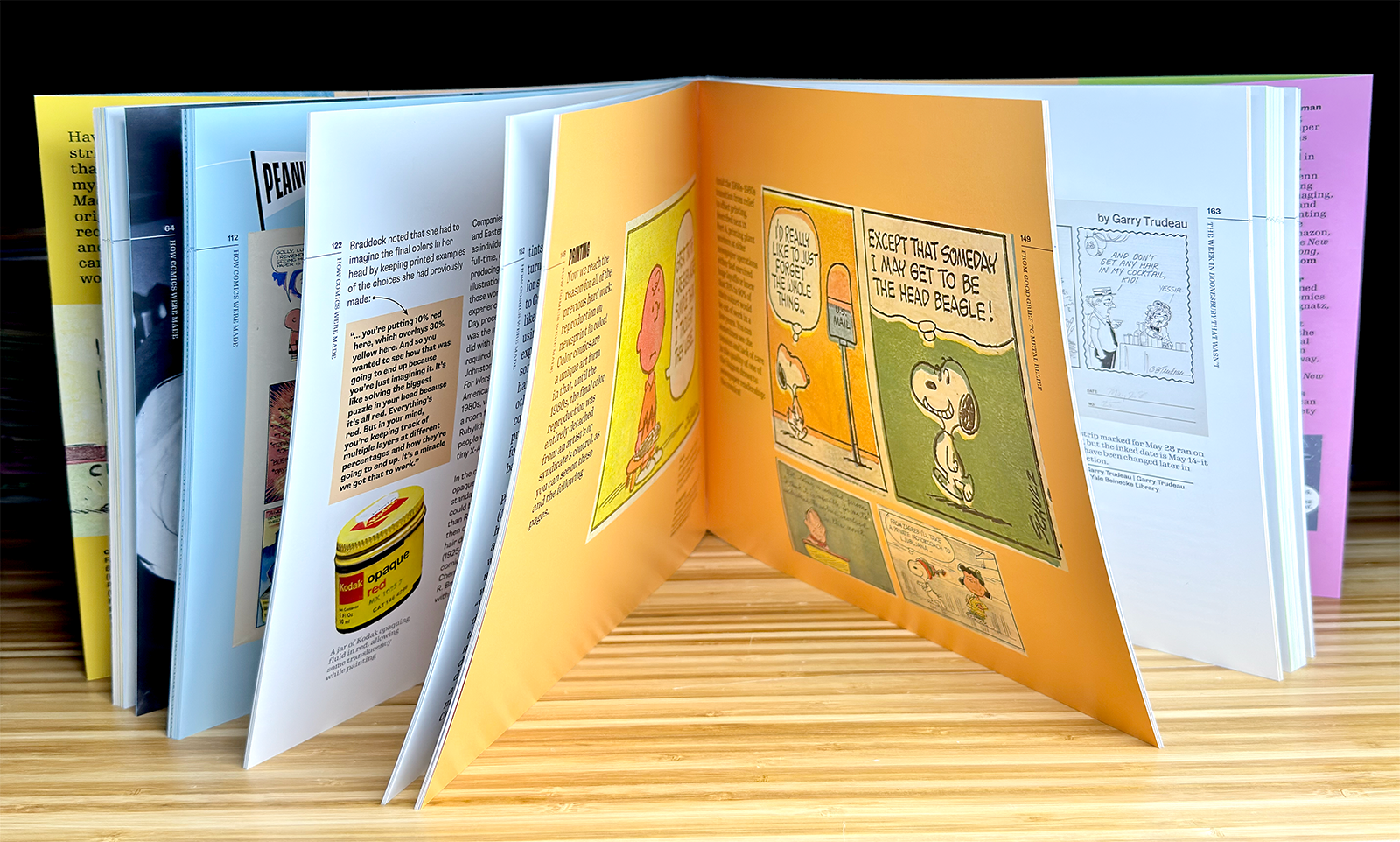
It seems like I only started talking about How Comics Were Made a few months ago, but I’ve been thinking about it for years. It coalesced in 2023. I almost leaped into the project then, but was committed to a client’s massive effort, Shift Happens, which needed full attention for months. Crowdfunded in March 2024, How Comics Were Made started shipping today! The huge batch of Kickstarter pledges and pre-orders since then will head out in the world over the next week. You can order a copy right now while they last!

Copies ordered starting today will ship in about a week, and after that will ship within a day or so of order.

I’ve also made available for purchase a special letterpress print that incorporates a Zippy the Pinhead comic in re-created mold (mat or flong) format. This limited-edition item, printed in a quantity of no

Books

How Comics Were Made: Foreword and Forward!

My book How Comics Were Made is off to the printers! I uploaded about five gigabytes of files today and should have proofs shortly. Then it’s off to the races—the press! I chose a nearby printer so that I could go “on press”: being at the printing plant while the book is underway, viewing pages as they come off the press, and approving them when they’re tweaked to perfection. Update, Sept. 22: It goes on press on Sept. 26! Nearly done!

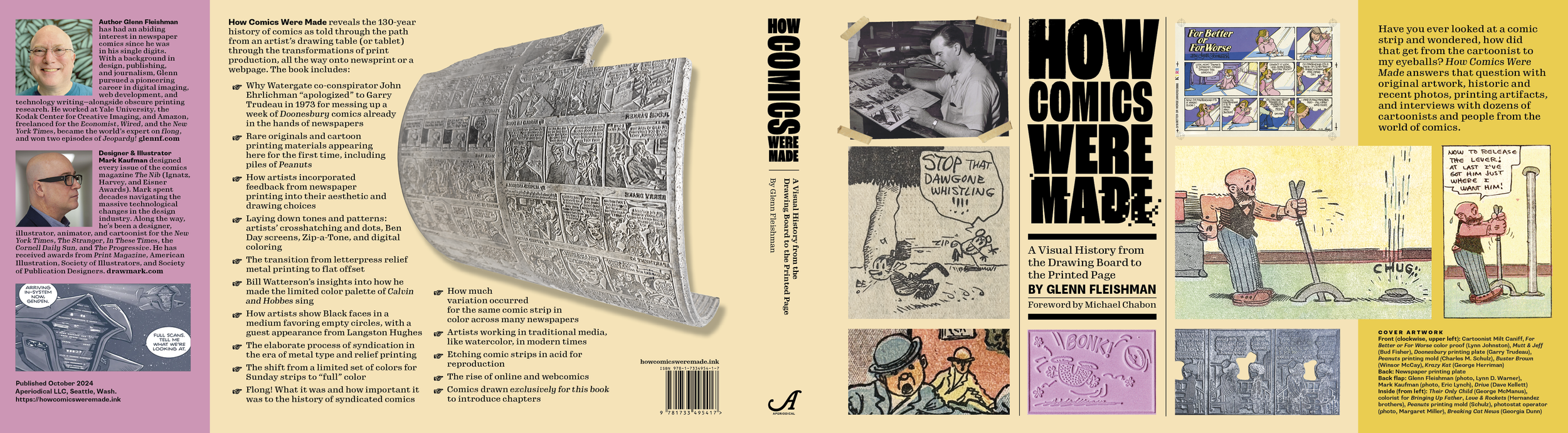
 The full cover: french flaps (left and right), back cover (left of center), spine, front cover (right of center)
The full cover: french flaps (left and right), back cover (left of center), spine, front cover (right of center)

I’m also happy to share that Michael Chabon wrote the foreword to my book! He is lifelong lover of comics and comic books, his grandfather was a typesetter, and he enjoys design, typography, and industrial history. A perfect choice! His book The Amazing Adventures of Kavalier

Books

Last Copies of Six Centuries of Type & Printing

I’m down to the last 50 24 copies (as of September 2024) of my book Six Centuries of Type & Printing. If you were interested in a copy, now is the time! The price includes the letterpress edition, an expanded book edition (which features a full bibliography), and U.S. shipping.

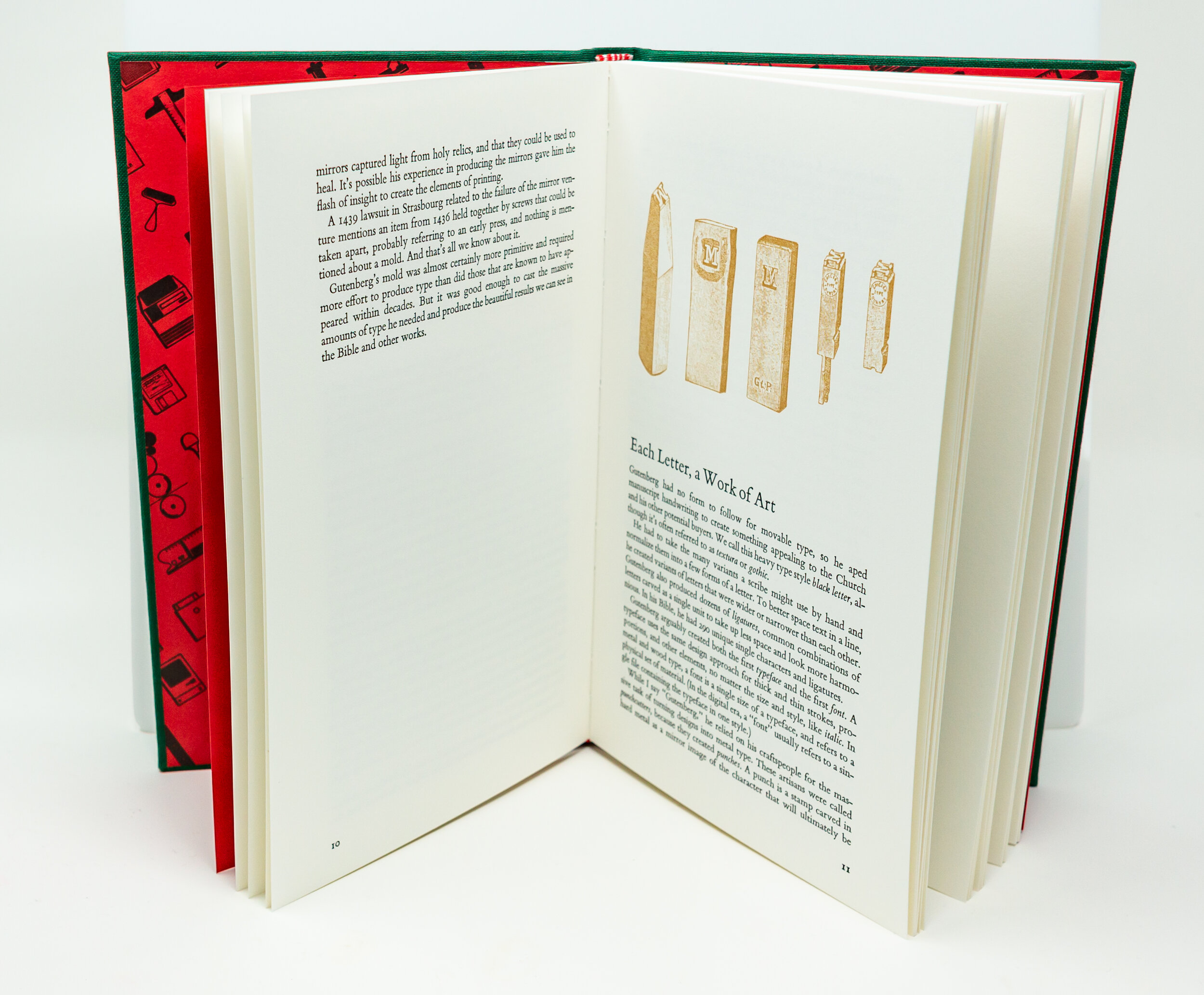
 Interior spread of  Six Centuries of Type & Printing
Interior spread of Six Centuries of Type & Printing

Back in 2019, when I launched the Tiny Type Museum & Time Capsule project, I envisioned a short edition of a book to include with the museum. The museum would have artifacts, uniquely created items, and a “curator’s manual” specific to what was included, the book would have a broader scope. As always, I was probably too ambitious to build out the museum and book at the same time—even with project partner Anna Peterson née Robinson, the fine woodworker who built the gorgeous cases. But when the pandemic

Cartooning

An Upcoming Book: How Comics Were Made!

I’ve just launched a website for How Comics Were Made: A Visual History from the Drawing Board to the Printed Page, a book that I’ve been cooking up writing for a few years. On the heels of editing and projecting managing Shift Happens for Marcin Wichary (thus part of raising over $750,000 in that campaign), I am excited to get back into print and share the comics and printing history I’ve been assembling for the last six years.

 Preliminary cover of  How Comics Were Made , designed by Mark Kaufman
Preliminary cover of How Comics Were Made , designed by Mark Kaufman

I’ve already started prep, and hired Mark Kaufman (of the recently late and forever-to-be-lamented The Nib) to design and illustrate the book. He’s created a preliminary cover that we’ll be refining as we move towards a Kickstarter campaign in February 2024. The book’s expected publication date: October 2024. I’ve done a far

A Press with Paper Sails Traverses the Sea of Ink

Books

A Press with Paper Sails Traverses the Sea of Ink

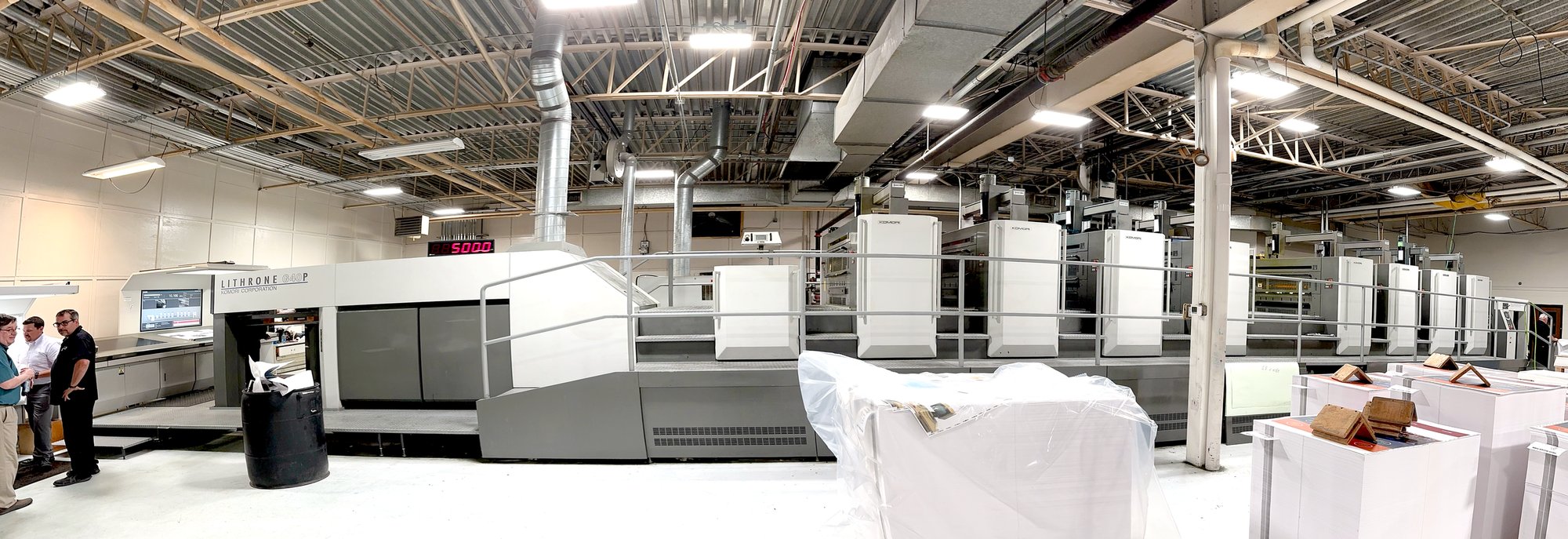
 Eight-unit Komori press at Penmor Lithographers in Lewiston, Maine
Eight-unit Komori press at Penmor Lithographers in Lewiston, Maine

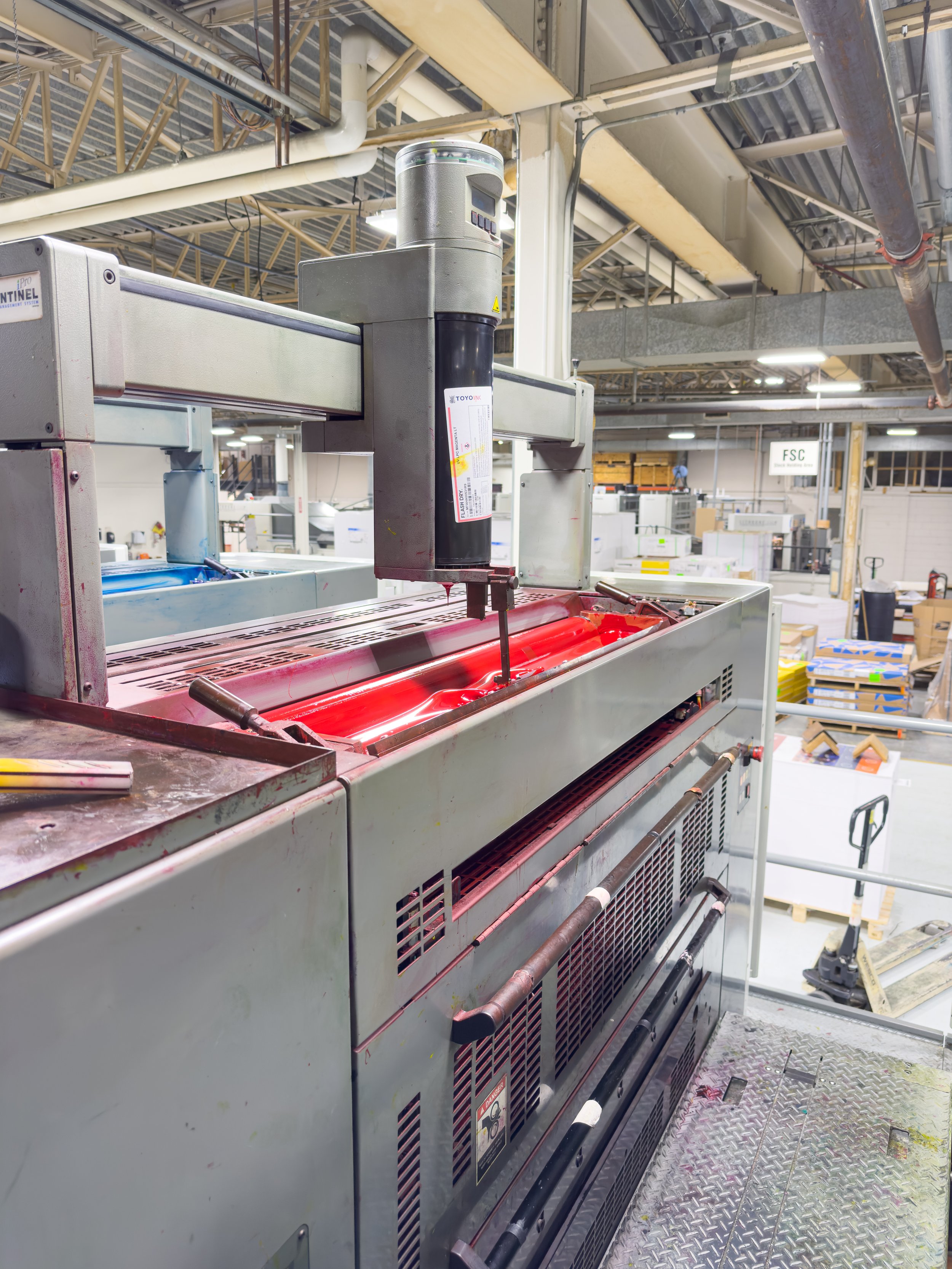
A modern printing press is a thing of wonder. It’s highly automated. It has cameras inside it. There are digital controls for making fine-grained adjustments. A scanner checks color bars as pages are pulled during a print run to make sure the density (amount of ink laid down) remains consistent. A press makes constant course adjustments, and the helmsperson—the press operator—is in constant motion to keep it trim.

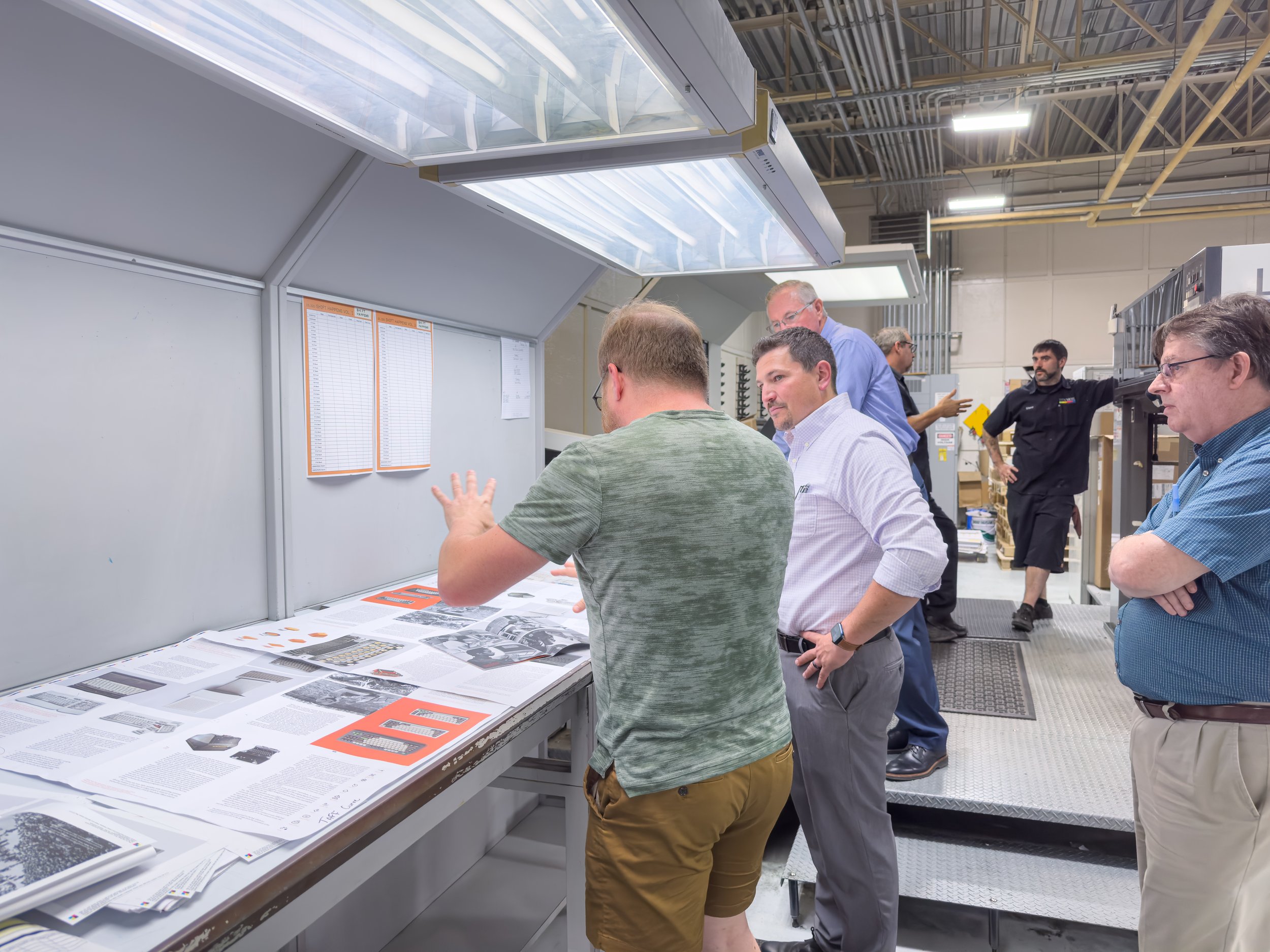
 It takes a crew to staff a press and print a book.
It takes a crew to staff a press and print a book.

I found myself thinking of it like a ship on the first day of a multi-day press check that I’m on with my author client Marcin Wichary for his massive book Shift Happens at our printers, Penmor Lithographers, in Lewiston, Maine. The press is long—maybe 40 feet end to end. At one end, one pressperson feeds

The Proof Is in the Printing

Print

The Proof Is in the Printing

I’m currently in Lewiston, Maine, with Marcin Wichary, the author and designer of Shift Happens. I’ve been his editor and project manager. Having worked with Marcin for years on the text, we shifted into crowdfunding (raising over $750,000) and now into production. After we talked to many printers over a couple of years and received lots of bids, Marcin opted to go with Penmor Lithographics, a company in the United States we knew we could go “on press” with—we could actually travel to them and view the pages as they came off a press.

If he had selected a printer outside the U.S., it might have been more expensive or impossible to do a “press check” like this. We would have entirely relied on a printer rep managing our interests to ensure everything went as desired during the printing process. (We were also concerned about

Books

The Latest Take Control Book Updates

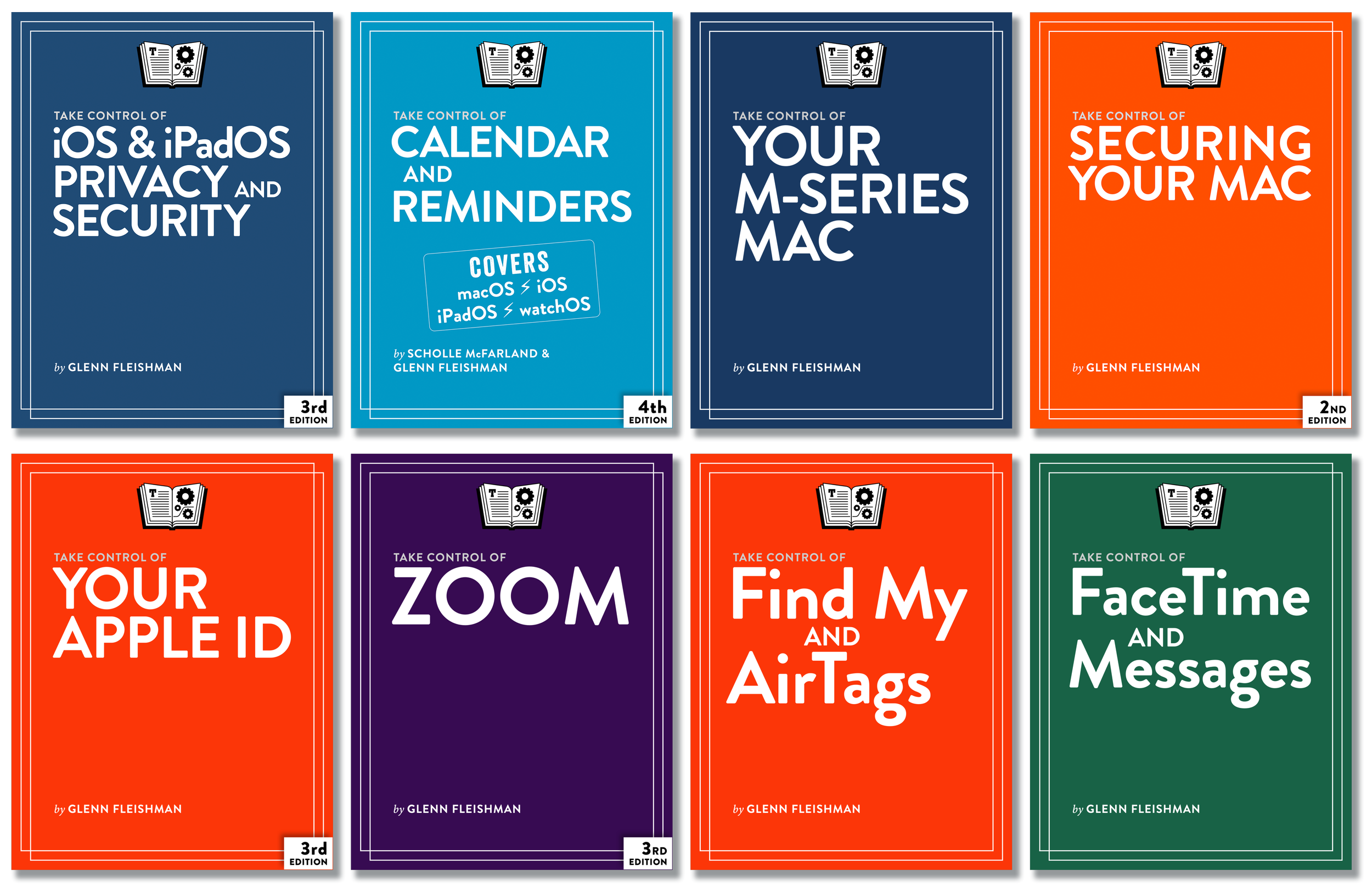
Over this sultry summer, I updated eight Take Control books, including new editions of four of them. Starting with Take Control of Zoom, which I discussed in this blog a few months ago. I then spent months testing beta versions of Apple’s new iOS 16, iPadOS 16, and macOS 13 Ventura operating systems. (iOS 16 shipped last Monday; the rest are coming soon, but available in public betas.)

The seven other titles now ready for action are:

  • Take Control of iOS & iPadOS Privacy and Security: With this new edition, learn about passkeys, Apple’s version of an industry-standard, simple-but-powerful secure website login credential; eSIMs, programmable cellular modules that let you change or supplement service without swapping a card; better tracking protection with Limit IP Address Tracking; Lockdown Mode, for protection against targeted attacks; Safety Check, to block misuse of data by people you know; and hundreds of other

Technology

Zoom Book Updated to Third Edition

I started writing Take Control of Zoom in spring 2020 at a time when hundreds of millions of people suddenly found themselves requiring videoconferencing, and Zoom offered the best free or cheap deal that wasn’t tied up with corporate subscriptions. The book evolved as Zoom did: the company improving its security, enhanced privacy, and added much asked-for features—and some that nobody ever would have considered.

Last week, we released the third edition of Take Control of Zoom, now overhauled for changes large and small:

  • Hybrid work: With the return of many people part-time and full-time to offices, I’ve reworked the book with a new section on hybrid work and updated it throughout to deal with situations in which you might be in the same space as other people working—some of them even on the same Zoom call with you!
  • Livestreaming: I added an entire chapter on

Books

New Book: Take Control of FaceTime and Messages

My latest Take Control book is out! This one’s a doozy: I cover FaceTime, Messages, and Phone across iOS, iPadOS, macOS, and watchOS in Take Control of FaceTime and Messages. I learned so many new tricks and hidden features in writing this book, I can’t even begin to describe them all. (That, I guess, is what a book is for). While the book covers all the major features and how to use them best, you’ll also learn a bunch of nuggets:

  • Both FaceTime and Messages support screen sharing, but in different ways with different sets of features. I explain both, and why to choose one over the other.
  • iPhones and iPads (on supported models) can simulate direct eye contact in FaceTime—even when you’re not looking at the camera.
  • Include friends and colleagues on Android and Windows in your FaceTime calls.
  • Point your iPhone at a